



Director: Ted Evans
Writer: Ted Evans
Stars: Sophie Stone, Anne Zander, Ace Mahbaz
Synopsis: In an isolated deaf community, Matt’s idyllic world cracks when Eva arrives, making him question his identity and the costs of maintaining his supposedly utopian society.
Ted Evans’ Retreat begins with a strings-dominated score which immediately unnerves the viewer. Paired with vintage black & white photographs of schoolchildren flashing across the screen, everything about the introduction to this film feels ever so slightly off-kilter. And that feeling never completely goes away throughout Evans’ film. Take Eva’s (Anne Zander) arrival at Chilmark, an isolated community in the English countryside for Deaf people. What’s introduced as a seemingly genuine community functioning for the benefit of its residents morphs into something else entirely. The exact form the plot takes is one that’s best experienced without any sort of hints regarding its direction. But what Evans is toying with both thematically and stylistically is equal parts interesting and exciting.
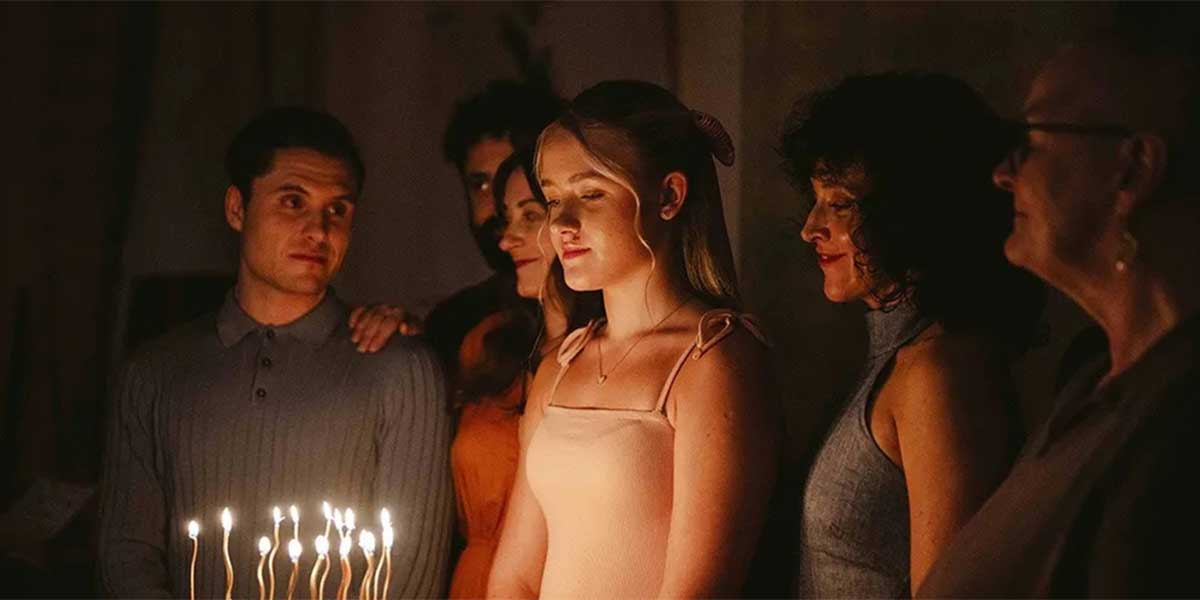
The reasons Retreat makes for an interesting film to engage with are twofold. On one hand, it oozes with style. Although this is Evans’ debut feature, he has a background in making short films. And those experiences have clearly left him interested in exploring not only an exciting visual language, but an auditory one as well. A majority of the film functions without sound. Evans seems very aware that coupling his thriller tone with such flair can create for a truly alarming experience. An example can be seen in one of the first nights Eva spends at Chilmark. An alarm begins going off, but there’s no sound whatsoever. Instead, all the lights go dark before repeatedly flashing an ominous red. As the group amasses quickly and shuffles into a dark and dingy basement, the experience is discombobulating for both Eva and the audience. It’s here where Evans begins really showing off with his first marvelous use of shadows. The camera pushes in to our leads, Eva and Matt (James Joseph Boyle), and then pushes beyond them to just capture their deep shadows against the wall. For a film that focuses on the ways in which these characters remain isolated amongst their community, it’s a perfect encapsulation of Evans’ script. It also looks really damn cool, and it’s a technique Evans returns to with equal effect later on in the film.
As the alarm lights still flash, no context is provided, nor is there any sort of official warning as to what is occurring. Mia (Sophie Stone), the leader of this community, rationalizes the drill as a way to build reliance on one another. But what happens if that community, or more directly, those in charge, doesn’t have their best interests at heart? Evans plants several eerie seeds in the first act of Retreat that leave hints regarding the overall tone of his film. There’s nothing wrong with a reliance on community. Larger structures exist partly due to the necessity of support systems. But no matter how well-intentioned something might be, all it takes is human intervention to twist something noble into something sinister.

We see this play out through dual narratives, though both are interconnected. It’s handled a bit messily, but the narrative shift ultimately works in the film’s favor. The focus of Retreat shifts from Eva to Matt around midway through. Matt has only ever known Chilmark. In this isolated community where people retreat from the outside world, all he wants to do is see the other side. As such, he is treated as the odd one out. It’s a simple and effective way at highlighting the hypocrisies of Mia as leader of this commune. Through her treatment of Matt, we see the first signs of typical human behavior invading the supposed utopia meant to be free of such prejudices. Evans does ultimately reveal the actual reasons for such behavior, but even after doing so, the strength of Retreat lies in its welcoming of forcing the audience to reckon with such systems on a fundamental level.

As we come to learn how Mia has warped something that could be beneficial into something cruel and unjust, Evans allows the viewer to place their own beliefs of such systems onto the film. It’s clear Evans wants communities such as these (without the sinister undertones) to thrive and be beneficial to those who partake. It’s what makes the haunted ending of Retreat all the more thought-provoking. Self-preservation can delude our most well-intentioned ideas, and Evans shows the outcome of such delusions. But he leaves his viewer with a tinge of hope before the credits roll. Despite the outcome shown in Retreat, we can ultimately hope for something beneficial. There is always a chance for something greater than what currently exists. It’s in that hope, left to the next generation, that Retreat turns all its thrills and its horror into something worth fighting for despite all that’s occurred thus far. While discussing this film, Evans simply stated he just wants everybody to “enjoy the cinematic experience.” In that regard, he succeeded. But he has also left his audience with plenty of text and subtext to chew on.
Retreat is celebrating its world premiere in the Discovery category of the 2025 Toronto International Film Festival.