



Director: Andre Gaines
Writer: Qasim Basir, Andre Gaines, Amiri Baraka
Stars: André Holland, Kate Mara, Stephen McKinley Henderson
Synopsis: A successful black businessman, haunted by his crumbling marriage and identity crisis, is drawn into a sexualized game of cat and mouse with a mysterious white woman on a subway that leads to a violent conclusion.
Expanding upon the provocative one-act play by Amiri Baraka, The Dutchman is a sleek, unsettling psychological thriller that weaponizes intimacy, race, and performance with unnerving precision. Directed and produced by Andre Gaines, the 88-minute feature adaptation transforms a famously claustrophobic stage work into something more cinematic without losing the suffocating tension that made the original text so enduring. Led by powerful performances from Andre Holland, Zazie Beetz, and Kate Mara, the film will feel like a slowly tightening vice.
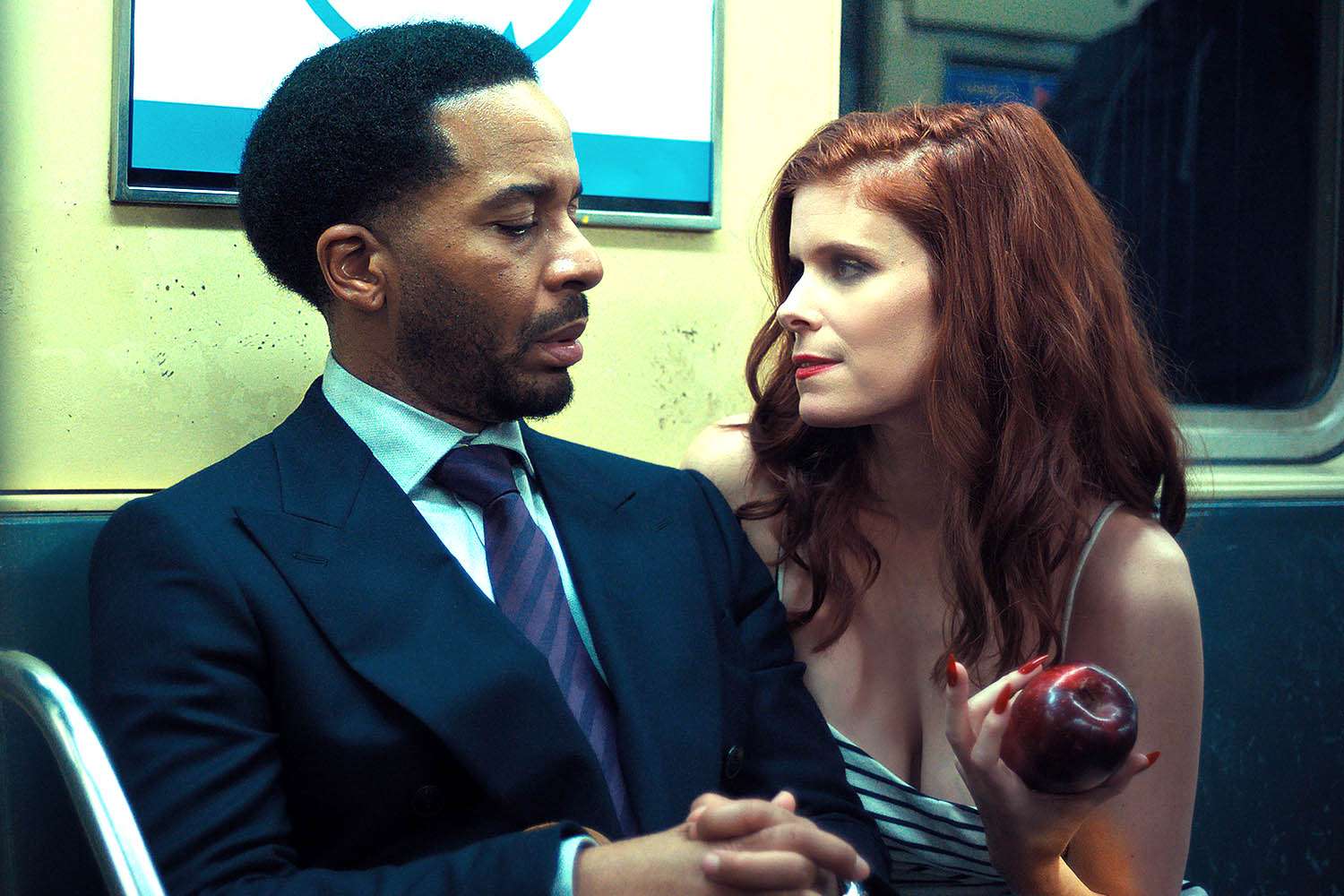
The Dutchman is a conversation film, but one charged with such escalating hostility so it seems that every line is like a concealed threat. Holland plays Clay, a successful Black businessman whose carefully curated life begins to unravel after an encounter with a magnetic stranger played by Mara. What appears flirtatious soon mutates into something far more invasive and psychologically predatory. Gaines stretches the original framework into a broader urban nightmare, using the city itself as an extension of Clay’s growing paranoia.
Audiences might make a comparison to Jordan Peele, which is understandable, though not entirely accurate. Like Get Out, The Dutchman dissects racial performance beneath the veneer of liberal civility, but Gaines is less interested in satire than destabilization. The film thrives on discomfort, forcing audiences to sit inside manipulative and invasive exchanges. Some viewers may also find the film’s ambiguity frustrating, particularly during the final act, which prioritizes mood and implication over narrative clarity. This does feel intentional; opting for mystery rather than exposing and giving concrete conclusions.
Holland delivers one of the film’s strongest elements through a performance built on restraint. Clay is introduced as composed, intelligent, and socially fluent; a man accustomed to navigating elite spaces by maintaining control. It is a remarkably internal performance, one that allows the audience to feel the pressure mounting before the character fully acknowledges it himself. Even though there are moments where he’s hard to root for, you’ll enjoy trying to work him and his story out.
Mara, meanwhile, is mesmerizingly unreadable. Her character shifts constantly between seductive, playful, antagonistic, and frightening, often within the same scene. Her menace emerges through unpredictability; she transforms ordinary social interaction into psychological combat. She’s seductive, wild, and someone you’d be drawn to and want to run away from at the same time. When she gives Clay a red apple, you can’t help but think of Snow White – the relevance being a scary but beautiful woman poisoning you to take advantage.
Zazie Beetz’s supporting role adds another layer to the film’s examination of privilege and performance. Beetz plays moments with calculated coolness, reinforcing the film’s central anxiety: that social acceptance can evaporate the moment someone refuses to perform correctly. Each actor has a believable and intense chemistry which will keep viewers interested and invested.
As the story continues, if you’re not paying attention, you may find it confusing. The film does rely on its audience being active. This isn’t a film to watch when you’re doom scrolling. Even if you feel a little lost and disjointed, this may very well be the intention, keep watching as the end has a violent conclusion you won’t see coming.
At just 88 minutes, The Dutchman moves with sharp efficiency, though there are moments where its expanded scope feels slightly constrained by its theatrical origins. A handful of secondary characters exist more as thematic devices than fully realized people, and certain transitions between realism and surrealism can feel abrupt. They could have been further developed and given the film more depth and conflict. Ultimately, The Dutchman is an intelligent, deeply uncomfortable thriller that trusts its audience to sit with contradiction rather than seek resolution. Anchored by excellent performances, the film transforms a classic stage confrontation into a contemporary nightmare about race, power, and the dangers hidden beneath performative civility.