


Directors: Phil Cunningham, Brent Dawes
Writer: Brent Dawes, Kyle Portbury, Sam Wilson
Stars: Brandon Engman, Brian Stivale, Shahar Tovach
Synopsis: From his mother’s songs to his clash with Goliath, David’s journey from humble shepherd to anointed king tests the limits of faith, courage, and love–culminating in a battle for the soul of a kingdom.
Animated biblical storytelling has often struggled to balance reverence with cinematic excitement, frequently leaning too heavily toward either solemn instruction or sanitized spectacle. David, directed by Phil Cunningham and Brent Dawes, attempts something more emotionally expansive. Angel Studios‘ Book of Samuel adaptation is a sweeping coming-of-age adventure about courage, faith, identity, and the burden of destiny. David frames its central figure as a deeply human young man navigating fear, loyalty, and spiritual conviction in a fractured world.
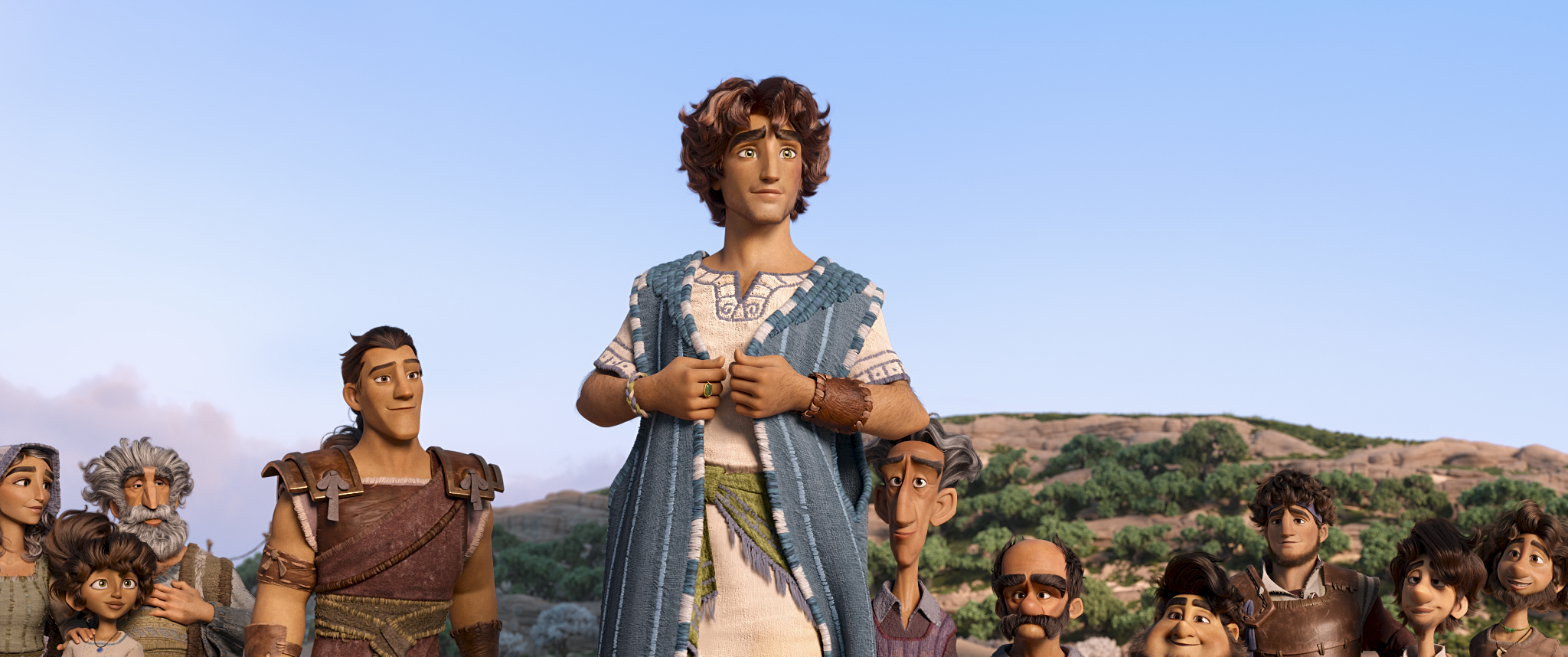
This is a great film for both adults and children; there’s no offensive language or inappropriate content, and adults can enjoy the drama and relatable themes throughout. At the center of the story is David, wide-eyed and bushy-haired, voiced with earnest vulnerability by Phil Wickham. His character is filled with younger incarnations, both warmth and innocence. He yearns for bigger and better things, and after valiantly protecting his sheep he’s summoned before the Prophet Samuel (Brian Stivale), who anoints the young lad as the future king of Israel.
David’s bravery emerges gradually through uncertainty and emotional conflict. He doubts himself, questions his purpose, and struggles beneath expectations imposed upon him by others. This layered portrayal gives the narrative emotional accessibility even for viewers less familiar with the biblical material.
Much of the film explores the emotional consequences of being chosen. The relationship between David and Saul, voiced by Adam Michael Gold, provides the story with some of its richest dramatic tension. Saul’s descent mirrors David’s rise, creating a compelling emotional symmetry between the two figures. A little more banter between the two could have given this film a humorous uplift. David’s character does become a little stale; he doesn’t develop enough.
The supporting cast adds texture without overwhelming the central narrative. Lauren Daigle brings warmth and sincerity to Rebecca, while Asim Chaudhry offers a more eccentric energy as King Achish. Meanwhile, Jonathan and Samuel are portrayed with understated nobility, grounding the film’s larger spiritual themes in personal relationships and loyalty.

Visually, the animation occasionally fluctuates in quality. Certain crowd scenes and character movements reveal budgetary limitations, particularly when compared to larger studio productions. Facial animation can sometimes appear stiff during dialogue-heavy exchanges, and the pacing in the middle section occasionally sags beneath the weight of exposition. At one hour and forty-nine minutes, the film perhaps stretches beyond what its narrative momentum can consistently sustain. There are influences from DreamWorks, Disney, and even Blue Sky Studios, with The Prince of Egypt and Ice Age coming to mind. The Giant and his sidekick reminded me of Jafar and Iago from Aladdin – this isn’t a bad thing. They’re quite an entertaining pair.
The film’s most memorable sequence, unsurprisingly, is the confrontation with Goliath. Yet what distinguishes the scene is not simply scale or action choreography, but the psychological framing surrounding it. The battlefield is a field of poppies (significance to fields that run red with blood). It’s a quick scene, and it’s in the middle of the film, the build up could have been stronger to give the scene more gravitas, but it’s exciting nonetheless. There is another battle scene towards the end, with a bigger build up, and the consequences feel more real.
However, the ambition behind the project is undeniable. The directors are clearly striving for emotional and spiritual grandeur rather than quick entertainment. The musical score plays a crucial role in this, blending orchestral swells with folk-inspired melodies that reinforce the film’s themes of devotion and destiny. There are some lovely songs, but they’re not too memorable. “Tapestry” and “Shalom” are the two that stood out and have stuck with me.

In an era where irony often dominates mainstream storytelling, David feels refreshingly earnest. It does not mock belief, nor does it aggressively sermonize. The film invites audiences into a story about courage born from conviction and compassion. David is a heartfelt animated epic that finds strength in its emotional sincerity. While some technical limitations prevent it from reaching the visual heights of major animation studios, the film compensates with atmosphere, thematic ambition, and genuine emotional resonance. By focusing on the humanity beneath the legend, Cunningham and Dawes craft a version of David’s story that’s a timeless reflection on fear, purpose, and the difficult path toward becoming who one is meant to be.