



Director: Amy Wang
Writer: Amy Wang
Stars: Shirley Chen, Mckenna Grace, Elaine Hendrix
Synopsis: An insecure Chinese-American teenager undergoes experimental surgery to appear white, hoping to secure the prom queen title and peer acceptance.
Amy Wang’s Slanted represents an interesting crossroads between genres and inspiration that’s rather intriguing. Many will roll their eyes at the absurdity of the film’s premise, but the experience of actually watching Slanted represents a clash between a strong foundation and weak execution. The inevitable comparisons to Mean Girls and The Substance are somewhat apt, but Slanted is actually at its best within its core themes of immigration and what it actually means to be an American within a system that pressures you to question your identity. The messaging is rarely, if ever, subtle, but it clearly comes from a personal place for filmmaker Wang, and that is where the film is most thought-provoking. Unfortunately, it falters within most of the actual comedy and race commentary of its satire, basically acting as a less clever Get Out that never digs any deeper into the racial implications of its commentary besides telling the same jokes and making surface-level observations repeatedly. It all forms into a mixed bag that has its fair share of thought-provoking observations that are coated with unsubtle and blunt commentary, resulting in an appreciative but frustrating experience.
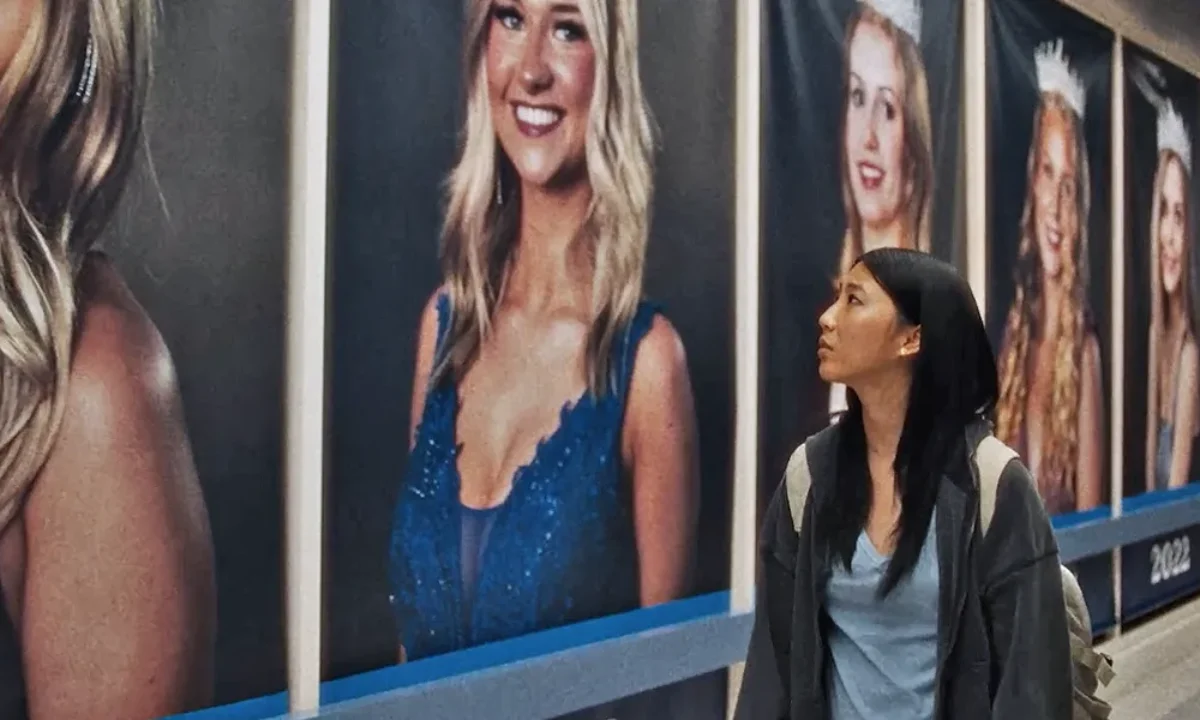
Slanted begins with the perspective of a younger Joan Huang, a Chinese-born girl who has just immigrated to a new town in America with her mother (Vivian Wu) and father (Fang Du). From the get-go at her school, we see her constantly bullied for the foods she eats, and she simply does not feel welcome in this environment, despite trying her best for her parents. From the very beginning, however, Joan saw becoming prom queen of her school as a sort of level that, if reached, would lead to everyone respecting her identity, and she’s been obsessed with it ever since. Now in the present day, Joan (Shirley Chen) is in high school, constantly seemingly embarrassed by her Chinese features and pressuring her parents to speak English instead of their native Cantonese.
Every day at school, Joan discusses her plans to run for prom queen with her best friend Brindha (Maitreyi Ramakrishnan) and sees getting an endorsement from high school elite Olivia Hammond (Amelie Zilber) as her ticket to the tiara, but she is still made fun of and sees that her not being the pretty white blonde archetype as the problem. After being contacted by the company Ethnos for using their skin change phone filter so much, Joan is offered to undergo an experimental trans-racial surgery to appear as the pretty white blonde she sees plastered all over her school hallways. She jumps at the chance and becomes Jo Hunt (Mckenna Grace) post the surgery, hoping to gain the admiration she’s always dreamed of.
In retrospect, it’s absurd that Slanted’s marketing has leaned more towards its minuscule body horror elements rather than the clear passion it derives from the center of Amy Wang’s own personal experiences, as it’s where the film excels the most. The film has a rather fresh perspective on the Asian immigrant experience, homing in on those who self-hate or feel the need to erase their own culture in order to fit into a new one. The film is about as subtle as a sledgehammer in this regard (and it’s more of an issue in other areas), but these aspects of the film work the best because they are where Slanted is at its most authentic. The obvious personal experience is very similar to Didi in the way the performances carry the emotions of each scene, and channel the vision of the direction so well. Shirley Chen’s performance is particularly captivating, and the internal and external struggles she conveys between her parents make even the shakier parts of the screenplay more meaningful.
It’s just a shame that Slanted ends up so weighed down by all the other elements of its satire that even its strongest elements can feel as if there was even more to delve into and there was a lot left at the table. The film leans more into its body horror and comedic elements in its back half as Grace replaces Chen, and it’s where all the commentary is either completely nonconfrontational or just completely predictable.

The body horror never reaches any full commitment levels, the teenage melodrama is about as plainly drawn out as you’d expect, and the actual comedy rarely evolves beyond “white people listen to Michael Bublé a lot” level jokes. It’s this period that buries a decent portion of Slanted’s more noteworthy elements; there are so many genre aspects it tries to tackle as it goes on, and the writing never extends cleverly enough to punctuate anything purposeful about these, on paper, clever concepts.
Slanted presents a compelling perspective of the immigrant experience, bringing a personal touch to the meaning of finding your identity as an Asian American, which feels lost within a plethora of blunt racial themes that barely scratch beyond the surface. Amy Wang’s nuanced body horror comedy ends up as a valiant but futile attempt at a satire.