



Director: Harry Lighton
Writers: Harry Lighton, Adam Mars-Jones
Stars: Alexander Skarsgård, Harry Melling, Lesley Sharp
Synopsis: A directionless man is swept off his feet when an enigmatic, impossibly handsome biker takes him on as his submissive.
What does the figure of a biker symbolize? Hyper-masculinity and rebelliousness are the first descriptors that come to mind. Every time you see a biker or a motorcycle group in a film, you think about trouble and impending danger. That is how most movies typically portray them. But there are better descriptors that encapsulate the image of a biker: freedom, loyalty, and a shared identity. A motorcycle gang is inseparable; they all head towards the same route without borders. Their identity is forged through the open road — a symbol of brotherhood and resistance against conformity; with each mile they travel, they become an act of defiance and unity. These descriptions align with the themes and character dynamics showcased in Harry Lighton’s directorial debut, Pillion (screening at the 2025 New York Film Festival in the Spotlight section). Lighton reclaims the biker’s image from macho rebellion to queer vulnerability.
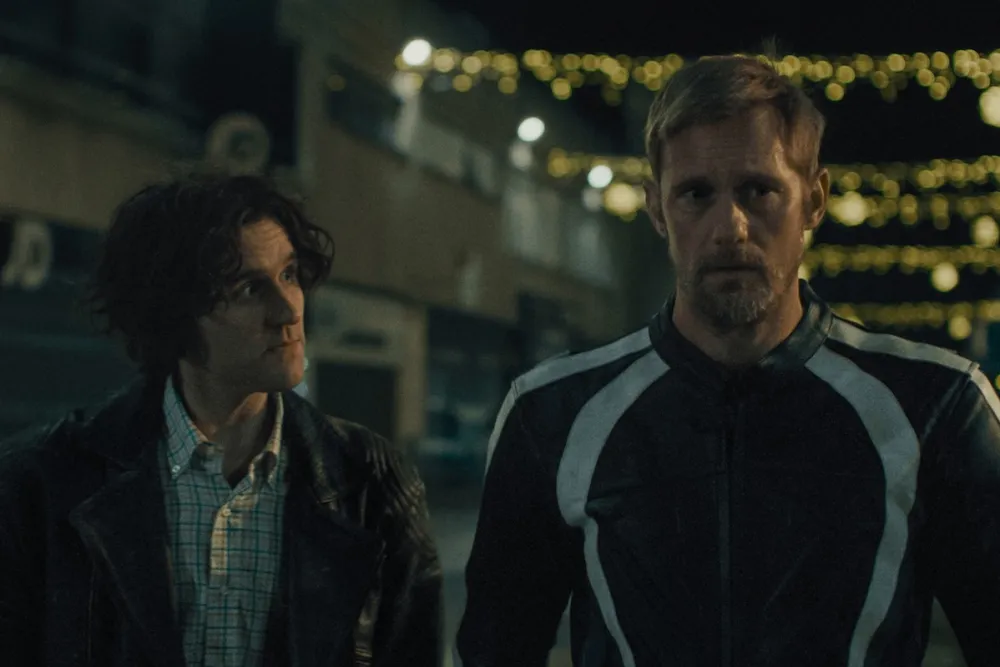
Lighton’s Pillion, based on Adam Mars-Jones’ 2020 novel ‘Box Hill,’ tells the story of vulnerability and power dynamics in modern queer relationships through the eyes of a lonely, feeble young man and his life-changing encounter with an alpha-dominant biker. Its title is aptly chosen, as the word refers to the passenger seat behind a motorcycle; the metaphors already pile up with just a single word. There have already been quite a handful of stories about bikers and the struggles of finding authentic desire and personal growth–Kenneth Anger’s provocative and influential short Scorpio Rising, as well as the underseen 1964 film from Sidney J. Furie called The Leather Boys. However, these particular portraits do not delve deeper into the internal and external resilience that comes with opening oneself to intimacy. That’s where Pillion separates itself from the rest. It expands on that step-by-step process that comes with finding yourself.
The Mars-Jones source material is set in the 1970s and has a higher focus on the AIDS crisis that was occurring at the time. To change the story to a contemporary setting, Lighton had to reimagine it, to some degree, to depict the struggles queer men face today. It is a challenging task to undertake, nearly rewriting a work to recontextualize scenarios with a contemporary worldview. In this change, there is a lack of solidity, which occurs when Lighton holds back on the complexity of the characters while performing the tonal balancing act of being stark or light-hearted. However, due to its leading pair being pitch-perfect with one another, and Lighton’s boldness leading to authentic depictions of the subculture he’s depicting, Pillion becomes a rather meaningful picture, with a few quirks that don’t crack the film’s sturdy backbone.
The two figures at the center of this erotic ballet are Colin (Harry Melling), a lonely young singer desperate for someone to hold, and Ray (Alexander Skarsgård), the ring-leader of a gay motorcycle club. The first time we meet Colin, he’s doing a vocal performance at a local bar, which makes his date head towards the exit. The embarrassment on Colin’s face says it all, and a reek of desperation oozes from his pores. The image of him sitting all alone at a bar, with Melling’s facial expressions revealing his feelings on the inside, shows us that this isn’t the first time he has been in that situation. Pain lingers through the soul, as drink flows down his body. That’s until Ray pops into the picture, where one Christmas Eve night outing shapes the course of Colin’s life.
From a choir boy to a submissive sexual treat for Ray, Colin finds something he didn’t know he wanted in a package he wouldn’t have dared to approach. But time curses the two, and Colin demands judgment in that controlling relationship, challenging the restrictions put upon him by the dominant Ray. He seeks to have a say on this bond, which helps Colin slowly forge his identity through retaliation. This isn’t the first time Harry Melling plays a character who falls in love with a biker, and this devotion causes a complete shift in his being. In Amanda Kramer’s campy and leather-bound Please Baby Please, Melling plays Arthur, a reserved man with inner sorrow who encounters a greaser gang as he heads home with his wife. Rather than beating them to a pulp, they taunt them. This teasing leaves a mark on the two tight-knit individuals to the point where they question their respective identities and loyalties.
Kramer has consistently explored liberation, personal freedom, and desires in her cinema, employing a highly stylized and campy approach. In that sense, Please Baby Please and Pillion are pretty different, as Lighton is not keen on utilizing splashes of neon lighting and colorful tints to play with the film’s themes. His direction is more stale visually, although it features well-framed shots that effectively convey the emotional and romantic physicality between the leading pair. However, even though one is more tame in terms of sexual elements and the other goes full-frontal, the two films are connected by Melling, who offers an excellent performance in both, and their themes of self-love. While I prefer Kramer’s, as her work is more playful, cine-literate, and creative, Pillion still has quite a few tricks up its sleeve that help its story have an impact.
Nods of comedy and light-heartedness are placed amongst highly erotic sex scenes in Pillion to both shock and create sympathy for Collin as he finds his true self. These scenes help the saddening aspects on the backend of the film feel more striking than provocative. Its melancholy might be slight–not utilized enough to create a wounding, long-lasting effect–yet the film’s heart lies in the right place, without ever needing to play melodramatic beats to conjure faux reactions. There were moments where the comedy stood out like a sore thumb and took me out of the film. Nevertheless, what continued to drive my interest from Pillion is Lighton’s depiction of the gay motorcycle club and the submissive-dominant relationships, which is where the film gets most of its personality and uniqueness.
Lighton wants to create authenticity of a subculture he doesn’t know much about by having people from it to help him dive into it with sincerity and attentiveness. Cinematic liberties are taken to make the narrative move along, just like any other feature, yet it is all done with genuine interest rather than disrespect. He ensures that there isn’t an “exoticism” with the subculture, or an exploitative edge that ridicules it. For some reason, William Friedkin’s Cruising comes to mind. The 1980s thriller starring Al Pacino received significant backlash from the gay community because of its portrayal of the New York gay leather scene, which included tons of hardcore sex scenes, most of them cut from the original print by the studio. Lighton also delves into the hardcore, although he doesn’t go bar for bar with Friedkin in Cruising.
Many perceived it as harmful and exploitative, leading to protests during filming and its theatrical release. Although the film has an authenticity, as Friedkin shot it at the actual bars with people who attended them, there is an outsider’s lens from the production that causes a loss of genuineness, which I, as a fan of Friedkin’s work and the film, find disconcerting. We never connect with the members of the New York leather scene; we only see them at the bars doing highly sexual acts. Meanwhile, Lighton does the opposite. He wants us to empathize and understand them thoroughly. And that is what I admire most about the film. While other directors in the past might have treated this scene with a judgmental or stereotypical eye, Lighton protects those who gave him entry into that world by treating them with respect. This is why Pillion, even with its tonal foibles, is bold and daring; especially in today’s cinema, this is a rarity.