



Director: Pietro Marcello
Writers: Letizia Russo, Guido Selei, Pietro Marcello
Stars: Valeria Bruni Tedeschi, Fausto Russo Alesi, Fanni Wrochna
Synopsis: After retiring from her legendary stage career, actress Eleonora Duse feels an irresistible call to return to the theater during Italy’s turbulent period between WWI and the rise of fascism.
Eleonora Duse, or better known as Duse, is an Italian actress deemed by many as one of the greatest of her time, making her name with the works of Gabriel D’Annunzio and Henrik Ibsen, both respected playwrights whose works were elevated by the actress’ presence in their plays. She changed theatrical performance completely in Italy, becoming a legendary silhouette for future generations to follow. Even to this day, her work is celebrated by modern actresses working the stage. Outside of Europe, her name may not be known as much, yet her impact is felt. Italian filmmaker Pietro Marcello wants to celebrate Duse’s career, influence, and prowess in a biopic—Duse (screening at the 2025 New York Film Festival in the Main Slate)—that captures her later years post-WWI. Throughout Duse, you feel Marcello’s admiration for the theater legend, with a focus on Valeria Bruni Tedeschi, who plays the stage legend. However, the picture is quite contrived in its approach to tell this part of Duse’s life, being both hollow and confused concurrently.
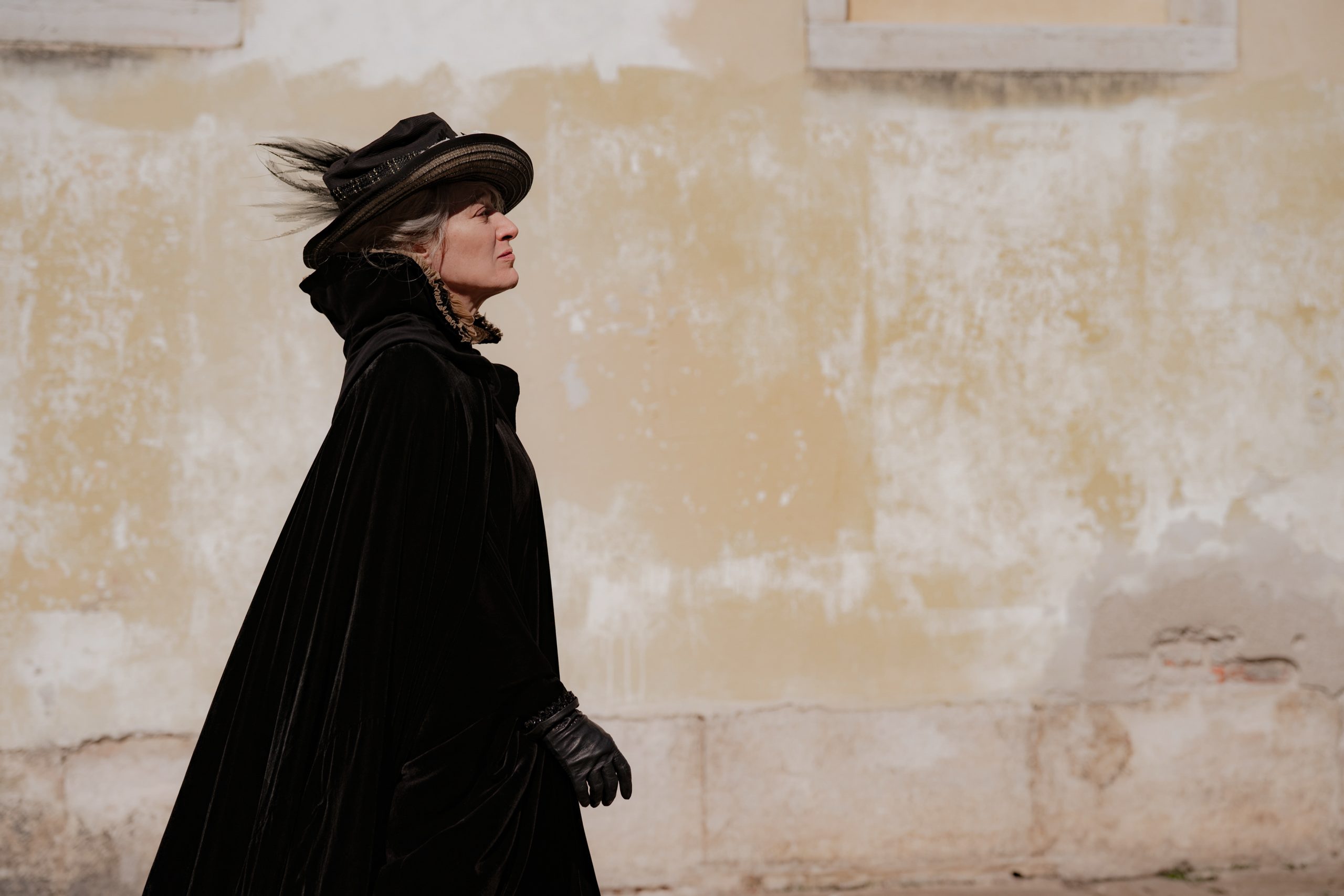
Duse begins with the glimpse of a fallen star, the image of its central subject (played by Bruni Tedeschi) trying to hold her head high amidst the tolls of WWI and an ailment slowly killing her–the tuberculosis makes her frail. The people still revere her and shower her with praise, although she hasn’t performed in nearly a decade. However, Duse knows very well that the image the people have of her from before is one she can’t seem to deliver nowadays. After a near-death experience, Duse decides to re-enter the world of theater, even if she is still ill and burned by the traumatic experiences that cast her aside from the arts. She ventures forth with hopes to reignite her fire and inflame the hearts of the people who want to traverse the theater stage of grace and damnation.
Her daughter, Enrichetta Checchi (Noémie Merlant), opposes this grand return to protect Duse. She begs that her mother bow out of this new stage play and focus on resting. But Duse’s mindset is difficult to change. Pietro Marcello uncovers this late stage of Duse’s career through her declining health and the rise of fascism in Italy. However, there is no insight into the political, cultural, and psychological changes, with the focus instead on the importance of performance. It is pretty disappointing that this is the road Marcello went for, as her story is so deeply embedded in the protest through the performance of the time that not including a proper deep dive into such limits the film’s vision.
The first half of Duse adapts the contrived biopic format, where characters yell and loudly exclaim at each other so loudly that it becomes farcical and unintentionally hilarious. One can’t help but laugh at the dramatic excessiveness in each dialogue; regardless of the conversation, it feels like a life-and-death situation, leading to disbelief from the viewer. Marcello has always been great at directing his actors to great performances, like Juliette Jouan’s revelatory role in Scarlet or Luca Marinelli’s in Martin Eden. Here, everyone, even Tedeschi on some occasions, seems lost, either overly performing even the most simple gestures or toning things down for a second, so that later they can shout their hearts out–a tonal disbalance that becomes an unbearable experience.
In the second half, things shift a bit, and Marcello begins to properly dissect the figure of Duse, exploring her vulnerability and thirst for independence, as well as her worsening sickness and elevated figure. The political angle of using art as a means for resistance, the only thing Duse has left to give to the world, is expanded upon through the Italian director’s silent, restrained direction. He has reined it in and, almost immediately, Duse, both the character and the film, become more vivid and engaging, which begs the question of why Marcello opted for a louder and over-dramatized synthesis on the meaning of Duse, not only as an actress, but as a revolutionary figure, in the first half of the film. It reminds me of Bradley Cooper’s approach to his Leonard Bernstein biopic, Maestro.
The film is loud and expressive for most of its runtime, focusing on performance and flash rather than nuance or a dissection of a career. Like Duse, Maestro lands in between celebration, homage, and absurdity–coming primarily from Cooper’s inability to contain his performance. Yet, when Cooper tones down the film and lets it breathe, you begin to see some honest, fascinating ideas about the subject of his film. Duse has more of these moments than Maestro, and Marcello is more prone to explore the Italian actress’ impact, yet both are true misfires due to mishandling in tone and breadth. It lacks the poetic nature of Marcello’s previous works and the urgency found in telling Duse’s story. In the end, Duse is too cautious to capture the fire that once made the actress immortal.