



Director: Antoine Fuqua
Writer: John Logan
Stars: Jaafar Jackson, Colman Domingo, Miles Teller
Synopsis: The story of the famous musician Michael Jackson, known as the King of Pop.
The Optimum Productions logo at the beginning of Antoine Fuqua’s Michael already reveals to the audience that this estate-approved “biopic” has nothing of value to offer to the audience, both as a piece of popcorn entertainment and as a work that examines the life of Michael Jackson, arguably the biggest artist in popular music, even seventeen years after his passing. More sanitized than The Jacksons: An American Dream, Fuqua’s transposition of the King of Pop’s early days as an artist, to his burgeoning successes with the Jackson 5, up until the release of “Bad” in 1989 is pure commercial junk that serves as fodder for the Jackson Estate to make as much money as possible off the sale of the film, and, by extension, his records.
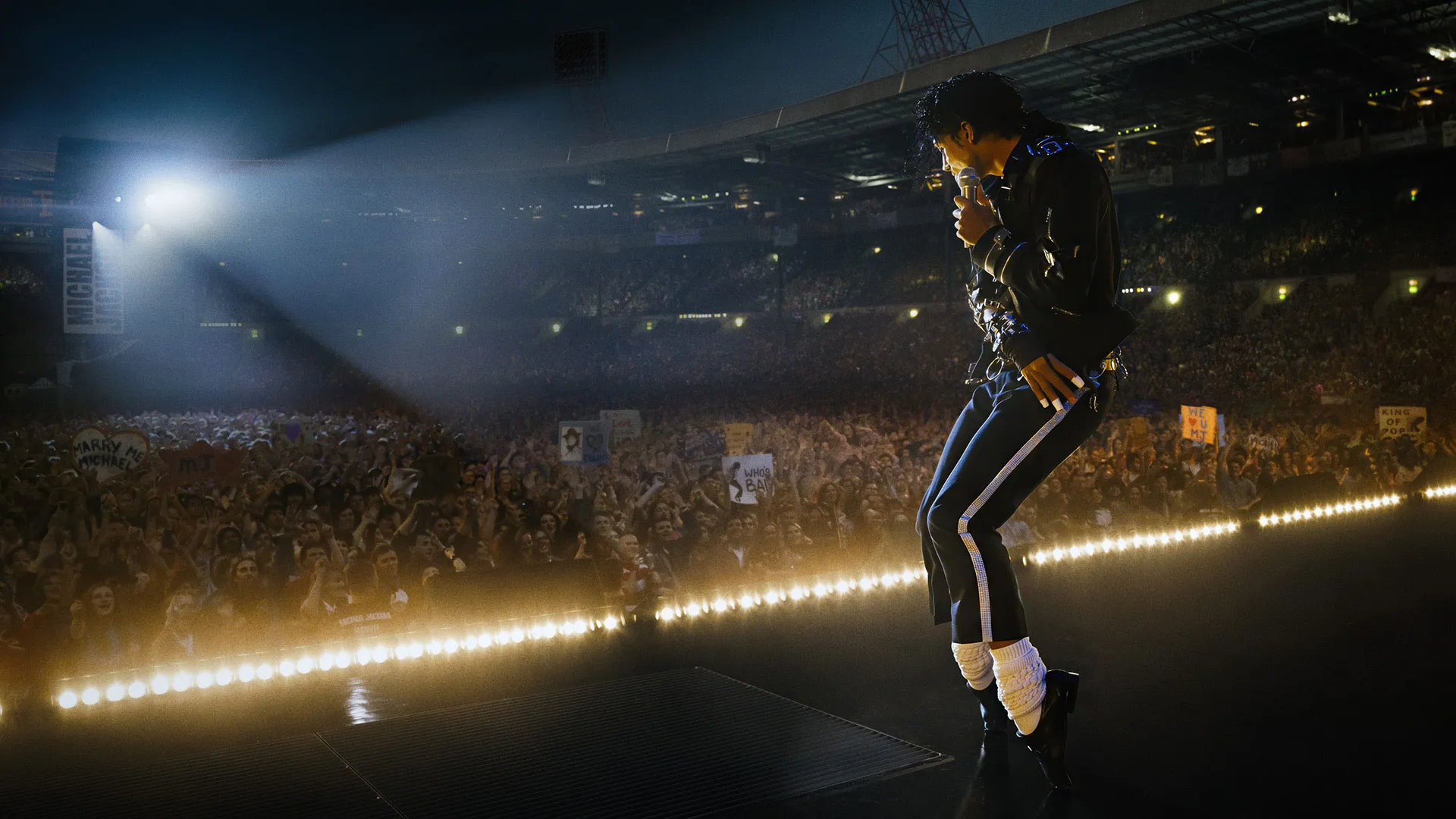
If you lived under a rock, had no idea who Michael Jackson (Jaafar Jackson) was, and hoped this biopic would give you some clarity on his impact on popular music, you will leave Michael with the same feeling. The Estate has given Fuqua and screenwriter John Logan permission not to interrogate the man behind the myth in any way, not even merely examining what drives Jackson’s creative process, and, more importantly, how he paved the way for multiple generations of Black artists to have a place on the musical scene following the skyrocketing hit of “Thriller,” which is still the biggest selling album of all time. Rather, they’ve instead allowed the Training Day filmmaker to bask in the glory days of Michael’s greatest hits, structured like a compilation video that speedruns through his biggest hype moments.
It’s a film that’s specifically engineered to make the audience point and clap in recognition at things they know, which, in turn, acts as a celebration of Jackson’s talents, as if the creative music videos that have been foundational for many artists growing up today and the albums that still sell massively didn’t speak for themselves.
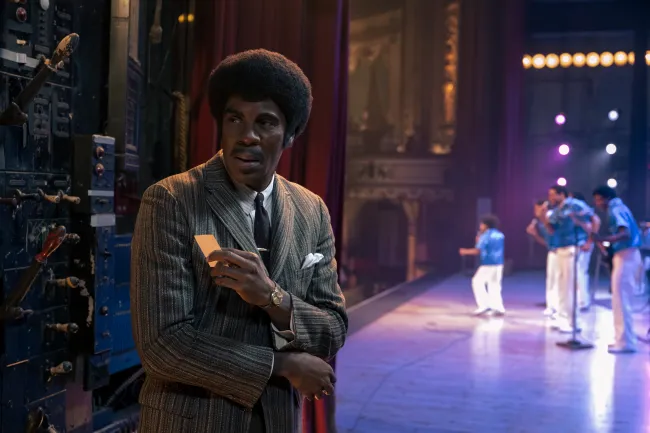
If you’re looking for having keys jingling at your face for two hours and seven minutes, Michael is the perfect movie for you. If you want your biopic to have some form of feeling behind it and say something (literally anything!) about the person it’s depicting, this won’t be the movie for you. It is especially baffling to see a film that’s so incurious about the titular protagonist that it gives more depth to Jackson’s abusive father, Joe Jackson (Colman Domingo), than to Michael himself. We even spend more time with Jackson’s personal lawyer, John Branca (horrendously portrayed by Miles Teller with a god-awful wig), than any of the Jackson siblings combined! While Domingo’s portrayal of Joe errs more on the caricatural side, especially during a garish backroom conversation with promoter Don King (Deon Cole), you get a sense of who he is behind his controlling façade in front of his children and wife, Katherine (Nia Long, pitifully underused).
Domingo doesn’t even need to do much to convey such internal anguish and inform the audience of the sheer terror he inflicted upon all of his kids, while that same profundity isn’t given to Michael. We get fleeting glimpses of a tormented artist in his early days (where he’s brilliantly played by Juliano Krue Valdi), as he forms a closer relationship with Motown president Berry Gordy (Larenz Tate) than his father, but they’re never deepened in meaningful ways. In fact, every secondary figure, with the exception of Joe, can be relegated to background characters. You wouldn’t know that Laura Harrier appears in the movie (for five minutes) as Gordy’s creative assistant, Suzanne de Passe, or that Jackson, in his later years, formed a close creative partnership with Quincy Jones (Kendrick Sampson) if these people weren’t named, because they have no impact on the narrative and on Jackson’s artistic journey.
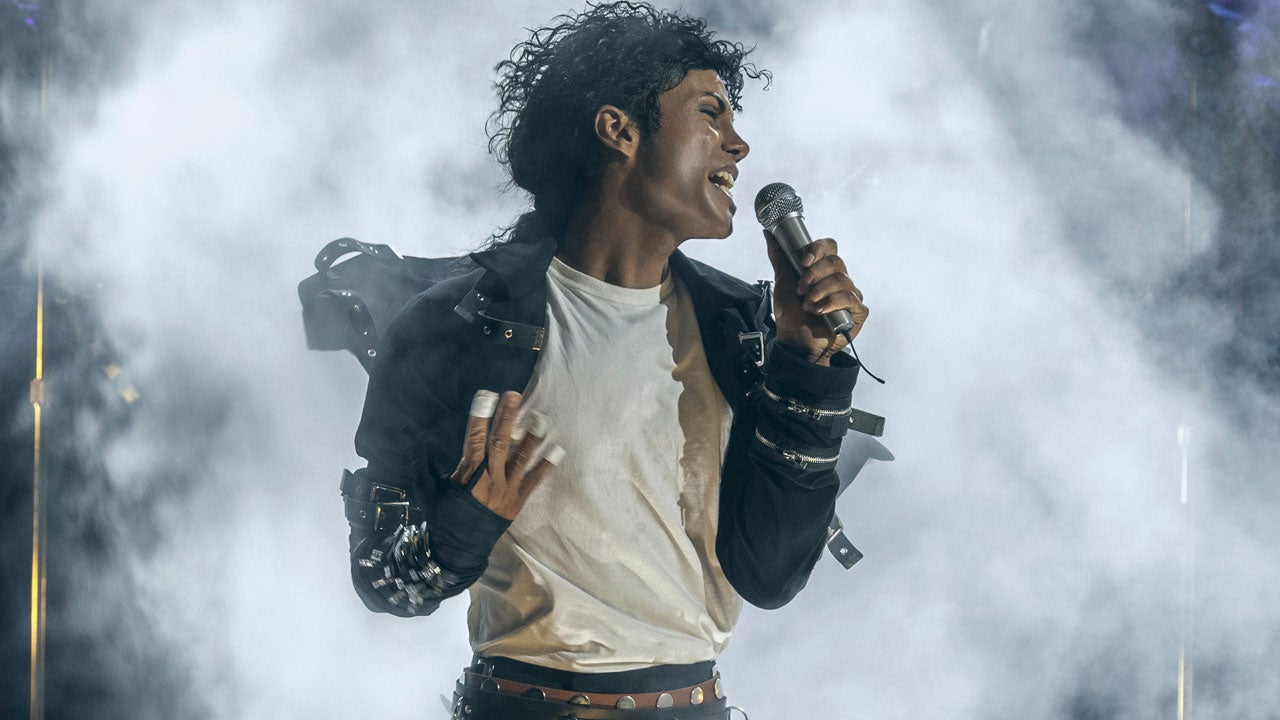
It’s all “Look! It’s Quincy Jones! Look! It’s John Landis! Look! It’s Gladys Knight!” There’s no interiority to anything being depicted. They’re props to support Jackson’s journey to success, or blips in the movie’s structure. We never sit with any of them to form meaningful connections, nor do we understand the influence they had on Michael’s life. It’s exactly what you think an estate-approved biopic will be. Fuqua depicts Michael Jackson as a saint with no flaws, a God-given musical talent, who must escape the clutches of his evil father (metaphorized by the figure of Captain Hook) to become the artist he was born to be. How many times does he repeat the words “I’m not a kid anymore!” to hammer home the fact that, yes, he’s a grown adult who can make his own decisions.
There’s no desire in parsing who Jackson is beyond the figure he’s obtained within pop culture. You’ll never understand why “Thriller” was such a watershed moment for music as a whole if you stick to this film, because it’s only a dent in a screenplay that attempts to recount as many events as possible from Jackson’s early life with the weight of a surface-level Wikipedia summary. You’ll never understand how he got so big other than “Wow, that guy can sing!” Even when Fuqua attempts to give texture by depicting Jackson’s obsession with perfection, not just on stage, but in the way he looks, through his multiple facial surgeries and progressing vitiligo, it never goes deeper than “He had surgeries on his face and attempts to hide his autoimmune disorder.”
The entire film can be summed up in these surface-level sentences. We never know any of the people that populate the world beyond the momentary dopamine rush you’ll get when you hear the name “Quincy Jones.” It’s “Things Happen: The Movie,” without any desire to formally (and thematically) reinvent the tired structure of the biopic in the same vein as Dexter Fletcher and Baz Luhrmann did when depicting the respective lives of Elton John and Elvis Presley. Were these films not as formally daring, they’d probably not be as good as they were, because the stories they follow are as conventional as the one treated in Michael.
Fuqua, on the other hand, has managed to make something as exhilarating as the moonwalk boring and captures Jackson’s larger-than-life talent with the lethargic energy of a television film. Garish CGI apes (the movie is much funnier if you pretend Bubbles the Chimp is actually Robbie Williams from Better Man), llamas, and giraffes aside, Fuqua has no idea what to capture in any given scenes that would heighten the musical numbers and physical derring-do of Jaafar’s breakout role. You can tell the film was reshot to hell, chopped, and screwed in ways that productions of this scale rarely are. Even the concert performances lack the intensity and pulse you will find in literally any of Jackson’s real-life shows.
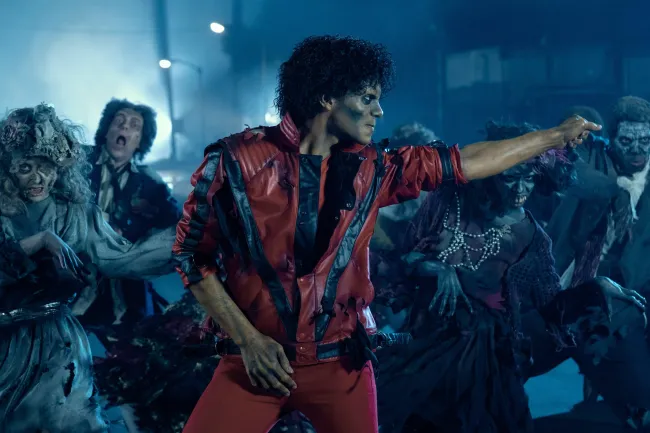
The only scene that works is a top-to-bottom recreation of John Landis’ “Thriller,” only because that clip still stands the test of time as the greatest music video ever crafted. Fuqua and cinematographer Dion Beebe attempt to capitalize on that nostalgia by replicating shots (and choreographies) down to a tee. However, once you’ve removed these scenes from the equation, which basically equates the entire product, you’re left with nothing but a commercial for MJ without any soul or artistic intent.
Of course, an estate-approved biopic would never allow Fuqua to even talk about the allegations of child sexual abuse that surrounded Michael Jackson in the 1990s (allegedly, those were shot, but ultimately scrapped, with Derek Luke reportedly cast as attorney Johnnie Cochran). However, even if you deliberately choose not to talk about this and end with the release of “Bad”(a problem in and of itself), there’s still enough material to make a pretty decent movie about Jackson’s path as an artist.
I mean, he was the face of the world when “Thriller” came out. That album is a generational masterpiece, a pop milestone that will never be replicated in our – or anyone else’s – lifetime. Strip away all of the controversies surrounding him, and you have one of the most culturally significant artists who has completely changed the landscape in ways that no one else can. This is a fact. No one can dispute this. Reducing such a music genius to a one-note character with zero interiority or tangible agency is genuinely baffling. Distilling a complex and multifaceted “HIStory” into montages of hype moments and aura, without letting the audience think about MJ’s past, present, and future, adds insult to injury.
Michael isn’t a movie. It’s a state-approved piece of agitprop by way of the Estate of Michael Jackson and the Pepsi Company. It solely exists to continue selling Michael Jackson products ad vitam aeternam. It also makes his legendary feats so hollow and trite that one even wonders how he got so big in the first place. We know, but the movie makes it look so easy that we never really get a sense of who he is or what drives him to push music into territories previously unexplored and to break all racial boundaries in the hopes of healing the world.
Michael Jackson in his prime, continually surprised audiences. He always found new ways (and dance moves) to entertain and blow our minds. “Thriller” and “Bad” are two of the greatest pop albums of all time. Antoine Fuqua’s Michael reduces this lasting cultural impact to just another pop artist who fell on hard times growing up, successfully confronted his terrible father, hit big with two massive albums, and was never seen or heard from ever again following “Bad.” It’s a good thing he decided to quit while he was ahead, and he was not involved in any controversies whatsoever, right? Right!?!?