



Director: Lav Diaz
Writer: Lav Diaz
Stars: Gael García Bernal, Angela Azevedo, Amado Arjay Babon
Synopsis: A portrayal of Ferdinand Magellan and Beatriz Barbosa’s 1517 marriage in Seville, focusing on their brief time together before his departure on the Spanish crown’s expedition.
The first descriptor which may come to mind when reflecting on Lav Diaz’ Magellan is painterly. The opening frame of this film, and practically each one that follows for the entirety of its 160-minute runtime, wouldn’t look out of place hanging in a museum. But Magellan serves a far greater purpose for its audience than merely being a stunning film to look at. Because within all the beauty present throughout Diaz and co-cinematographer Artur Tort’s imagery lies the much uglier truth coursing throughout this historical epic. It’s the painful irony that such natural beauty could exist amongst the powerfully cruel forces looking to bastardize the serenity established by nature and appreciation of the mysteries around us. Throughout the DNA of Magellan, the arthouse version of both historical epic and biopic, lies a much larger examination of a world’s influence on a man rather than the titular man’s influence on the world around him. Despite leaning into narrative speculation on occasion, Diaz bathes this film in a sense of dreadful realism. In other words, this isn’t a stylized film. It’s unsensationalized, never shying away from the hard truths and realistic pain driven by the film’s narrative and literal journey. But that’s not to say it doesn’t feel like a distinct vision from a master filmmaker.
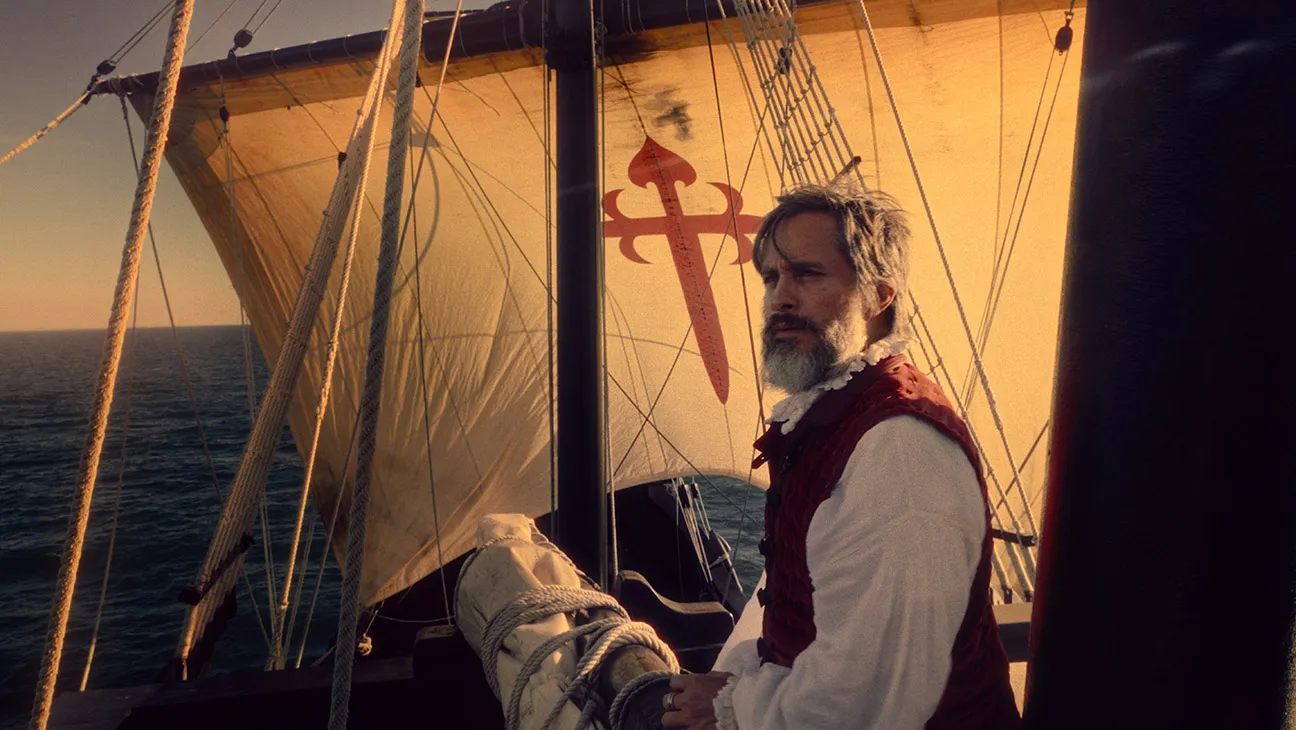
Magellan instantly dazzles you with its crystal-clear digital cinematography. With a camera that moves so infrequently, this is a wondrous example of contemporary slow cinema. Characters seem to enter and exit the frame at their own will, or at whatever pace the script deems most effective. This technique is something that should never be seen as padding out a runtime; it’s all part of serving a larger function. As an audience, we are held captive by Diaz’s composition. Through his patient hand, we become moved and haunted in equal measure. We see serene landscapes, prayer rituals, and even mundane tasks painfully invaded with no control whatsoever. In lulling the viewer into a sense of exploration through wandering eyes and minds, a complicity is built into the very fiber of Magellan. That’s particularly fitting considering so many of the conversations in this film revolve around the complicity of the man, and by extension humans and larger society, at its center.
There’s never a question as to whether or not the actions of Ferdinand Magellan (Gael García Bernal) are justifiable by any means. There’s deservedly no vindication or attempts at sympathy from Diaz’ artistic point of view. But what makes Magellan such a fascinating film is just how easily Diaz pulls from the foundational iconography of hero’s journey cinema and storytelling at large. But instead of acclaim and wild fortune for his titular figure, Diaz instead captures the lies pushing this journey forward and the truths experienced along the way. Despite such beautiful cinematography, there’s little beauty in this exploration. It’s a toiling journey full of harsh experiences, hypocritical morals and actions, and purely reprehensible evils perpetrated in the name of religious beliefs. And the journey, and what it truly stands for, never really ends; instead it festers. Bathed in nightmarish ideologies, the journey captured in Magellan is akin to a painting slowly rotting from within.
The film begins in 1511 with Magellan taking part in the Capture of Malacca. It’s an opening act that immediately feels haunted. This is something that Diaz will home in on the longer his grip remains held around his audience. It’s not long before he goes ahead and makes his intentions for the film as clear as possible. In a moment that feels akin to “the celebratory speech” scene commonly found in war films, the clearly drunken general indicates his intent on pushing forward to conquering Aden. He meanders on about the reasons for doing so, but falls into a drunken slumber midway through. Portrayed quite literally, Diaz interrogates such drunken power and how it’s simply an unquenchable force of history. There will never be a satisfying moment for these characters we have no choice but to follow on their journey. They’re constantly seeking more and more under the guise of nationalism and religious benefit, all the while isolating themselves further and further from the beauty Diaz so effortlessly captures in his compositions.
As Magellan progresses through time via harsh jump cuts, we find the titular figure at various different points in his life. The unflashy editing is one of the many manners in which Diaz crafts this stylistically understated film. Another component is indicated by just how long it takes for the audience to ever get a good look at Bernal. For a star so known for his striking looks, it’s nearly an hour into the film before Diaz ever frames him in a semi-close-up shot. And rather than being treated to a celebratory explorer thrilled with his previous conquest, we see that of a man both haunted and frustrated by his stagnancy. Suffering from a gnarly (and gruesomely realistic) leg injury, Magellan remains grounded in Lisbon with little to do. We witness what can only be described as a moment of somber reflection being shattered by the world jovially progressing forward around him. Unable to partake in another trek in the name of spreading Christianity through violent means, Magellan is repeatedly confronted by the reminders of his previous actions. He seems to be spiraling further and further without any sort of forward momentum. Whereas he seeks action and adventure and is unable to sit still, the audience will hopefully be embracing the measured rhythms of Diaz’ latest slow cinema project.
If the intent of slow cinema is to allow the mind to wander in exploration of every nook and cranny of a film’s subtext, Magellan greatly succeeds. But the characters within it, on their arduous journey across the seas, fundamentally misunderstand this true purpose of sitting in quietude. Magellan does whatever he can to end up on another journey, regardless of whether or not he fully agrees with the true reasoning behind Spain sending him off on his voyage. It’s this necessity of partaking in a hero’s journey that leads to the downfall of Magellan and his crew. Some on the journey lose their minds plain and simple. Others lose their lives or their freedoms due to unjust hatred, bigotry, and villainizing perpetrated by the church. Over the course of this film, Magellan retreats into himself, yet is never as haunted as he is in the first moment we see Bernal in close-up, save for a particularly breathtaking dream sequence. It feels like the moment that breaks him spiritually, mentally, and physically. Even still, he makes the decision to carry on with his actions. Considering this film ends on an inquisitive note regarding the complicity in our actions, it’s fitting that this journey is a nightmarish descent in cinematic form with little form of escapism. Diaz has not captured a hero’s journey where the central figure learns the flaws of his ways and comes to terms with his place in the world. Diaz instead crafts a story where the central figure removes themselves further and further from the humanity he’s claiming to be charitably sharing. Magellan may think he’s the hero at the center of this film, but Magellan consistently reaffirms he’s anything but. It’s one of the many dichotomies present in the film that make this a deeply compelling watch.
Magellan is currently playing in theaters.