



Director: Lee Cronin
Writers: Lee Cronin
Stars: Jack Reynor, Laia Casta, Mary Calamawy
Synopsis: The young daughter of a journalist disappears into the desert without a trace. Eight years later, the broken family is shocked when she is returned to them, as what should be a joyful reunion turns into a living nightmare.
If anything, Lee Cronin’s The Mummy is one of the gnarliest films I’ve seen this year when it comes to gore, with moments involving toenails that, as I type this, are sending a shiver down my spine. While the refreshing inclusion of Egyptian history into the story and the dedicated performances are admirable, much of this film is more cruel than creative.
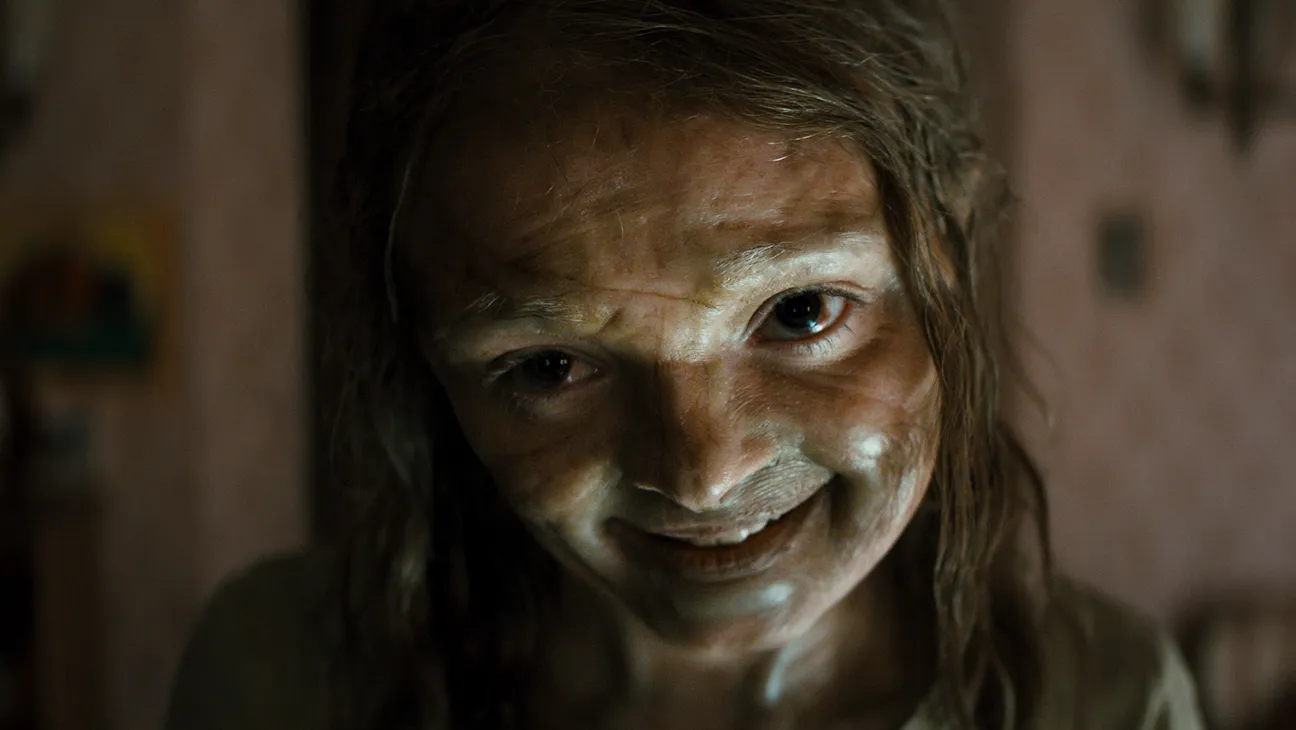
There’s nothing more frustrating than a film like Lee Cronin’s The Mummy, which is competently made, thanks to Cronin’s confidence with horror, but falls short of its immense potential, with inklings of greatness sprinkled throughout its over two-hour runtime. Primarily, when exploring the depths of Egyptian culture, but those elements are sadly squandered by a screenplay that would rather focus on shock value above anything else. This leads to plenty of disturbing scenes, evoking imagery that is hard to stomach, yet it all comes across as hollow as an empty sarcophagus.
What begins as a mysterious woman and her family driving through a desert toward their home quickly turns deadly. Their residence houses a sarcophagus that is a couple of thousand years old, just below the floorboards. For the time being, it is unknown who this family is or what the origin of the mummy inside is, which is far from resting. All we are let in on is that whoever is being held within is upset by the disturbance and takes it out on those around them, which is enough to keep audiences engaged for the time being.
The film cuts to Charlie Cannon (Jack Reynor), a journalist awaiting the airtime of his broadcast. He helps his young daughter, Katie (Emily Mitchell), learn Morse code while her brother, Sebastián (Dean Allen Williams), sits nearby. It’s pretty clear from the start that Charlie is preoccupied with his career rather than his family, cutting lessons short in order to fixate on his hand movements during his aired segment. He’s not a completely absent father—physically he’s there, but he mentally checks out to focus on his job.
He has brought his family to Cairo, Egypt, for his work, but with both parents working, it’s hard for them to keep an eye on their children at all times. Katie is an independent and inquisitive young girl who is part of a Girl Scouts group. She would rather learn helpful survival skills than indulge in her father’s newest on-screen appearance. And, like any young girl, Katie is naive to the dangers of the world, making it incredibly easy for someone with ulterior motives to take advantage of her kindness.
Naturally, when Charlie finally hears the news of a promotion, he’s ecstatic, calling his pregnant wife, Larissa (Laia Costa), to share the news while she’s busy working in healthcare. For Cronin, this is where any semblance of a tone other than dread and gloom disappears. As he notices wrappers from candy that his daughter has been hiding, he tries to find her in her usual spot, out in their overgrown garden. She’s nowhere to be found, having been swept away by The Magician (Hayat Kamille), who tricks her into coming with her.
Cronin utilizes a multi-year time jump, placing audiences back into Charlie’s and his family’s lives eight years later. Their surroundings have changed, and they are now living with Larissa’s mother in Albuquerque. The hope that Katie is still out there hasn’t left. Larissa is the one who keeps hope alive most for her eldest daughter, setting up her old childhood room for her to eventually stay in. When they receive a call that Katie has been found in a sarcophagus, they have many questions but choose to take the advice of doctors and care for her at home, where their lives will never truly be the same.
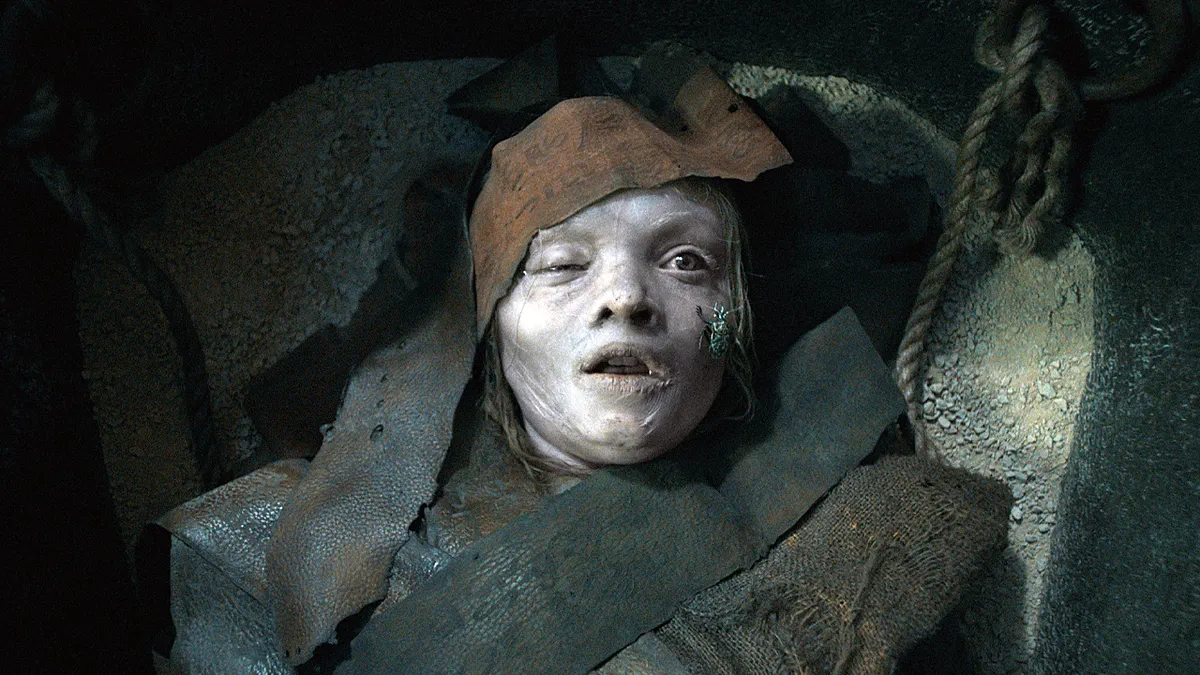
This version of the classic Mummy story is far more violent than previous iterations, but it only partially works. There are plenty of bloody moments that focus on molting skin, a twist on the traditional mummy linen wraps. Teeth are ripped out at the dinner table, and wolves consume a woman who has just fallen out of a two-story window. Lee Cronin’s The Mummy undoubtedly has some of the most stomach-turning horror this year has to offer.
Cronin uses the Egyptian language and history spanning centuries upon centuries. It’s the film’s most interesting aspect, but so much of the runtime revolves around Charlie and his family that this culture gets brushed over. The film uses the imagery of Cairo with its vast ancient surroundings, yet outside of a few moments of deciphering three-thousand-year-old language and learning about rituals passed down for several generations, there’s not much to chew on. Rather, a large amount of the film takes place in Larissa’s childhood home, making the film become repetitively dull. Even as the film comes to a close, multiple moments feel like the conclusion, yet it keeps going.
For those not interested in seeing a young girl—and later a teenage version of Katie (Natalie Grace) being put through disturbing moments, then Lee Cronin’s The Mummy won’t be for you. Both Grace and Mitchell are put in distressing situations, with the older version dealing with more of the gory moments, while the younger Katie is bound and held against her will, loudly screaming and pleading on tape. Frankly, the tape being teased earlier in the film was enough to convey her suffering; it being played in full later on is unnecessary.
Thankfully, the film is well cast, and Katie is played by two young actresses who capture the terror and tenacity her character needs. It can’t be easy to play an essentially possessed vessel, especially with the amount of makeup required at certain points. Reynor is just as unlikable here as his previous character in Midsommar; he is convincingly hot-headed, especially in his scenes with Detective Dalia Zaki (May Calaway). Cronin earns a few extra kudos for his use of Calaway; her final scene is one for the history books.
For better or worse, Lee Cronin’s The Mummy isn’t interested in being easily digested; it works until it doesn’t. With one stunning split diopter after another, it’s a well-made and acted take on a classic that flirts with greatness.