


Director: Antonin Baudry
Writers: Antonin Baudry, Bérénice Vila
Stars: Simon Abkarian, Niels Schneider, Anamaria Vartolomei
Synopsis: 1943–1944. To free France, General de Gaulle must unite a divided Resistance. He also fights to establish his legitimacy with the Allies.
If you liked De Gaulle: Résistance, you’re going to like De Gaulle: Liberté. That much is clear. The second part of Antonin Baudry’s epic centered around French general Charles de Gaulle before he became President of France contains the same aesthetic impulses that defined Part One, and enough dense exposition to please any fan of historical epics. The only difference is that Volker Bertelmann did not return to compose part two and was instead replaced by Théo Cascio, in his second-ever feature film score.
At 29 years of age, Cascio creates an enveloping soundscape that refuses to follow in the footsteps of Bertelmann’s repetitive motifs. He will, of course, tip the hat to the sonic palette that the Oscar-winning composer established, but there’s never been a clearer difference in sound than if one hears both scores back-to-back. Anyone who has been accusing Bertelmann of “reheating his nachos” might be the most vindicated people alive once they heard what Cascio accomplishes in De Gaulle: Liberté, elevating the film’s on-screen action with enough ferocity to convert even the biggest skeptics of the character into fervent patriots.
Because, yes, Liberté once again bathes in the same excessive patriotism as its prior installment. Every action the protagonist performs is for the good of “LA FRANCE!” as he engages in diplomatic talks with United Kingdom Prime Minister Winston Churchill (Simon Russell Beale) and United States President Franklin D. Roosevelt (Campbell Scott) to establish his legitimacy within the allied forces. His goal is for France to be liberated from the Axis powers that have controlled the country since 1940 and to dissociate completely from the Vichyists, to the detriment of FDR, who believes Henri Giraud (Thierry Lhermitte) is best placed to lead the country following Admiral Darlan’s (Mathieu Kassovitz) assassination.
There are lots of diplomatic talks as De Gaulle is pressured to sign an agreement giving Giraud permission to lead France and the Allies into victory, but he refuses to sign anything because of the latter’s connections to the previous Vichy regime. De Gaulle believes he is the best placed to form a new – and liberated – France, if the powers that be give him complete control of the operations to ensure the freedom of his country, but the U.S. and U.K. are skeptical that his unorthodox methods will work.
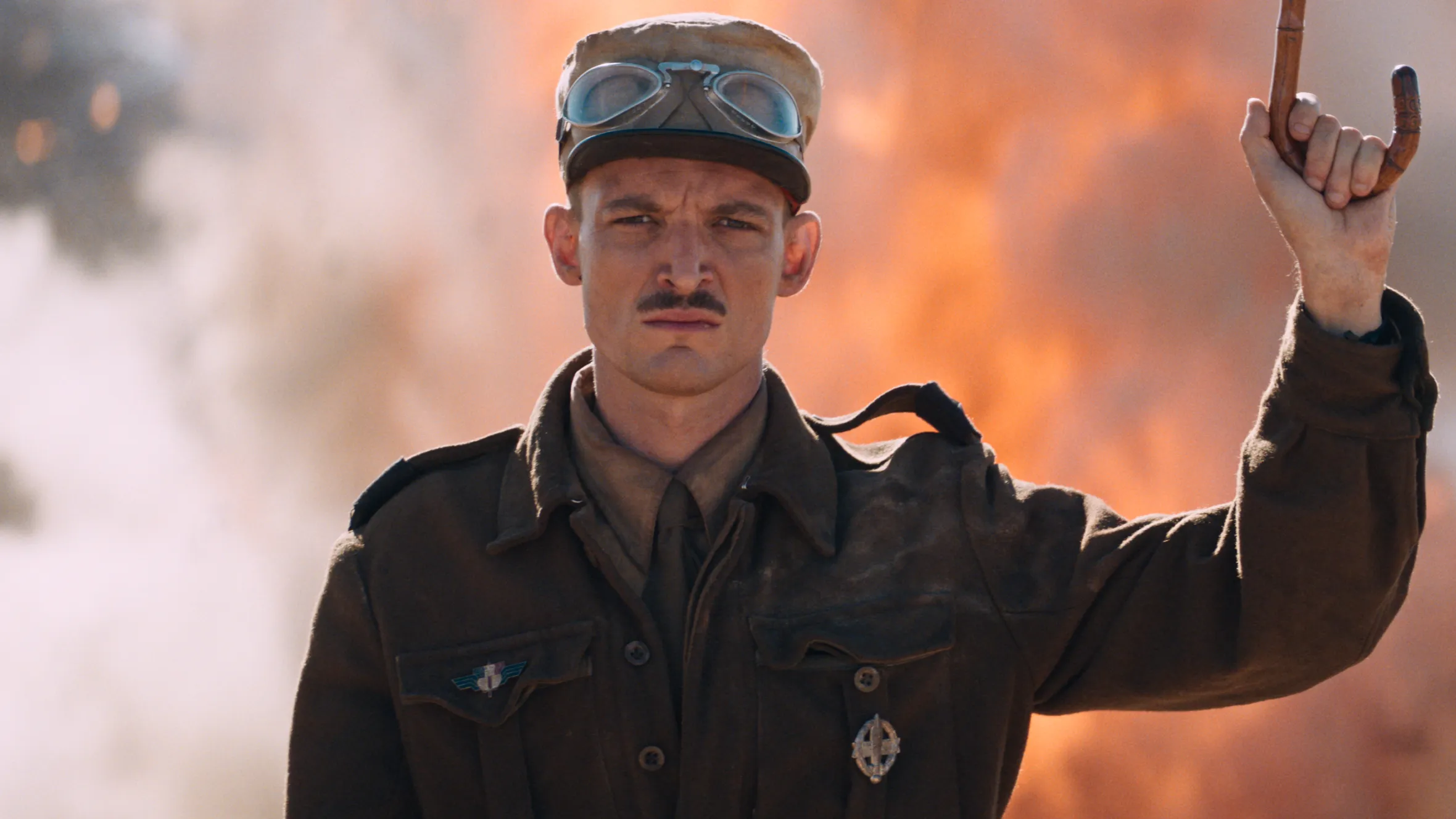
Just like the first part, De Gaulle: Liberté can take a while to get going. We’re essentially following three parallel stories – De Gaulle attempting to convince Churchill and Roosevelt to trust, General Leclerc (Niels Schneider) facing German troops in the Libyan desert, and Jean Moulin (Félix Kysyl) ramping up the resistance with Olivia (Anamaria Vartolomei), within the streets of Paris – which eventually intersect during its final scene. It can feel like a lot to take in, especially when Baudry packs so much historical information into each exchange, but unlike the first part, none of it feels outright propagandistic. Some might disagree, especially if you have strong feelings (one way or another) about De Gaulle, but this critic had limited knowledge of who he was for France before seeing Baudry’s diptych.
Perhaps this influenced my judgment on the movie. It probably did, but the thing is: the craft that’s on screen is undeniable. The action sequences have a sweeping grandeur to them that is severely missing in American films, especially the Ksar Ghilane battle, which is as spectacular to look at as Résistance’s “morceau de bravoure” in Bir Hakeim. I was half-expecting Liberté to be more action-oriented than the first entry, but it’s as deliberately paced as its prior installment, which could alienate viewers looking for less “exposition” and more “action,” but I’m completely unsurprised by this choice, since De Gaulle’s actions during this time were primarily diplomatic.
Interestingly enough, instead of (yet again) recreating D-Day, in which the film culminates, Baudry utilizes archival footage after visualizing the most potent image of the entire duology, as De Gaulle stands in front of a cliff, looking onwards during a thunderstorm as lightning strikes, and shows the extent of the fleet preparing to travel to Normandy. This strong image is layered with so much significance and represents how De Gaulle will be remembered as in the eyes of France. Perhaps Liberté’s ending is a bit excessive in its patriotism, but the word “patriot” is probably closely associated with De Gaulle – no matter what his critics (and there are many valid criticisms) say.
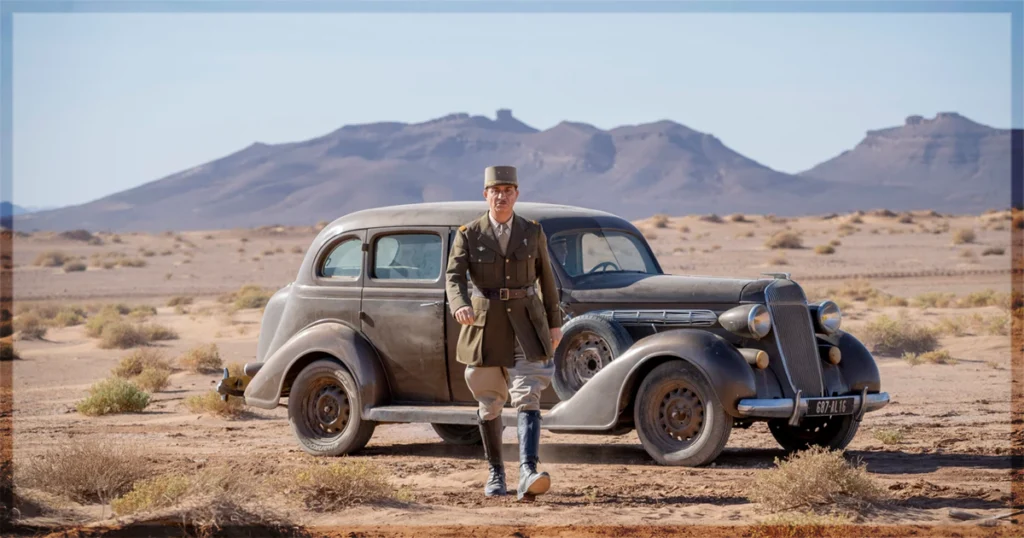
In any event, Simon Akbarian’s performance succeeds greatly in expressing what De Gaulle means to the eyes of France, but I was surprised how more time was given to Schneider’s Leclerc and Vartolomei’s Olivia than to the film’s titular character. The latter, in particular, is one of the most exciting burgeoning talents working today, and her turn here is especially sensitive, especially during the film’s denouement, when France’s freedom inches closer to reality and Olivia is stuck between danger and liberation. It’s a final moment that cements the film as one of French cinema’s greatest contemporary achievements, even if its structure is slightly wobbly and Baudry seems more concerned with giving audiences a “history lesson” than with something with real cinematic weight.
However, when the action hits, it’s so spectacular that any thought of Liberté’s “dense plotting” immediately dissipates and perhaps will encourage you to yell out “LA FRANCE!” when the diptych eventually reaches its natural conclusion. It’s a rare two-part epic that doesn’t disappoint and gives us grandeur so palpable that Hollywood should feel ashamed of the garbage they put out weekly that qualifies as “epic.” Nothing more epic came out this year than De Gaulle, and that’s a fact.