



Director: Brandon Christensen
Writers: Brandon Christensen and Ryan Christensen
Stars: Jaime M. Callica, Sean Rogerson, Catherine Lough Haggquist
Synopsis: Two police officers investigate a domestic dispute and there is an accidental shooting. Not wanting to be crucified by the public, the officers attempt to cover it up – only to uncover that the cameras aren’t the only things watching them.
Each year, Shudder releases a new V/H/S anthology series, giving emerging filmmakers a chance to showcase their talents in the found footage genre. Like most anthology projects, some segments are stronger than others. However, as a horror franchise, the V/H/S films have hardly influenced other titles in the genre. At least not in the same way as films like Hereditary or The Conjuring. The new Shudder release, Bodycam, is one of the first horror movies that feels heavily inspired by V/H/S. The tonal similarities are so strong that if it were shorter, one could easily see Bodycam as a V/H/S segment.
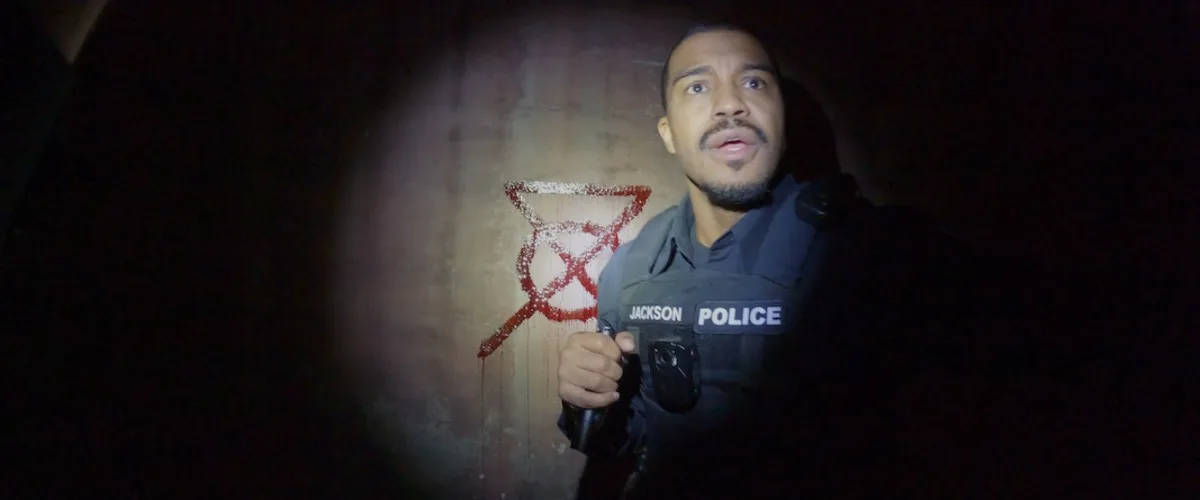
Directed by Brandon Christensen, the film centers on two cops called to investigate a domestic dispute. The two men, Officer Jackson (Jaime M. Callica) and Officer Bryce (Sean Rogerson), enter the home and are immediately met with an air of strangeness. The entire home is dark and eerily quiet, and a baby crib has a dying animal lying inside it. They finally encounter the home’s husband and wife. The wife is bloody and erratic. The husband holds a newborn while standing next to a hole in the basement. Above the hole is the word “Rise” written in red letters. The welfare check ends violently as one of the parents is killed by Officer Bryce. The screenplay by Brandon and Ryan Christensen then confronts police corruption. Bryce wants to cover it up because of how the situation appears optically. Jackson, on the other hand, pushes back on the idea and insists on doing the right thing.
Once they depart, the real horror begins to unfold. Homeless individuals and locals repeat a common threat to Bryce, saying, “You take something from us, we take something from you.” For as many things as the film gets right, the aporophobia aspects feel problematic. The stigma around people experiencing poverty is already hard to overcome. Making them scary in a horror film amid a homeless crisis does not sit well. But the other details, while not entirely original, do offer an energetic horror ride beyond troublesome depictions. Officer Jackson attempts to keep a handle on things while Bryce’s reality shatters. The department is no longer responding to their radio calls, and loved ones begin acting out of character. The pacing in these scenarios is solid. The only drawback is that Christensen sometimes leans on easy horror cliches. For instance, the elongated demon/ghost face has been featured in almost every horror movie in the last decade. One cannot see an elongated mouth without thinking about the trailer for Grave Encounters.
While Bodycam speaks about police corruption, it feels like a missed opportunity to explore the topic of police brutality thematically. The potential was ripe considering recent events. However, one can make a case that Bodycam is an allegory about the broken and oppressed fighting back. For instance, Officer Jackson’s mother, Ally Jackson (Catherine Lough Haggquist), takes in individuals from the street and continually draws a distinction between the neighborhood residents and her son. A few moments later, the locals his mother supports are seen chanting in a circle inside the home.
The greatest strength of Bodycam is its approach to filming. The hardest part to explain in a found footage movie is why the characters keep recording. It’s smart to use the body-cam setup because police are required to keep them on at all times. The approach makes the footage feel more believable. The problem comes with the horror elements. There isn’t much new here in terms of horror ideas or scares. But depending on your perspective, this can be seen as both a strength and a weakness. The scenes have been done before, but Christensen manages them skillfully. Frequent horror enthusiasts will know what to expect. The jump scares are loud; when evil is nearby, the footage glitches; strangers invoke the cliché of demonic voices; and threats emerge from the shadows, cackling. Also, like the current V/H/S style, the film’s final section shifts into absurd territory.
Bodycam plays the correct notes, even if they are familiar. The pacing is better than most low-budget offerings, and there are a few surprisingly effective moments. The film will perfectly serve the audience who loves the V/H/S franchise. It has all the chaotic energy of the V/H/S films, while retaining some of its silliness. However, the final act arguably falls victim to the campy side. It’s not perfect, and at times it feels like a short film that was overextended. Still, for a direct-to-streaming horror film, the 75-minute police ride should satisfy.