



Director: Giulio Bertelli
Writers: Giulio Bertelli, Pietro Caracciolo, Pietro Caracciolo
Stars: Yile Vianello, Alice Bellandi, Michela Cescon
Synopsis: As the fictional Olympic Games of Ludoj 2024 approaches, Agon shows the stories of three athletes as they prepare and then compete in rifle shooting, fencing and judo.
In his contemplative and visually rigorous film Agon, director Giulio Bertelli strips away the high-octane artifice typically associated with the “road to the Olympics.” Set against the backdrop of the fictional Ludoj 2024 Games, the film tracks three female athletes as they prepare for and compete in rifle shooting, fencing, and judo. While these sports are professionalized and governed today by strict protocols designed to mitigate harm, Bertelli never lets the viewer forget their primal origins as modes of combat intended to inflict violence.
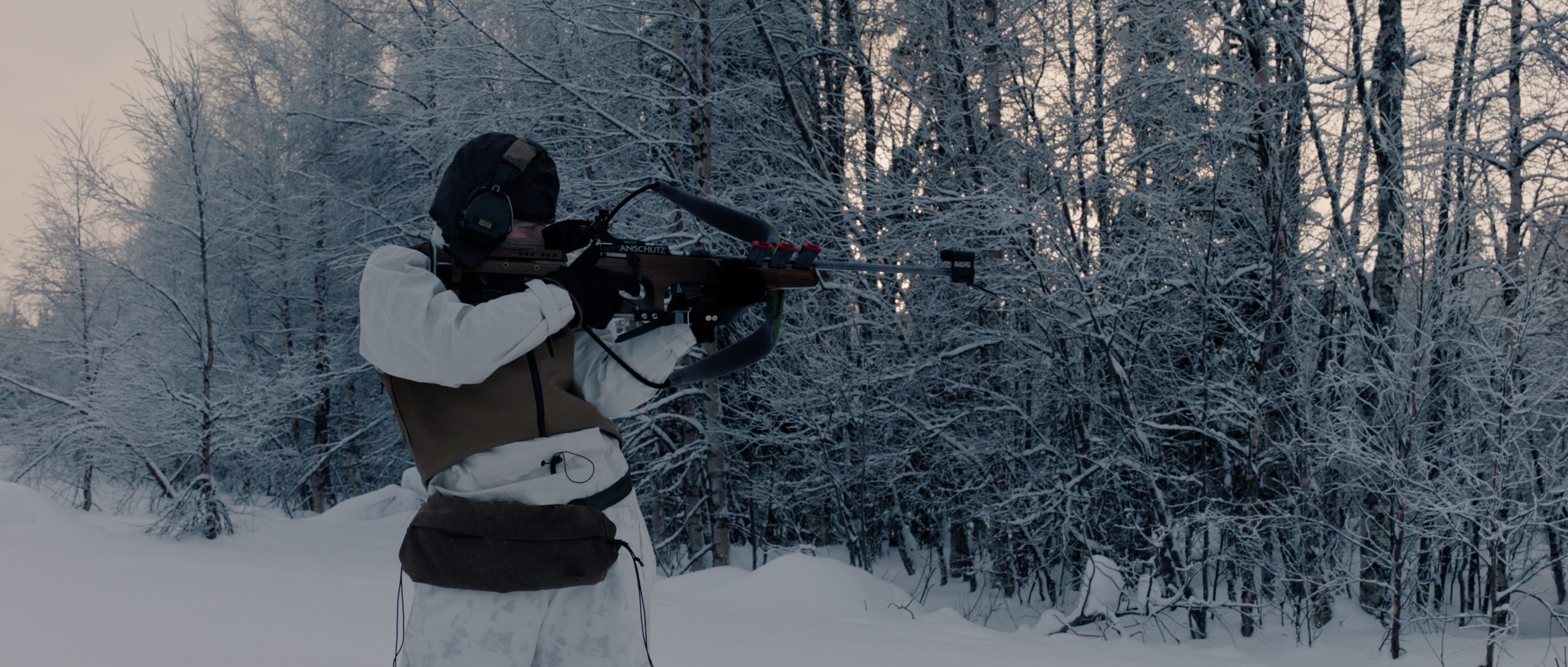
From its opening frames, Agon establishes a stark visual dissonance. The film’s aesthetic is unexpectedly airy and muted, filmed with a detached, chilling elegance. Rather than relying on the gritty, high-contrast visual language of the traditional sports drama, Bertelli employs a clinical, documentary-like lens. This muted palette creates a profound friction with the brutal reality of what we are observing. When they come, the sudden, intrusions of pain and failure feel both jarring because the world they inhabit is so beautifully, coldly composed, and yet they also feel inevitable; a natural consequence of pushing the limits.
Oscillating between wide shots that capture the macro-geometry of the sports and invasive, extreme close-ups detailing specific physical processes, the camera treats the human body as just another piece of apparatus. An unflinching early sequence of a knee operation sets the tone. By juxtaposing the visceral reality of surgery with the heavy industrial manufacture of bullets and fencing blades, Bertelli is telling us that flesh and bone are as specialized, and as prone to failure, as the tools they wield.
Crucially, the film almost seems to desexualize its subjects. In contemporary cinema, women’s bodies are frequently either objectified or framed as triumphant vessels of “empowerment.” Agon rejects both narratives, presenting these young women as highly tuned, ambitious instruments of sporting excellence. This visceral authenticity, however, is not merely a feat of acting; it is lived. By casting real-world athletic powerhouse such as Olympic gold medalist in Judo, Alice Bellandi, Bertelli blurs the boundary between documentary and fiction.
The repetitive muscle memory and the exhaustion etched into the micro-expressions of these athletes carries the weight of lived experience, making palpable the psychological toll and “emotional saturation” of being treated like a machine.
Yet, Bertelli purposefully allows this mechanical artifice to crack in moments of profound, solitary desperation. The facade shatters during two highly intimate scenes: when the rifle shooter, Sokolov, masturbates, and later, when an injured Bellandi resorts to a desperate bout of binge eating. Rather than observing the physical acts themselves with the clinical detachment used during their training, the camera anchors itself in long, unflinching takes fixed solely on the actresses’ faces. In these suffocatingly quiet moments, the audience is forced to reckon with the devastating emotional toll of their discipline. The bodies they have treated as mere tools finally demand a visceral, human release, revealing the psychological weight of their ambition.
Perhaps the film’s most striking formal decision is its acoustic landscape. Deprived of the public, the fictional events are staged entirely within soundstages to feature a new, overwhelming layer of audio. The validating, triumphant roars of the crowd are entirely absent. Instead, the soundtrack is a stark, tactile symphony: the metallic clash of equipment, the heavy breathing, and the guttural grunts of extreme exertion. This sonic isolation forces a profoundly intimate and often uncomfortable watch, confronting the viewer with the raw grind of elite competition without the emotional safety net of a cheering audience.
The film finds its sharpest tension in the friction between these ancient forms of combat and the digital age. In a brilliant flourish of what the director terms “techno-realism”, Bertelli shows athletes embracing video games to hone their competitive edge. This digital interface acts as a sterilising filter over the reality of combat, abstracting the flesh-and-blood competitor into pixels and blurring the line between human frailty and digital perfection.
This hyper-modern intrusion extends far beyond training, bleeding into the very real anxieties of the athletes. They must navigate the contemporary threat of “cancel culture” via social media, the parasocial nature of which further dehumanizes the competitor, flattening their experience into yet another label, “Influencer.” Furthermore, the film delivers a bitter irony through a tragic equipment malfunction. In sports that have been heavily sanitised by advanced padding and sensors to ensure safety, the catastrophic failure of this technology underscores the inescapable danger athletes face. It exposes the fallacy that modernity can entirely tame the violence of the arena.
Agon manages to be utterly compelling without ever relying on the manufactured highs and lows of the genre. It understands that the capricious nature of elite sport provides its own inherent suspense. In a world where the margin between victory and defeat is separated by a hair’s breadth, the simple, repetitive mastery of a routine does not require a stirring orchestral score. Ultimately, by stripping away the glamour and the crowds, Bertelli asks a haunting question: what remains of the human drive to compete when the external rewards are gone? He has crafted a somber, essential meditation on the banality and the grotesque beauty of the athletic grind.