



Director: Mamoru Oshii
Writer: Mamoru Oshii, Yoshitaka Amano
Stars: Mako Hyôdô, Jinpachi Nezu, Keiichi Noda
Synopsis: In a decaying city, a little girl takes care of a large egg which she believes was laid by an angel, and crosses paths with a gun-toting young man searching for a bird he saw in a dream.
Angel’s Egg is quite simply one of the most mesmerizing films you could ever hope to see. To fully engage with Mamoru Oshii’s 1985 film is to completely lose oneself in the expansive world he and co-creator Yoshitaka Amano conjured up for their 73-minute film. Yet there is a contradictory element that arises when calling this film expansive and focusing on its short runtime. And as far as the authorial intent of Angel’s Egg goes, that’s sort of the point. To elaborate on this is to dive into some of the many possible feelings this film evokes. And while this film can be interpreted in a variety of ways and operates within a fairly loose plot structure, this review will be addressing certain story developments. To view this film with fresh eyes is a true treat, so beware of possible spoilers to follow.
The world depicted in Angel’s Egg initially overwhelms with its sense of scale. Everything feels frighteningly massive. And there’s very little to look at to properly allow for a baseline understanding of what the rules of this world are. With no context or scale provided, everything seen seems as if it stretches on for miles and miles. But the more time spent in this vast world, the more we realize how frighteningly empty it is. There’s so much nothingness, yet among the empty streets and seemingly abandoned spaces are items and spaces which provoke curiosity and dread. Oshii effortlessly drops his audience into a world ready to be discovered. The hope is that we will walk away with our own understanding of it however best we can. It’s perhaps the greatest strength of this film. Angel’s Egg is a film that’s deeply evocative, making great use of every second of its 73 minute runtime.
The contemplative nature of the introductory sequence to Angel’s Egg is a perfect distillation of the rest of the film’s tone and pacing. It never provides an easy answer, but that’s why we showed up to a film like this in the first place. Oshii is begging his audience to seek out these answers amongst the ruins of his seemingly broken world. And we as viewers should have no issue obliging him. This is an absolutely gorgeous-looking restoration in every sense of the word. With so much of its visual imagery focusing on the interplay between shadows and the movements of objects or characters within and around them, the new life breathed into this 40-year-old film encourages a wandering gaze. We constantly scan the frame as the nameless Girl wanders around the world in search of who knows what.
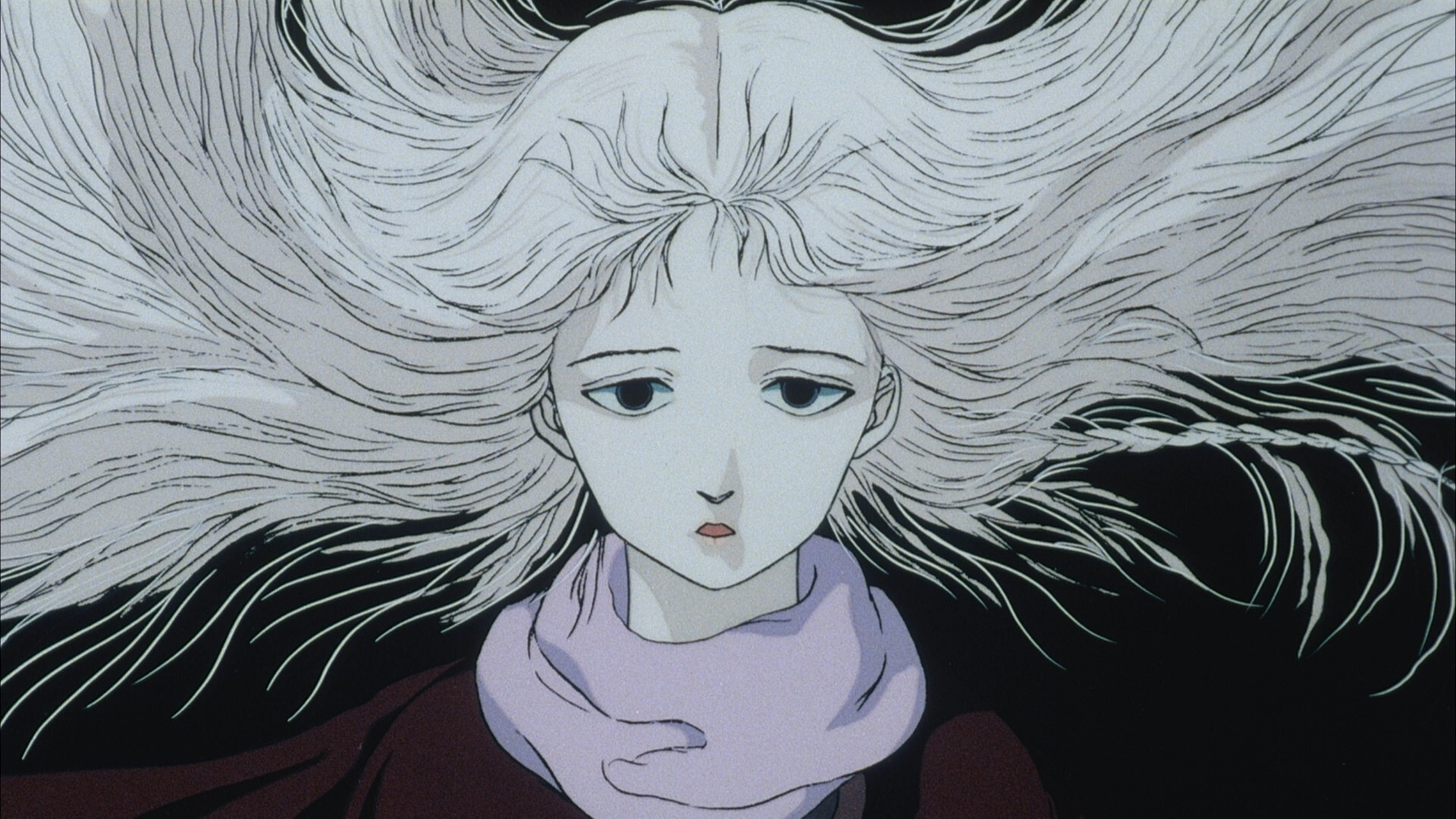
As the Girl traverses this world with her egg preciously hidden away, there’s an unnerving loneliness about her. More accurately, there’s a tragedy to this character. Nothing is ever explicitly revealed nor directly addressed, but how she’s drawn and animated speaks volumes within the confines of this borderline dialogue-free film. One look at her eyes as she curiously explores the world and you can see a tired sadness within them. Whatever is driving her motivations, even if it’s nothing but a wandering curiosity, has left her worn down yet remaining ever guarded. The only thing she seems to value more than her own peace of mind and innate curiosity is the safety of her precious egg. So when she comes across the nameless Boy, seemingly the only other living being within miles, she’s understandably cautious.
Despite having the same lost and tired look behind his eyes, this Boy is a bit more open with the thoughts floating around in his mind. He’s more forthcoming, even going so far as to warn the Girl of the necessity of keeping her greatest treasure held close at all times. In telling the Girl to essentially trust nobody with what matters most to her while returning the egg to her protection, he gains somewhat of a sympathetic view in the eyes of both the Girl and the audience. It only makes the third act of this film that much more of a tragic and shocking betrayal.
The world of filmmaking is often referred to as the Dream Factory. It seems fairly obvious as to why. Through the medium of cinema, we see countless examples of artists taking dreams of all sorts and bringing them to life before our very eyes. And it’s also quite common to see films, especially ones in the vein of Angel’s Egg, be referred to as dream-like. To watch any random minute of this film is to understand exactly why. But I’d argue Oshii’s film takes this descriptor a step further, in a way so few films actually pull off. One hypnotizing sequence in particular causes Angel’s Egg to feel like a genuine dream. This comes in the form of an extended sequence where the Girl sleeps with her egg as the Boy guards her ever so vigilantly. The camera remains still as the campfire slowly loses its glow and the darkness of this world begins to creep in ever so menacingly. And there comes a point during this sequence where the camera seems to be fading to black around the edges of the frame before being reawoken to continue our watch. The Boy may be a competent guardian, but the thought of leaving the Girl alone rattles us to attention. Despite Angel’s Egg beckoning for your unfazed attention, it’s also attempting to lull you into a sense of calm serenity. It’s all in service of Oshii’s upcoming attack designed to be gut-wrenching. It makes for perhaps one of the most horrifying and purely cruel moments in cinema.
In just over an hour, Angel’s Egg provides its viewer so much by doing so little. This isn’t a dig at the film in any way. It’s actually one of the most successful examples of the “less is more” mentality. The sad loneliness which permeates throughout Angel’s Egg is immensely potent. Aside from the Girl and the Boy, what little proof we see of possible “life” inhabiting this film is cold and unmoving. It’s only upon the possibility of destroying something beautiful that life seems to take shape in its own perplexing and compelling way. Amidst so much nothingness, we only hope for some form of company. But Oshii’s film seems intent on cautioning its viewer with regards to opening ourselves up to others. Perhaps it will always lead to a vicious conclusion stemming from emotional betrayal. There might be a shred of hope present at the heartbreaking finale of Angel’s Egg, but it’s undeniably a film which will leave its audience shaken upon the arrival of the credits. Despite being just one of many possible readings into Angel’s Egg, that any possible signifier can remain so potent and impactful speaks to the immaculate ideas presented within this film. That this new 4K restoration will be widely available for waves of filmgoers to be both haunted and enamored by is one of the most exciting cinematic prospects of the year.
The new 4K restoration of Angel’s Egg is celebrating its New York premiere at the 63rd New York Film Festival as part of the Revivals section.