



Emilie Blichfeldt’s debut feature, The Ugly Stepsister, is gloriously gross, as the “ugly stepsister” of the Cinderella story goes to extremes to be beautiful enough for the facile Prince to take note of her. Bone-crunching plastic surgery, sewn-in eyelashes, and eating a tapeworm are but a few of the horrors Elvira (Lea Myren) goes through to be the belle of the ball.
Nadine Whitney spoke with Blichfeldt; Anne Cathrine Sauerberg, the film’s primary makeup and hair artist; and Thomas Foldberg, who designed the prosthetics that caused audiences to squirm and brought the movie to the attention of the Academy Awards.
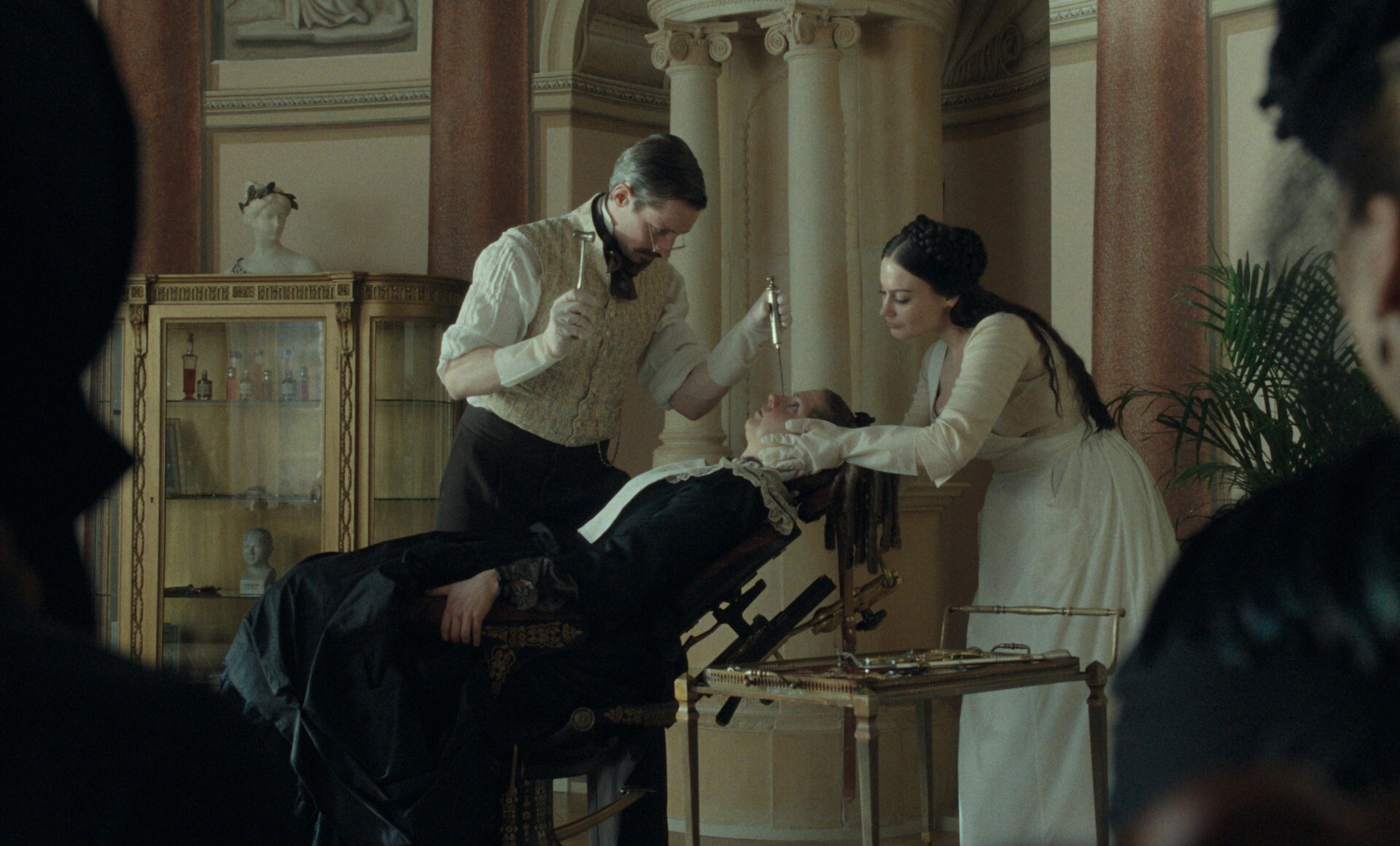
Nadine Whitney: Hello again, Emilie. I interviewed you ages ago when The Ugly Stepsister was first coming out, and I’m so pleased that you have an Academy Award nomination—and gosh, I wish it could be for more than hair and makeup. Apologies, Anne Cathrine and Thomas!
Thomas, you were responsible for most of the prosthetics work. Can you tell me a little bit about how you worked with Anne Cathrine to create a kind of merger between your prosthetics and her makeup, especially for Lea Myren as Elvira?
Thomas Foldberg: The prosthetics for the Elvira character were definitely the most challenging part of the film, but also the most fun to execute, because they’re such a big part of it. We had to be with Lea for so many days. It’s interesting, because the whole design phase I actually did without Anne Cathrine. That was me working together with Emilie to find out what actually had to be done. Anne Cathrine came in later and then came up with this wonderful look for the character, as well as the makeup she’s wearing—eye makeup and so on. You build the character from the beginning with the director. I’d never worked with Emilie before, but she had this really clear universe and some really good mood boards, so it was really easy for me.
Anne Cathrine Sauerberg: Sometimes, especially when you have a really short time, you just have to decide, “Okay, we’re going this way,” and it worked out really well. Emilie and I needed a lot of character work before we started shooting. The strange thing is that sometimes a movie has a will of its own, and it’s very much driven by Emilie’s visions—but there’s also always something you can’t quite explain when you’re making a movie. We didn’t have to say very much to communicate while shooting. When you say, “I’m going to make it a little mush-mush,” they know what you mean, so we don’t see the edges or whatever.
I wish I could say that I sat down and said, “It’s going to be like that,” but looking at Emilie’s smooth parts, it kind of came together. Maybe that’s also part of the creative process—it’s kind of hard to explain when it happens.
Also, you have a team. I had two wonderful Polish girls whom I’d worked with before. I had to explain a look to them, then show certain pictures. I found reference images, but I think something happens that’s very intuitive about doing it. The great reference pictures were presented by Emilie.
Nadine Whitney: Emilie, I’m guessing you probably provided a lot of pictures from films like Morgiana (1972) by Juraj Herz and his Beauty and the Beast (1978). I’m also going to guess Fruit of Paradise (1970) by Věra Chytilová. The Ugly Stepsister has a very strong Eastern European–Czech aesthetic, especially with the blonde wig that Elvira is wearing.
Emilie Blichfeldt: Yes! It is absolutely in that universe. A lot of those wigs are quite terrible because they’re made in the 1950s, 1960s, and 1970s, so they’re very artificial and plastic. We wanted to go camp, and we wanted to give it this timeless look by filtering it through the 1960s and 1970s. When Anne Cathrine brought in images of Cher for the eye makeup, I thought, “Okay, I met the right person.” I think that’s the chemistry Anne Cathrine is talking about.
When I saw Anne Cathrine’s work—she did a great TV series set in the 1960s, all about curls and curlers, called Carmen Curlers—I knew. She also made this amazing wig for a photo shoot of a big model in the 1960s that doesn’t exist. The way she curated that was just immaculate. We wanted to go with the (sur)realism found in these Eastern European movies, but they’re also camp. That’s the fine balance we had to thread to build a universe.
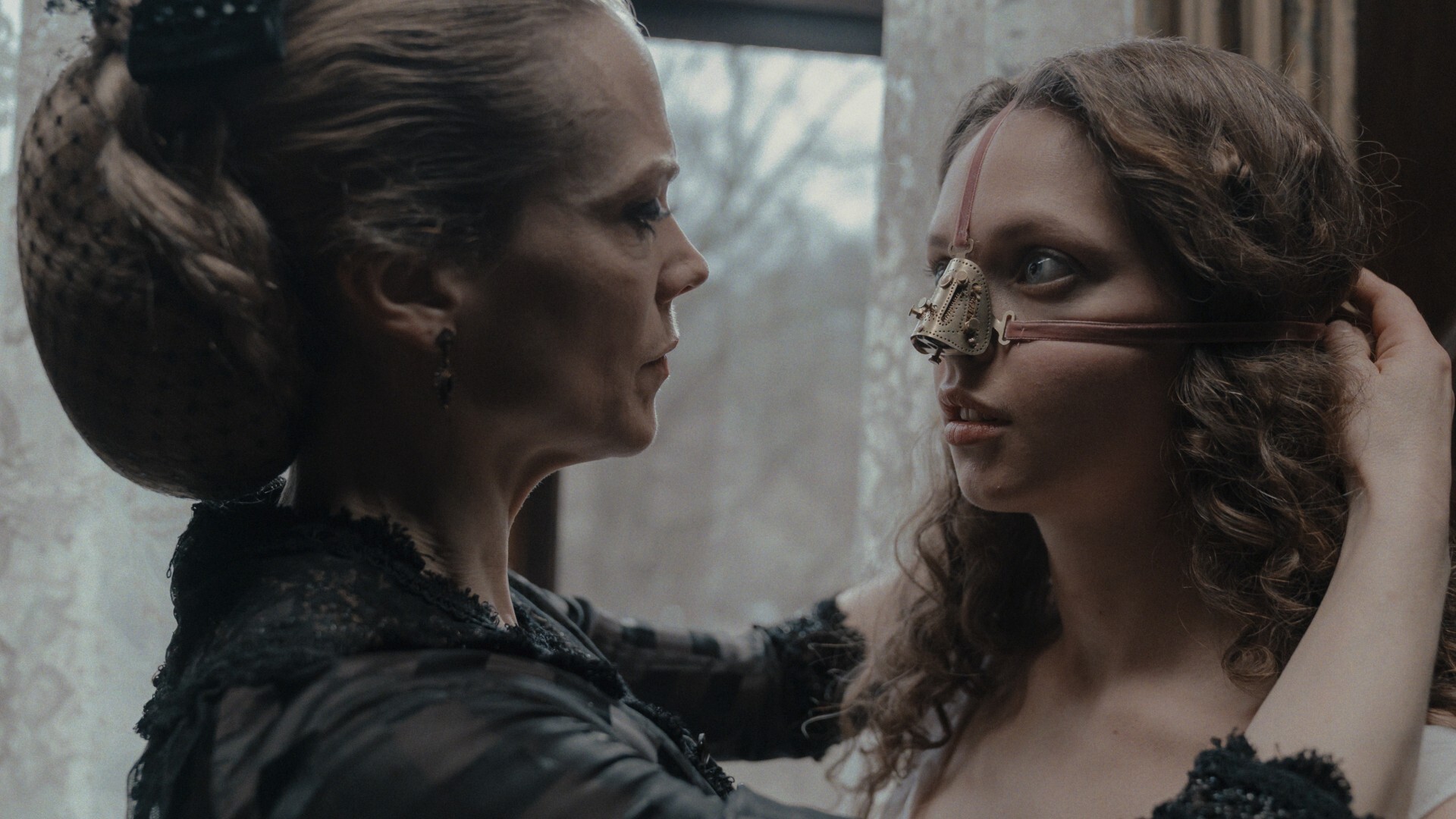
Nadine Whitney: I rewatched the film last night, and I was amazed at how certain things were crafted. For example, Lea is wearing a wig of hair falling out on top of her own hair, and then another wig on top of that. I don’t know how many noses she ended up having to wear. Anne Cathrine, were there any specific challenges you encountered?
Anne Cathrine Sauerberg: I sat in a basement for two weeks in Warsaw [laughs]. I cast my mind back to the blonde wig, and it kind of just happened. I think it was more like running a race, given the tight shooting schedule. I tend to get very absorbed in what I’m doing, and having to change directions on set wasn’t so easy to get into.
Thomas Foldberg: I think, yeah, there was a lot that was really challenging. But the most challenging part was actually the shooting. We had such a short time, and we filmed somewhat chronologically—but not always—so it ended up being a continuity… nightmare is the wrong word.
Emilie Blichfeldt: It’s the right word!
Thomas Foldberg: I mean, it was crazy. We’d have to switch from Elvira’s first look with braces to without braces, or have different noses. We were switching back and forth all the time. I had to make printouts, change things on my phone, and label my makeup mirrors—not with a complete plan, but just to communicate what was needed so my assistant could keep track.
Nadine Whitney: What about ensuring the actors can act through the prosthetics, like the fake teeth and braces?
Thomas Foldberg: Nobody has really asked, but it’s fairly simple because the dental prosthetics are very thin. The braces only attach to the side of the cheek, so Lea didn’t really have anything in her mouth. The broken teeth were very thin acrylic teeth placed on top of her own, so it was quite simple and very standard in many ways.
Anne Cathrine Sauerberg: If you go to Thomas’s Instagram page, it’s really great to see all the things that happened and how the effects were made. Some of the things look simple, but they’re actually quite complicated.
Nadine Whitney: One of the best visual jokes for me throughout the whole film is Otto, Agnes’s father, slowly decomposing over the course of the movie. It’s funny, but it’s deeply grotesque.
Emilie Blichfeldt: I came to Thomas with a long, long list of things I wanted him to do—create Elvira’s character, change it throughout the movie, show different stages of healing or hurting, Elvira’s chubbier-appearance prosthetics. I had body parts, a tapeworm, a dead corpse rotting away, and popping pimples. Thomas thought I was crazy and didn’t think it was going to happen. Chopping off toes, sewing eyelids.
As a director, having only 28 days to shoot, and then seeing Thomas make all of these things from that long list—putting in so much work and designing them to perfection—and then only having time on set to shoot one frame of an object was hurting me so badly. I really felt that it’s both an honor and a horror as a director that your work is based on other artists’ work.
I’m the boss of the whole thing, and I know we have to compromise, but here was this artist who made these art pieces, and I could shoot them for five minutes. It’s insane!
Nadine Whitney: That’s the beauty of finding the right collaborators, though. I imagine trusting that these things people think are crazy can be done, even if they’re only on screen for a few frames. They’re still impactful.
I think the film is incredibly timely—and it was timely when you were writing and shooting it. There’s also another film, Toxic, a Lithuanian drama written and directed by Saulė Bliuvaitė, about two contemporary girls, one of whom also swallows a tapeworm egg. I think these films are in conversation, because these beauty standards just haven’t gone away.
Emilie Blichfeldt: Yeah, it’s insane how the tapeworm is arriving at the same time as Ozempic and all these other weight-loss drugs. Ozempic simply wasn’t a thing when I wrote the script—and it makes you lose your hair. I researched a lot of data and saved one example that I found especially funny. There’s one that lists anal itching, hair loss, epilepsy, and other things as possible side effects of tapeworms.
Nadine Whitney: I have to ask about the penis…
Emilie Blichfeldt: It’s Thomas’s. [Everyone laughs.]
Nadine Whitney: I’m keeping that in the interview! I wouldn’t be ashamed of it—it has quite a bit of girth.
Emilie Blichfeldt: I know. I had to be quite specific about a lot of things. As a director, sometimes you’re like, “Oh shit, did I write that?” Now I have to talk very explicitly about something. I had to be very explicit about the amount of hair on Agnes’s body double’s butthole. My Google searches were not very suitable for work—but it was my work.
And with this penis thing, I really debated it. I’m very specific about how bodies are represented in movies. I had a friend draw a very crooked penis, and I thought a lot about penis representation, but it didn’t end up in the movie because I felt it took away from the moment, which was about the more glorious parts of sexual life. It shouldn’t be gross or weird, but more like a pure experience. I asked Thomas to make his finest work.