



Guillermo del Toro’s Mount Everest has been Frankenstein since he was a child. As a filmmaker, references to Mary Shelley’s 1818 novel can be found in Cronos, Mimic, The Shape of Water, and The Devil’s Backbone.
Nadine Whitney speaks to Guillermo del Toro about the combination of science and capitalism and the Industrial Age in Frankenstein.
Nadine Whitney: Guillermo, I’ve been rewatching your filmography and you mention Frankenstein in many interviews. The novel is always there in your mind and references.
Even in Mimic there’s an aspect of Frankenstein. Can you tell me a little bit why you’ve moved the period up slightly from the Regency to the Victorian era?
Guillermo Del Toro: In Mimic, they call it “your little Frankenstein” about the Judas bug. But look, for me, I spent a little over a month just determining where and when a movie happens, you know? It’s a big difference if you move it a couple of years later or earlier. The Crimean War obviously is one of the reasons because one of the questions I want to ask is how many times a sort of altruistic pursuit is financed by death. And thematically, death and life are so linked. Victor has no problem getting money. He says he’s working for life, but he gets money from a merchant of death. And he treats the dead with absolute disrespect, just throwing what is spare parts for him out into a lake. He doesn’t consider anything human in his quest for life. He ignores life while looking for life. That’s an aspect thematically that needed the war.
The war is also important to the Romantic movement because it was framed by the Napoleonic Wars. And I wanted to bring it into the fray of telling the story. The second aspect is moving it forward for the technology. I wanted photography. I wanted photography to be sort of a very expensive hobby that only a few were doing, and they were doing it for reasons that were documenting something, doing an artistic painting with photography.
But also, the steam engine, the fuel engine was experimental at this point. If I move it another seven years, the French launch the first fuel commercial engine properly, and I needed it to be at least close to that. And finally, some of the science that is a little behind what I would like it. I would like to talk about sepsis and Dr. Lister, but it’s too early. I really moved it as close to that as I could. But it’s a very studied and very deliberate reason behind it.
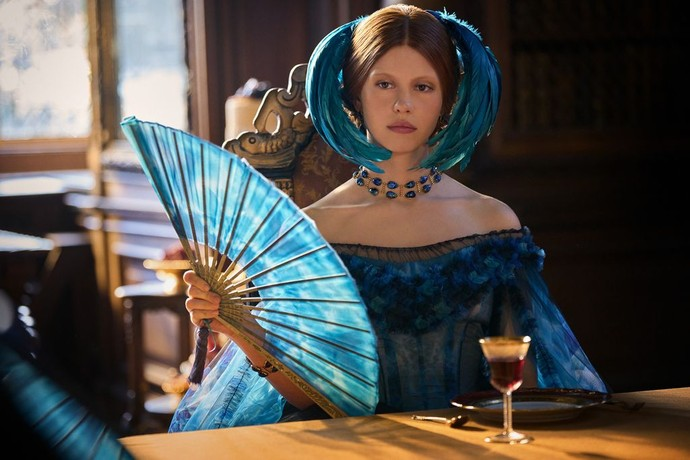
Nadine Whitney: And also, you get to dress Elizabeth in amazing mid-century fashion, you have her look like a Pre-Raphaelite model.
Guillermo Del Toro: The costumes are much better in 1850 than in 1818. [laughs]