



Directors: Angelina Jolie
Writer: Angelina Jolie
Stars: Salma Hayek Pinault, Demián Bichir
Synopsis: A parable-like tale exploring themes of family, war, and revenge.
Having your heart in the right place as an artist is an important thing. Unfortunately, it is not the only thing. There are countless examples of films that wear their hearts on their sleeves and want to get across an important message. And that message is a part of the artform, but alone it is not nearly enough. Some of these films comes across more as a lesson than a story and thus, fails to reach an audience at a core level. Very unfortunately, Without Blood transfers over into that lecture hall tedium for the majority of its runtime.
Without Blood, based on the novel, “Senza Singua,” is a surprisingly simple story of revenge. Well, as simple as revenge can be. The film opens with some of the most beautiful images of director Angelina Jolie’s career. The sun-drenched, golden pallor of the countryside is truly idyllic, which of course is the entire point. That perfection is about to be abused and destroyed in a single moment of violence. Just before this, a nameless father figure (Alfredo Herrera), after seeing armed men arrive, gives his son (Alessandro D’Antuono) a rifle and stows his daughter (Karolay Fernandez) under some loose floorboards. From there, we see the brutal violence on display. We learn precious little about this man, but it is enough to keep us intrigued, even after his and his son’s death. His daughter survives, but only because of the kindness of one of his killers, Tito (Ariel Perez Lima).
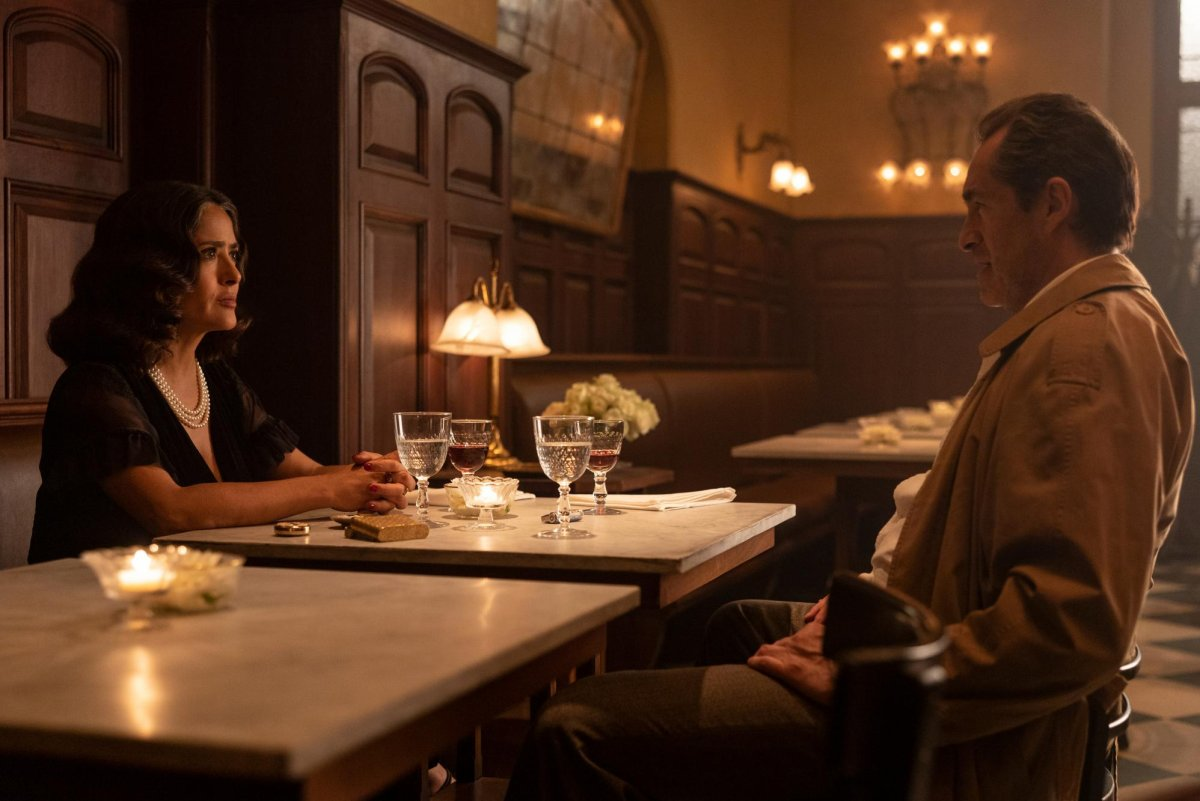
After this extended opening sequence, the film truly begins on its path. The young girl, Nina is now much older, and of course, played by a different actress (Salma Hayek Pinault). Quietly, she walks up to a newsstand and strikes up a conversation with the owner (Demián Bichir), and takes him out for a meal. Although it is framed in a mysterious way, the script, adapted by Jolie, removes that riddle almost immediately. This man tells her flat out at the table that he knows who she is and has been waiting for her to find him.
The hair and makeup design for the film is impeccable and subtle. The choice of a grey streak in Hayek Pinault’s hair is indicative of her holding on to her pain so much that it may be leaking out. This is a common occurrence in many pieces of art, most memorably in “Les Miserables.” Bichir, for his part, appears haggard without it being painfully obvious. The structure of his face, paired with his posture, not to mention his stunted, halting speech patterns speak of a man who is not simply tired, but brutalized by his own choices. He may have saved Nina’s life, but that does not erase any of the guilt and pain he has earned.
Both of the lead performances border on greatness, so it is a shame that the story fails them at every turn. The vast majority of the film’s runtime is simply one long conversation over a meal. Without Blood attempts to make this one event, Nina’s family’s deaths, enough to propel the film enough that one elongated discussion can hold the audience’s attention. It feels crass to say it, but it simply fails at its one task. Hayek Pinault and Bichir wring every bit of emotionality out of the screenplay that they can manage, but one cannot help but wonder how much more talking is truly necessary.
The blocking and lighting of these back-and-forth moments is also both understated and efficiently shot. That lighting is purposefully reminiscent of the opening scene, bathed in golden light, but with a very different mood. Jolie does have a gift for choosing the right moment to flip between the two perspectives, even when the audience is squirming in their seats hoping for another flashback, simply for a little bit of excitement. Again, that 15 to 20 minute introduction is the only bit of action that we have to hang onto and her choice to make this film about war and conflict in general, rather than take a specific stand is probably a mistake in the long run.
Jolie does manage to get her points about revenge and family across, but at a very long, and tedious cost. Had this been a short film in which Bichir and Hayek Pinault bantered across the table, there is some cinematic glory to be had. Unfortunately the pacing of the film leaves the audience wondering why the points are so belabored and repetitive. Our two leads deserve better and Jolie, a gifted visual director at times, will hopefully find better material to provide that distinctive picture that I truly believe she has waiting for us.