



Director: Francesco Sossai
Writers: Adriano Candiago, Francesco Sossai
Stars: Filippo Scotti, Sergio Romano, Pierpaolo Capovilla
Synopsis: Two blustery 50-somethings, have an obsession: going for their last drink. One night, they run into Giulio, a shy architecture student, whose way of seeing the world and love will be transformed as the trio wander from bar to bar of Veneto.
If you’re looking for a road-trip buddy comedy with arthouse sensibilities, Francesco Sossai has made the film for you. The Last One for the Road is one of the most charming films of the year. Yet for all its humor and the irreverent attitude of its two central characters, this is a quietly devastating film in several regards. Through Carlobianchi (Sergio Romano) and Doriano (Pierpaolo Capovilla), Sossai finds a way to channel his incredibly potent ideas into a deceptively wrapped package. A film about the time we’ve lost, the time that has been wasted, and the unrelenting forward momentum of life itself, The Last One for the Road is an often funny film. It will leave you smiling by the time its credits begin to roll, but you’ll also contemplate your own life long after exiting the theater. And so much of this film’s emotional impact rests on the shoulders of Carlobianchi and Doriano. They exhibit absolute hooligan behavior for so much of its runtime that the moments of genuine emotion and dramatic turns shock the viewer. Wasn’t this just supposed to be a fun movie about two old friends looking for that perfect final drink?
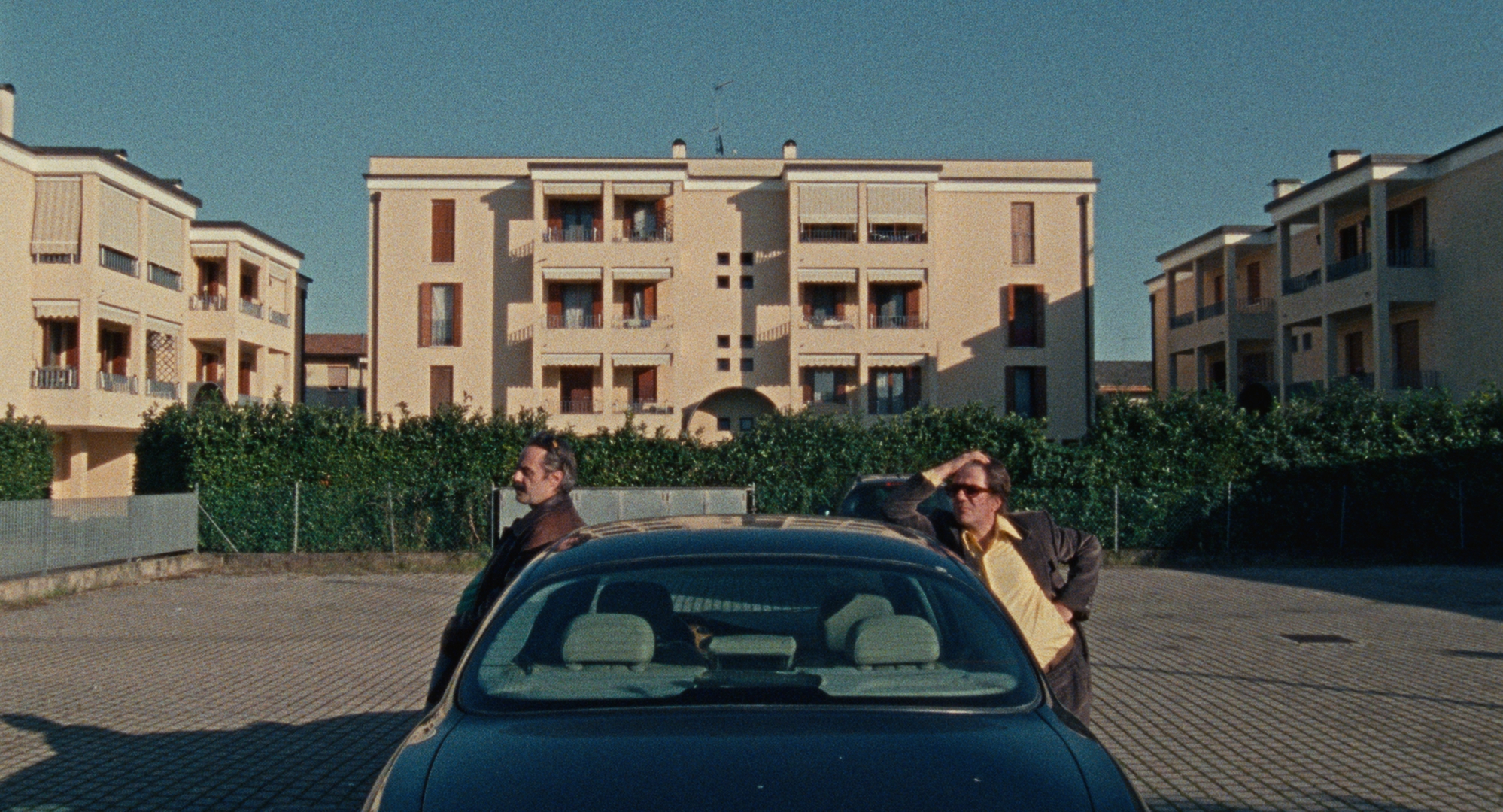
Of course, that very much is what the film is about. But that quest for the final drink of the evening is ultimately revealed to be quite the folly. How could it not be? These two don’t really operate on the typical day-and-night cycle the rest of us seem to follow. When we first meet them, they’re both asleep in the front seats of Carlobianchi’s beat-down Jaguar. One can only guess what time it might be, let alone the last time they actually had a peaceful enough moment to themselves to have a genuine night of rest. But there’s more important things in life to think about for these two. This includes, but is not limited to: where they’ll get “one last drink” while looking more sloshed than perhaps anybody ever has previously in cinema. The urban legend of their hometown is a brief topic, which Sossai plants as a kernel for what’s to come. This duo even drunkenly announces the through-line of the film, captured through startling close-ups which are uncomfortably intense. Anybody who’s been at a bar a bit too late and spoken to somebody who drank a bit too much will instantly recognize what Sossai and director of photography Massimiliano Kuveiller have perfectly captured here. Though the introduction of The Last One for the Road is a loose and rollicking good time at the movies, it’s only a matter of time before reality comes crashing back down for these two. Not that Carlobianchi or Dori are ever all that phased by it amongst others.
In this instance, it consists of a smash cut from comical interactions with random bar patrons to violently throwing up beneath a vast highway system. It’s here that Sossai provides the first of many wistful glimpses that make up the film. It takes the form of a quietly delivered statement: “The ‘90s were great.” This is immediately followed by a conversation shrouded in darkness. The two look out onto a neighborhood, and reckon with the change of their outlook over time. Where they once saw boundless opportunity and the chance for a life beyond their harmless, small-time criminal enterprise, they now see walls too high for them to mount. Life has passed these two by. No matter how much they seem to drink, it’s a seemingly inescapable truth that sneaks up on them in their rare moments of somber quietude. Lucky enough, they’re about to literally stumble into somebody that may perhaps change their lives.
While looking for that last drink, and this time, of course they actually mean the last, they find a group of students celebrating a graduation. One of them is Giulio (Filippo Scotti). It’s in his charming, reserved demeanor that this wild duo morphs into a wonderfully odd, but still riotous, trio. Giulio tells his crush that he won’t be joining them at the next bar. When he tries to appease her by rescheduling for another time, she simply states one of the most universal truths there is in this world: “There’s never another time.”
And what happens next essentially occurs without even a moment of thought on the part of Carlobianchi. He and Dori are two guys who have clearly lived a lifetime seizing every moment available to them until there was nothing left to grab onto anymore. In Giulio, whether they actively realize it or not, they see a project. It could even be perceived as a second chance. There’s still time for him to rectify the error of his ways before it’s too late. And so, the two middle-aged men head off to the bar with this group of graduates, Giulio reluctantly in tow. Eventually, he decides to double down on calling it quits and quietly exits. But Carlobianchi and Dori can’t be rid of that easily. They once again convince him to stay out for one more drink. Seriously, this time it’ll actually be their last one. It’s in this next bar that Sossai’s film begins soaring to new heights both beautiful and impressive.

Carlobianchi and Dori may seem easy to cast judgement upon at face value, but there is something inherently poetic about their lifestyle. They see an entire side of the world that few get to actually experience. And an even smaller amount of people within that group actually internalize everything around them. The Last One for the Road does an excellent job at capturing the quiet beauty to be found in these pockets of the world that are overlooked or cast to the side. In these tiny neighborhood haunts Carlobianchi and Dori clearly frequent, we see live musicians playing their hearts out to the point of tears falling from their eyes. The soft neon lighting beckons patrons to the dance floor, or to simply sit in contemplation amongst fellow strangers, friends, or perhaps nobody at all. It’s incredibly evocative, and the further down the rabbit hole Giulio is reluctantly dragged by his newfound partners in crime, the more Sossai’s film begins to open up these pockets of beauty hidden throughout the world in plain sight. But with that beauty, there can also be a profound sense of sadness and loss.
The whole reason Carlobianchi and Dori were on the road in the first place was to surprise their friend, Genio (Andrea Pennacchi), at the airport. He’s been in Argentina for several years now, and is finally making his return to Italy. They’re particularly excited to celebrate the grand reunion at a small café the three of them used to frequent, but can’t recall the exact location of. Luckily, Giulio finds it through context clues and the marvels of modern GPS, and off they go. It’s only upon arrival that they see it’s been boarded up. And by the looks of it, it has been for quite some time. It’s here, amongst the literal ruins of a life that has long since passed them, that we come to understand Carlobianchi and Dori better. This isn’t just as characters, but simply as people.

Any one of us can end up a victim of circumstance, and Sossai sneakily injects this truth into the very foundation of his film on more than one occasion from here on out. So who can blame these two for dealing with life the way they best see fit? Giulio, a student of architecture and a passionate art lover, teaches the two about what a capriccio is. In simple terms, it is a recognizable landscape that has been altered by a designer to include imaginary details pulled from fantasy. He describes it as “an imaginary landscape… one that doesn’t exist.” That’s The Last One for the Road in a nutshell. Sometimes, all we end up searching for is something that simply doesn’t exist. We can picture it so clearly, and can fully understand the steps needed to reach our destination. But time is uncaring, and by the time we actually get there, it may be completely unrecognizable. In that reality comes the duality of this film. Yes, it is a cautionary tale in some ways. But Sossai also imbues it with the infectious energy of capturing individuals who simply go out and take matters into their own hands. They undeniably feel the weight of everything throughout their day-to-day life, but that doesn’t stop Carlobianchi and Dori from imbuing plenty of their own airy personality and lightheartedness into it whenever possible. Maybe they’re not the most aspirational set of characters in cinema, but they certainly bring a valuable reminder to it. And it’s nevertheless an important idea to impart upon audiences in a clever, and wildly entertaining, manner.
The Last One for the Road is celebrating its North American premiere in the Centrepiece category of the 2025 Toronto International Film Festival.