



Director: Claire Denis
Writers: Claire Denis, Suzanne Lindon, Andrew Litvack
Stars: Matt Dillon, Isaach De Bankolé, Tom Blyth, Mia McKenna-Bruce
Synopsis: A vast public works project in West Africa. Horn, the construction site manager, and Cal, a young engineer, share lodging behind the double gates of their compound. Leone, Horn’s recent bride, comes to join them the same night that a man appears at the fence. His name is Alboury. Like a specter in the darkness, he demands the body of his brother who died earlier that day on the site. He will hound the two men all night long until they return it, as Leone watches the disaster play out before her.
Isaach de Bankolé has been a working actor for the better part of 40 years, yet despite his many collaborations with filmmakers like Claire Denis and Jim Jarmusch, among others, most “modern” audiences would probably recognize him from The Brutalist. Brady Corbet’s epic tale of artistry and corruption housed its fair share of scene-stealing performances – most notably Guy Pearce’s work as Harrison Van Buren, a role that would have won the Aussie an Academy Award in a just world – but de Bankolé’s turn as Gordon, the blue-collared pal to Adrien Brody’s László Toth, is the film’s most understated and grounded. While the Ivorian actor’s lines were limited and on-screen sequences relatively sparse, he served Corbet by remaining soft-pedaled in a movie chock full of theatrics and showy efforts from stars on their grandest levels. de Bankolé’s Gordon is a stoic realist, not one to shout nor berate, and certainly not one to take over a room with bellowing provocations about greatness and wealth. But given that he’s played by the man who rose to prominence in Denis’ Chocolat and has since made meals out of appetizer-sized portions in many a great film since, his position in the background never causes him to go invisible.
So it’s extremely fitting that de Bankolé spends much of Denis’ new film, The Fence, lingering both in the background of many scenes and above the entire picture given its inciting incident, the death of his character’s brother on a construction site. Alboury has come to collect his brother Nouofia’s body; the site’s foreman, Horn (Matt Dillon), is hesitant to deliver it to him, so much so that it’s immediately evident that something awry and worth concealing has occurred. For the entirety of the film, Alboury stands on the other side of a fence – fitting – separate and unequal to Horn, who mans his workplace like a dictator with skeletons in his closet. By its conclusion, it matters less whether or not the literal fence is still standing, but if the barriers between Denis’ four main characters have been broken down, burst through, or have held firm. In some ways, all three occur at once.
As The Fence is a mystery, questions abound from the top. Why, apart from their significant age difference and lack of chemistry, do things feel so off between Horn and his new wife Leone (Mia McKenna-Bruce), who arrives at the worksite thanks to Cal (Tom Blyth), Horn’s trusty human steed? Speaking of Cal, what’s up with him and Horn, namely their somewhat psychosexual dialogue that reeks of a power struggle and homoerotic fantasy? More than anything, though, uninformed audiences are sure to wonder why everyone is talking like that? The answer to the latter is far simpler than the rest: The Fence is adapted by Denis and her Both Sides of the Blade co-writers Suzanne Lindon and Andrew Litvack from Black Battles With Dogs, a French play by Bernard-Marie Koltès, and her choice to do so in such a faithful fashion causes her script to maintain its theatrical quality to a tee, but to a fault as well. There’s nothing wrong with a filmmaker exercising loyalty when it comes to a beloved source text – especially one she has lived with since seeing the play in 1979 – but one wonders whether or not this particular piece of stagecraft possesses enough of a cinematic quality for even a master such as Denis to get the translation right.
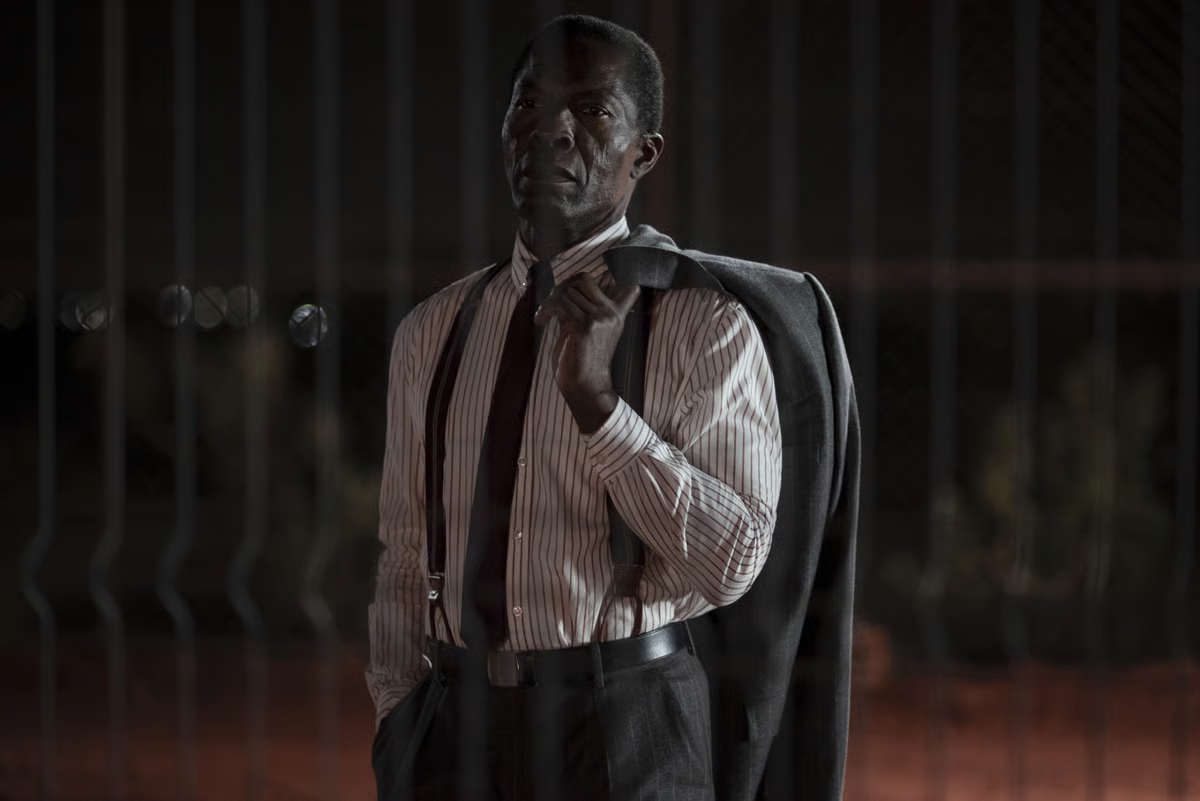
One can feel the stiltedness not only coming through in the dialogue, but in the way the characters move, too. While they have more room to walk about on Denis’ set – which has convincingly been turned from a real-life jail guarded by towers stocked with gunmen, gates, and barbed wire into a collection of shipping containers used as offices and bedrooms for those working on the site – than they would on stage, her actors seem committed to the notion that they only have so much flexibility to their motion, as if they’ll disappear behind a curtain should they travel too far. And though Dillon and Blyth are both excellent performers delivering stellar work here, only de Bankolé and McKenna-Bruce seem to be aware that they will be appearing in front of a crowd via projector, not a director’s off-stage call for action.
Still, The Fence represents a fascinating entry in Denis’ legendary oeuvre, one that has never quite gone mainstream but has, at the very least, become more recognizable considering her inspired casting choices and her continued commitment to thrillingly romantic storytelling, even in its most harrowing sense. 2019’s High Life, one of the best films of that year, starred Robert Pattinson, Mia Goth, and another Denis mainstay in Juliette Binoche, and portrayed a spaceship full of criminals and a mad, horny doctor as they careened toward a black hole and screwed or murdered one another in the process. (It was her first film scripted entirely in English.) She took on double duty in 2022 with Both Sides of the Blade and Stars at Noon, and though neither film should be considered amongst her best efforts, they represent the two sides to her ever-evolving coin: A devotion to thoughtful, sensuous cinema in both French (Blade) and English (Stars), and a curiosity with actors old to her (Binoche and Vincent Lindon in the former) and new (Margaret Qualley and Joe Alwyn in the latter).
The Fence somehow manages to be less successful than each of these previous three projects while being significantly more interesting at the same time. It’s certainly a play in film’s clothing and not the other way around, but even at its least digestible, it rises above what most other similarly brilliant auteurs would manage to mine from its material. Come for the fact that it’s another movie from Claire Denis – who knows how many more we’ll get – and stay for the dramatics within. Just don’t expect an intermission nor a moment to collect your thoughts on why it plays out in such stark, stagy manner.
The Fence screened in the Main Slate at the 63rd New York Film Festival. It is currently seeking U.S. distribution.