


Director: Christophe Gans
Writers: Christophe Gans, Sandra Vo-Anh, Will Schneider
Stars: Jeremy Irvine, Hannah Emily Anderson, Evie Templeton
Synopsis: When a man receives a mysterious letter from his lost love, he is drawn to Silent Hill, a once familiar town now consumed by darkness.
Twelve years after readapting Beauty and the Beast with Léa Seydoux and Vincent Cassel, French genre auteur Christophe Gans returns to the world that made him a known figure within video game adaptations in Return to Silent Hill, promising to audiences a “faithful” adaptation of Konami’s Silent Hill 2, highly regarded as one of the greatest video games of all time. Whether or not these words are true (almost) doesn’t matter, since Gans is a highly interesting (and underappreciated) figure within genre cinema. He’s only made five films in his thirty-year career, each brimming with jaw-dropping images and unwieldy ideas that consistently make us rethink the way we watch movies and the art we consume.
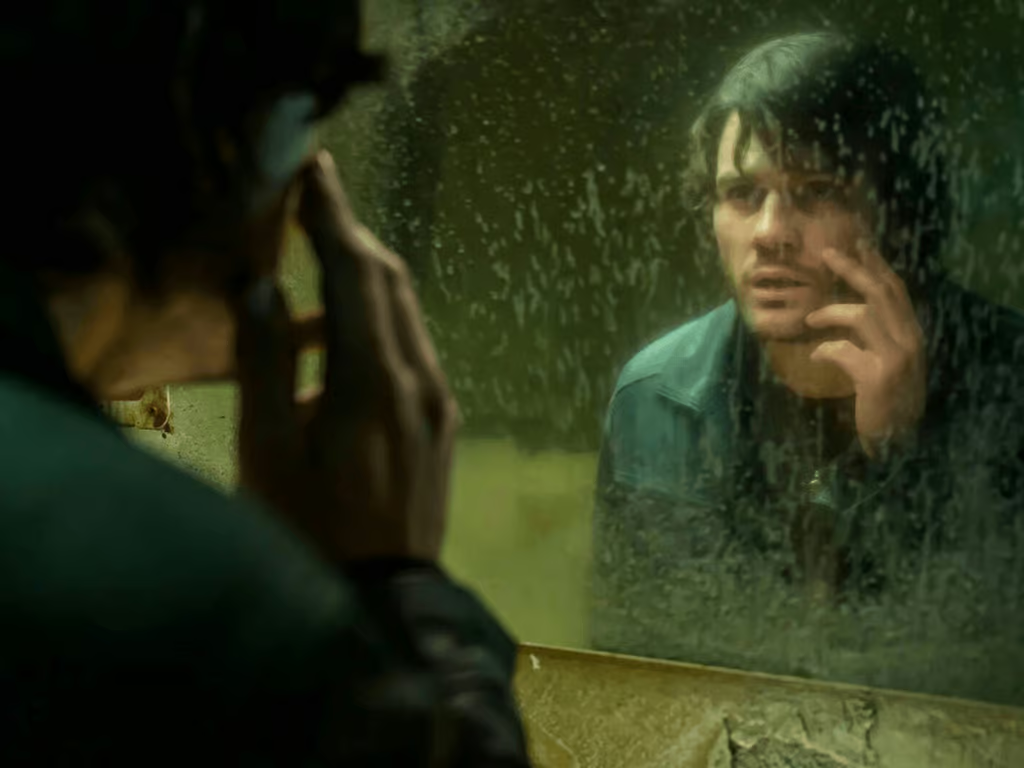
Return to Silent Hill is no different, although it doesn’t reach the level of his two masterpieces, Crying Freeman and Brotherhood of the Wolf. It’s also probably not a faithful adaptation of Silent Hill 2, which has made fans angry with the fury of a thousand thunders, with some even sending death threats to Gans for allegedly “ruining” the video game. While those threats are totally uncalled for, since the game stands on its own two feet, one can’t entirely dismiss Return to Silent Hill as a “bad” video game adaptation when Gans himself thinks about his place within post-digital cinema in an era where textures are becoming more artificial and images no longer hold meaning within the moviegoing public.
It may lack the verve of Dan Laustsen’s photography, but the visual poetry of a decaying world that dies with James Sunderland (Jeremy Irvine) is still present here. In any event, it is a step above – both visually and thematically – from MJ Bassett’s dreadful Silent Hill: Revelations 3D, because Gans holds reverence for Konami’s game and is at least curious in further expanding his conception of what he believes some of Silent Hill 2’s themes are. It may not be a “definitive” interpretation of the urtext, but it’s far more interesting than the dreadful attempts to blatantly steal gamers’ money with the nearly unwatchable A Minecraft Movie and Five Nights at Freddy’s 2.
As a meditation on grief and the lengths one will go to bring someone “back” from the dead, Return to Silent Hill is an imperfect, but frequently moving piece of work. It represents James’ tormented psyche inside a labyrinthine story that consistently blurs the line between the harsh reality he lives in and the harsh nightmares he can’t fully wake up from. Gans’ writing may not be as sharp as in the first time he took a crack at the world of Silent Hill in 2006, with frequent bouts of clunky and unintentionally hilarious, indigestible expository exchanges between James and the various figures he meets, either in Silent Hill or the Otherworld, but his visual compositions remain unmatched, and perhaps more compelling when we put his two approaches side-by-side, twenty years removed from the first installment.
Dolly shots are no longer frequent – this thing is erratic and always in the face of his tormented protagonist, who lives an internal (and external) torture he can’t fully extinguish, even by diving deeper into the quasi-post-apocalyptic Hellscape of Silent Hill. Sadly, though, Irvine’s hair game is the most unconvincing aspect of his (and anyone’s) performance, but some musical juxtapositions are so good that one can easily overlook some of the production’s cheaper traits, compared to the refined visual palette of the original. Again, though, Gans collaborated with Dan Laustsen, and that cinematographer is one of the greatest to have ever done it.
Comparing that film to Return to Silent Hill feels a bit like an apples-to-oranges situation, though Gans repeats some of its best sequences with less thrilling effect. Pyramidhead makes his grand return and feels less imposing than when Laustsen’s baroque compositions highlighted him, while a sequence with “Dark Nurses” is the exact same as the first installment, sans the palpable tension we felt when Rose Da Silva (Radha Mitchell) explored the film’s titular ghost town. That said, Gans compensates for this repetition by offering different stylistic considerations in his Return to Silent Hill, with the camera being more handheld and nervous than in the first go-around, when we spent time understanding the town’s mechanics through its visuals alone.
The most exhilarating aspect of Gans’ Silent Hill transpositions is how we’re able to comprehend how this universe works – and what the protagonist feels – by simply making its visual language an intrinsic part of the viewing experience, and trusting the audience to put two and two together. Again, the dialogues aren’t that refined, but what’s on screen still remains profoundly affecting by the end, neatly tying the different parallel stories in a way that reads as emotionally intimate and genuinely earnest. Irvine is particularly good as Sunderland, though he may not be the “definitive” version of the character fans wanted to see, which could limit the emotional attachment to the protagonist.
Is it a bad thing that Gans takes so many liberties with the material to deliver his conception of the video game? To be honest, I don’t have the answer to this question, but his love of Silent Hill can’t be denied, and the aesthetic impulse he brings to his pictures can’t entirely be shunned. Considering that Emerald Fennell is about to desecrate Emily Brontë’s Wuthering Heights, I can understand the frustrations from the fans who want to see their favorite game adapted on screen. However, there are a few auteurs who are as earnest in their image-making as is Gans, and the fact that he’s only made five films in his longstanding career feels a bit criminal.
For better or worse, Return to Silent Hill is Christophe Gans’ Megalopolis. It’s filled with brain-melting imagery and unwieldy themes that are only somewhat developed. However, the sincerity behind it is so powerful that any perceived “flaw” I had didn’t matter by the time it reached its final scene and gave Sunderland a sense of peace and finitude that few protagonists who dared enter Silent Hill ever managed to have…