



Director: Asghar Farhadi
Writers: Asghar Farhadi, Massoumeh Lahidji
Stars: Isabelle Huppert, Virginie Efira, Pierre Niney
Synopsis: In search of inspiration for her new novel, Sylvie begins spying on her neighbors across the street.
Krzysztof Kieślowski’s Dekalog: Six (or A Short Film About Love, whichever version you prefer) is one of the greatest movies ever made. Scratch that, Krzysztof Kieślowski’s Dekalog compendium is one of the greatest movies ever made. A masterclass in visual (and thematic) storytelling, Kieślowski’s ten intersecting stories, each based on the respective Ten Commandments, pose weighty existential parables and make us aware of the human condition more than any other filmmaker – past and present.
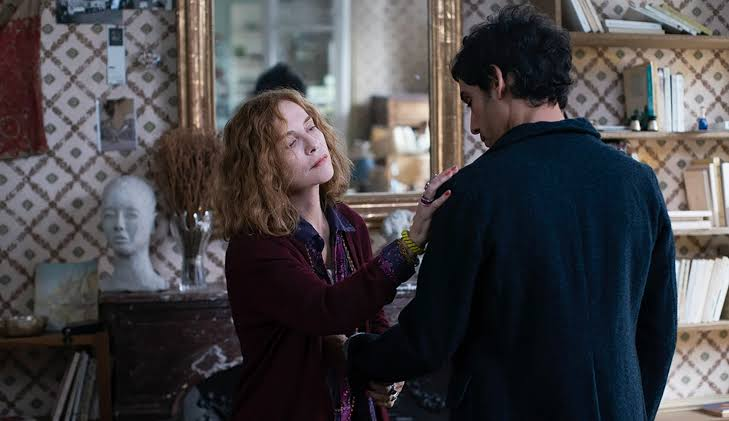
It baffles the mind that anyone else would dare remake (or reinterpret) one of Kieślowski’s stories within his 10-hour Dekalog, but this is what Asghar Farhadi attempts with Parallel Tales. Attempts, because it won’t take long for you to figure out that the acclaimed Iranian filmmaker, in his second French-language film after 2013’s The Past, has completely fumbled the bag and proves to all of us that no one – not even the greatest living artist – will ever successfully remake, reinterpret, or “loosely adapt” stories based on Kieślowski’s ultimate masterpiece.
It doesn’t matter if Farhadi has composer Zbigniew Preisner by his side – the same composer who gave us the ethereal musical patterns of Dekalog – there’s no saving this disastrously misguided (and overlong) drama, which twists itself to its head until it becomes painfully boring. What starts off as a story that takes the core essence of Dekalog: Six and expands upon it – Kieślowski’s scathing critique of voyeurism by putting it on the same pedestal as adultery – rapidly spirals out of control and loses our interest, especially in how it wastes not one, but six of the finest French actors working today.
To their credit, there isn’t a single bad performance in Parallel Tales’ ensemble. They do the best they can with what is possibly the flimsiest screenplay of their respective careers. But they’ve been in so much better stuff that it almost feels criminal to waste their talents in a movie that does them zero favors. The main problem that Farhadi deals with is how he refuses to limit his “voyeur” to one character, as Kieślowski did, until a pivotal turn that saw Grażyna Szapołowska’s Magda become the voyeur herself, after longing for Tomek’s (Olaf Lubaszenko) gaze, without knowing that he had attempted suicide following what he believed was a soul-crushing rejection.
Parallel Tales begins with Isabelle Huppert’s Sylvie as the voyeur, but eventually all characters become the very thing they’re seemingly against. Huppert’s character is currently finding inspiration for her book about her mother’s upbringing in the apartment where her mother lived right across the street from Sylvie. As such, she spies on the three people who currently inhabit this abode: sound-effects artists Nita (Virginie Efira), Théo (Pierre Niney), and Nicolas (Vincent Cassel). Writing a story based on the things she sees (not necessarily the things that are happening), Farhadi begins to mix A Short Film About Love with A Short Film About Killing (or Dekalog: Five) until these stories don’t matter much because they were all a fabric of the author’s imagination.
Imagination eventually becomes reality as Sylvie’s newly hired assistant, Adam (played by Extraction’s Adam Bessa), stumbles upon her manuscript and begins to stalk the neighbors across the street. What follows next is a series of contrivances so ridiculous that it almost defies categorization and makes us even wonder if Farhadi was ever good in the first place. After all, his previous film, 2022’s A Hero, was widely contested as plagiarized until the filmmaker was acquitted of all charges in 2024. Whether or not he was acquitted should still make us question exactly what kind of filmmaker he is and what stories he tells as a distinct voice within world cinema.
There’s nothing distinct or singular in Parallel Tales. The glimmers of aesthetic flourishes at the top of the movie are quickly dismissed by the time Farhadi introduces us to all his characters. The “binocular view” shots are, of course, a direct copy (there it is) of the way Kieślowski floated his camera in Dekalog: Six. There isn’t anything that feels inherently part of Farhadi’s own DNA in this movie, even if he can direct known actors well. They’re not the problem here. Isabelle Huppert is obviously great. I mean, the scene where she lights a cigarette with a toaster alone is worth the price of admission (the way it builds up to that humorous moment is a feat unto itself, thanks in no small part to Huppert’s no-nonsense attitude).
Virginie Efira is also excellent. When has she given a bad performance? (And we haven’t seen anything yet this year from her, if the resounding praise for Ryusuke Hamaguchi’s All of a Sudden is real) Especially in the last few scenes, the resounding emotional catharsis she feels is genuinely heartbreaking, even if the clumsy “fiction meets reality” sequence that occurs earlier doesn’t make much narrative (or thematic) sense. The actors do their best. They are not at fault. It’s Farhadi’s handling of Kieślowski’s parables that sinks the movie, because he has no idea what to say about the subject of voyeurism and obsession. Adam becomes obsessed with Nita, until it reveals something in Théo that she wasn’t aware of. Who’s obsessed with who now? Farhadi never bothers to explore thoughtful themes that are at the forefront of the picture, but certainly meanders for two hours and twenty painstakingly long minutes.
Many dialogues (and situations) are endlessly repeated, none of them actually adding anything tangible to the proceedings. It’s a ponderous, lethargic affair that exposes how misguided of a filmmaker Farhadi actually is, especially when given the task of handling one of the densest and most thematically-rich filmic texts of all time. There isn’t anything quite like the Dekalog. It is, no pun intended, a spiritual experience. Your perception of humanity is completely renewed (or maybe worsened, depending on your interpretation of the work) by the time you’ve gone through its ten hours. By the time you’re done with Parallel Tales, the only thing you’ll feel is a deep sense of relief that it’s finally over and I can finally return home to think of other things instead of the film I’ve just seen…