



Director: Tizza Covi, Rainer Frimmel
Writer: Tizza Covi
Stars: Alfred Blechinger, Al Cook, Alois Koch
Synopsis: When blues musician Al Cook’s memory-filled apartment faces demolition, an old dream emerges from his isolated life.
Elton John sang it best in 1983: “I guess that’s why they call it the blues.” Such a fitting song for a film that’s bound to remain perhaps the most quietly devastating film of the year. It also feels appropriate that The Loneliest Man in Town relies quite heavily on themes most commonly found in blues music to push its narrative ever so mournfully forward. It’s obviously understood that great art, no matter its origins or firm sense of place, can transcend borders and language entirely. But fully embracing that beautiful fact still won’t brace an audience’s first meeting with Al Cook (Alois Koch, playing a fictionalized version of himself). He’s the type of enigmatic figure which begs the question of where in the world could somebody so distinct ever possibly have come from?
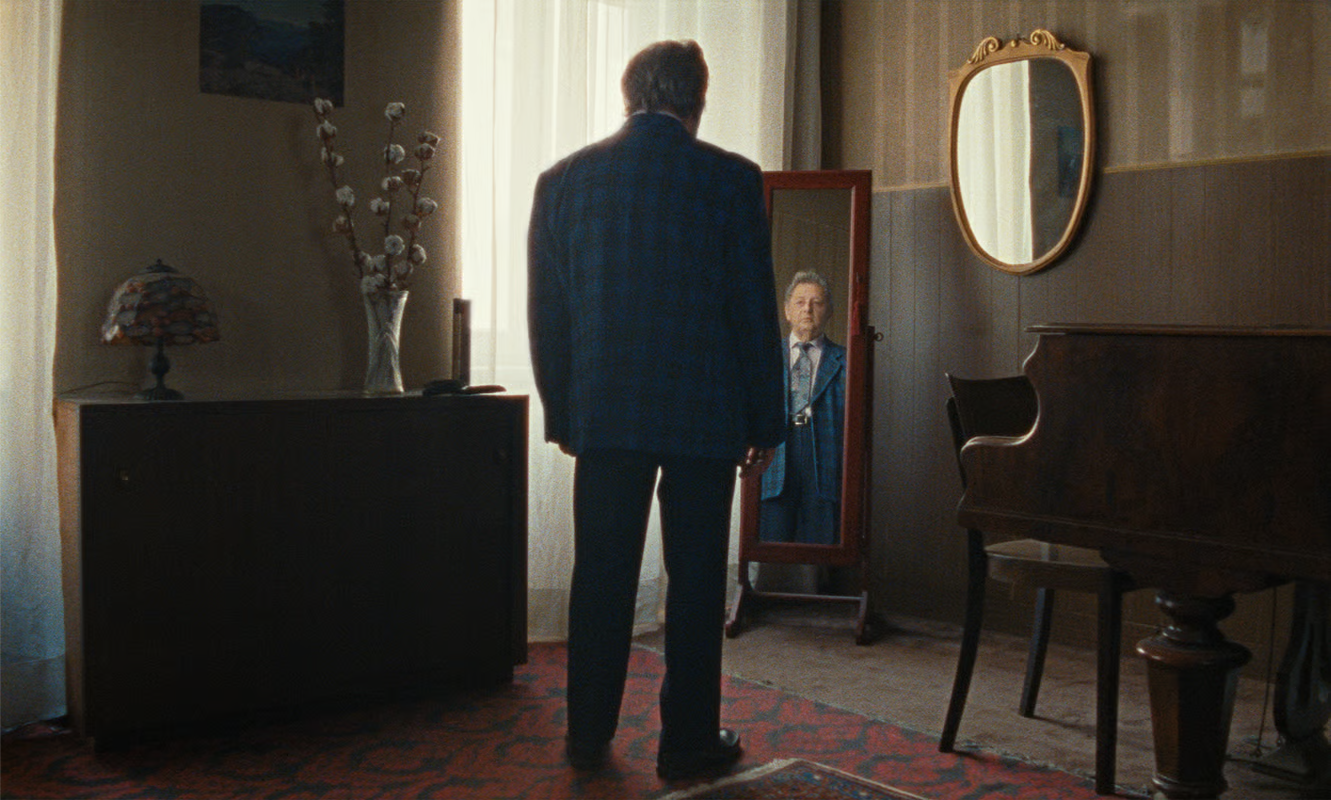
The sole tenant of the building he has lived in his entire life, writer/director duo Tizza Covi and Rainer Frimmel introduce Al and the primary setting of their film to their audience through an extended dialogue-free tour of sorts. Al goes into his basement storage unit, where every inch of the walls is seen covered in photographs of family and legendary musicians alike. Most of the floor space is also taken up by countless records, all devotedly and properly handled with the utmost care and respect. It would appear that Al is living the dream of many physical media aficionados: simply having a space to find serenity surrounded by something cherished. But that welcoming potential is quickly cut short by the first of many impeccable directing choices from Covi and Frimmel. Al puts on a 1950s Lonnie Johnson song titled “I’m So Tired of Living Alone.” All the warmth of this space is immediately sucked out of the frame, instead holding on Al’s face as he longingly looks at a picture of his wife fighting back tears. It may seem dull or trite, but in practice, it is indicative of setting up the exact wavelength Covi and Frimmel are going to operate in for the remainder of their film. From the initial set-up this film was building out, one might have expected the warm embrace of a Christmas-time set celebration. The look on Al’s face as he somberly decorates his Christmas tree tells a different story entirely. It’s one that becomes much more detailed the longer The Loneliest Man in Town plays out.
For all the enigmatic qualities Al appears to contain, Covi and Frimmel do a great job at building up Koch into a full-blown leading man. Besides, how could a blues musician pulling off such impeccable fits, done-up hairstyles, and vocal inflections not also be an incredibly engaging movie star? His performance feels like it was pulled right out of an Aki Kaurismäki film, which is equally fitting considering the desert-dry humor Covi and Frimmel rely on to inject levity into this deeply sad film. There’s a contrast that’s both shocking and comical between how great Al can make loneliness appear versus how achingly it sometimes pains him. There’s never a romanticism at play, but smartly, Covi and Frimmel provide Al without a lot of opportunity to remind the audience he still has a lot of life left in him. And yet, this film makes another smart decision in how it develops Al’s character with specific regards to his aged yet idiosyncratic gusto.
All the warmth of a rich record spinning and glowing candlelight in Al’s larger, more lived-in apartment upstairs can’t keep out the wintry sadness which is occasionally kept at bay, yet often accompanies the holidays in some shape or form. The power goes out completely, and upon further inspection, comes to realize it was shut off by his new landlords, a largely faceless corporation with the cruelly ironic slogan “building new values.” It certainly won’t be the last time Covi and Frimmel dole out harsh reminders to their audience and beloved protagonist of how horrid these property management companies are willing to behave as if real lives and histories aren’t being completely erased by their actions. And rather than make The Loneliest Man in Town about a lonely man’s lofty fight in his twilight years against a standardly-evil company, Covi and Frimmel make the devastating choice to make this a fundamentally honest film instead. The fight for ethical justice and standing up for one’s life in the face of cruelty such as this, however noble and worth it, can be too tiring and all-encompassing. After a few more deeply annoying, yet still quite funny, run-ins with the unbelievably cast goons of the faceless landlord, Al merely gives in. Critically, Covi and Frimmel never judge Al for this decision. How could they? How could anybody in the audience?
What then plays out across the remainder of The Loneliest Man in Town is an ode to looking towards the future despite being so firmly embedded in the past. There’s an innate understanding baked into this film regarding the bittersweet melancholy that accompanies a complete purge of items held onto because of emotional attachment. At one point, Al begins going through a collection of his VHS tapes. Some have Elvis performances stored on them, others go the way of home video capturing interviews from decades earlier or a simply touching serenade to his wife. As Al wistfully takes in the exuberance of his younger self, he finds himself hearing a key piece of self-delivered wisdom from decades prior: “People are ashamed to show feelings.”
With this film, Covi and Frimmel are not ashamed to do so in the slightest. They instead reckon with the freedom that can stem from moving forward towards a dream never realized, alongside the seemingly impossible task of completely cutting ourselves off from the past that formed us the version of ourselves which currently exists. It’s captured so wistfully through Koch’s performance, not just in terms of mannerism or dialogue, but in musical moments too. The first time audiences hear Koch sing will serve as the ultimate testament to him being such a singular force. There is such gravitas and depth behind his thickly-accented American blues music that remind the audience so clearly of Al’s storied life. It’s something we are only momentarily privy to. It’s far from over, but it’s certainly changing in some radical ways. Approaching such a truth can be wistful, as it certainly is portrayed in the film. But with a very touching final stroke of filmmaking genius, or perhaps providence, The Loneliest Man in Town serves as a reminder that a determined soul is a deeply powerful force. And we can allow ourselves to form some extraordinary new memories while holding onto the essential core of our past if we merely take the first step forward and fight on however we best can.
The Loneliest Man in Town is celebrating its North American Premiere in the Main Slate section at the 64th New York Film Festival.