


Director: Gianfranco Rosi
Writer: Gianfranco Rosi
Synopsis: Naples faces dual volcanic threats from Vesuvius and Campi Flegrei. Amid increasing tremors, archaeologists work as residents live anxiously, haunted by Pompeii’s fate while emergency services strain.
“You’ve never seen death?” the French multihyphenate Jean Cocteau once asked, rhetorically. “Look in the mirror every day and you will see it like bees working in a glass hive.” It’s plenty fair to assume that the Italian documentarian Gianfranco Rosi is aware of this quote, though when it came to beginning his new film, Below the Clouds, with one of Cocteau’s wisdom-filled nuggets, a note about being swarmed to death was likely never on his radar. Instead, he went a more direct route: “Vesuvius makes all the clouds in the world.” The latter statement gets right at the heart (and appears at the beginning) of Rosi’s eighth documentary, both referencing the volcano that looms over its actual subject, the city of Naples, and the film’s title itself. Mount Vesuvius is, of course, famous for burying the Roman cities of Pompeii and Herculaneum with an eruption almost 2,000 years ago, and still sits close enough to roughly three million people that could feasibly be impacted by another explosion. These are the people that, to use Rosi’s parlance, reside below the clouds Vesuvius manufactures and live in a practically religious fear of the volcano’s destructive capabilities. Any and all tremors, whether felt or imagined, are reported to an emergency line that can’t do anything but quell concerns with factual evidence that everything is going to be fine.
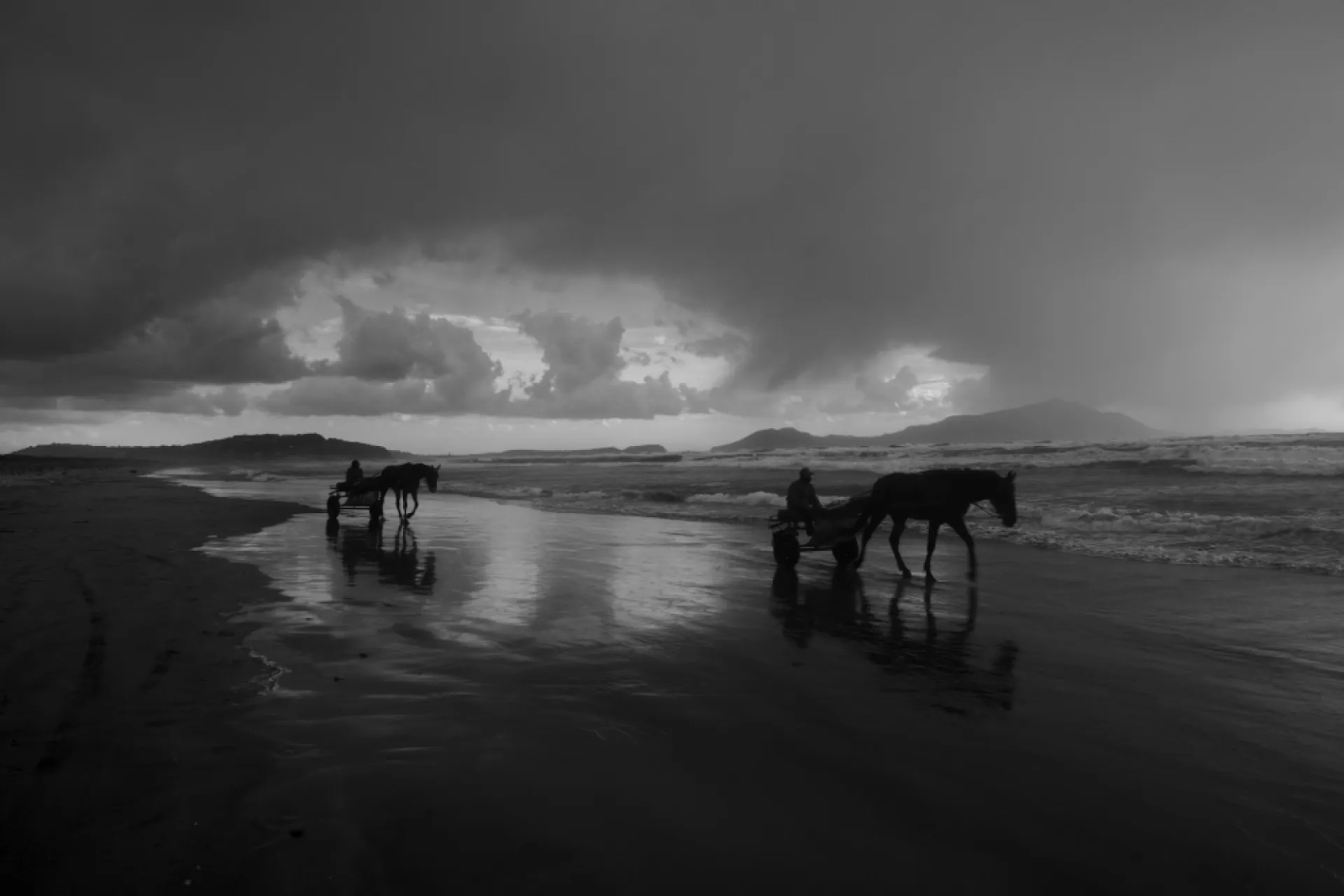
The “below” that Rosi focuses his gaze on (at least when he’s not capturing Naples from far above in stunning black-and-white photography) owes plenty to the roads paved in the past and present by documentarians like Frederick Wiseman and Wang Bing, who prefer focusing on communities through the eyes and testimonies of their inhabitants. The latter’s Youth trilogy, in all its 10-hour glory, could work as a particularly strong companion piece; it follows Chinese migrant workers navigating life in a professional and personal capacity with intense scrutiny. It’s not done critically, but intimately. Below the Clouds has a similar feel to it – aside from the fact that its foreboding elements are closely related to the volcano looming in the background rather than job insecurity and uncertain futures – with its curiosities primarily related to the people living in the city. Rosi descends into underground tunnels with a group of investigators seeking evidence that tomb-robbers have been at work; he spends time in a tutor’s makeshift classroom, where an elder shopkeeper teaches students how to read and write with a critical mind; he descends again into the basement archives of a local museum, chatting with the clerk who says the artifacts on display have been “her friends” for years.
Frequent visits with the aforementioned call center works provide an occasional reprieve for the audience, but exhibit an undercurrent of dread existing within the community they communicate with. Some are curious to know the time; in one devastating scene, a domestic-abuse call is heard in its entirety; most callers are curious as to whether or not there has been an earthquake. They’re sure they felt a tremor, and are wondering whether or not they should evacuate the area. Earthquakes aren’t uncommon in Naples – roughly 2,700 are reported annually – but they are infrequently related to Vesuvius’ activity, if ever. That doesn’t stop the concerns from flowing in at a rate that would be sure to overwhelm any operator, let alone the few on staff at the center Rosi captures.
Not a great deal happens over Below the Clouds’ two-hour runtime, though it’s both stunning and naturally fascinating enough to hold viewers at attention, if only because they’re witnessing something unfamiliar. The municipality that sits beneath Rosi’s longingly-filmed clouds is quiet and still more than it is ever bustling (at least on camera), a quality that juxtaposes almost too perfectly with the constant concern radiating throughout the film; imagine watching a scared sloth attempting to outrun a predator and you’re halfway there. Yet the beauty of it all is so undeniable that you almost need no other reason to take it in aside from its existence. Rosi forgoes sound as much as he does color, a sensation that takes some getting used to without ever feeling wholly discomfiting, especially for those familiar with the directors past works.
Below the Clouds is somehow more compelling than 2020’s Notturno, though the two might make for an even better double bill than the work of Bing or Wiseman. A documentary that was shot from 2017 to 2019 and centered on people from Middle Eastern areas with proximity to war zones, Notturno was similarly methodical and interested in the lives of people whose safety constantly existed under duress. One might not jump to connect a volcano to a war zone, but the former is certainly more threatening than the latter insofar as scope of tragedy. (Should the proverbial bomb detonate, that is.) That Rosi manages to consistently highlight the threat of a community’s surroundings while still prioritizing its citizens remains his hallmark as a documentarian, and an infatigable one at that. He regularly spends years filming his movies on location in order to capture the whole story. The only problem with that approach is one that solely plagues his audience: The waiting game for one of his muted, minor stunners is always a far more brutal test of endurance than the films he makes.
Below the Clouds screened at the 63rd New York Film Festival and will have its awards-qualifying release this fall. Mubi will release the film in early 2026,