



Director: Lee Sang-il
Writer: Satoko Okudera
Stars: Ryo Yoshizawa, Ryusei Yokohama, Ken Watanabe
Synopsis: Nagasaki, 1964 – After the death of his father, the leader of a yakuza gang, 14-year-old Kikuo is taken under the wing of a famous Kabuki actor. Alongside Shunsuke, the actor’s only son, he decides to dedicate himself to this traditional form of theatre. For decades, the two young men grow and evolve together – from acting school to the grandest stages – amid scandals and glory, brotherhood and betrayals… one of them will become the greatest Japanese master of the art of kabuki.
Lee Sang-il’s Kokuho begins with an intriguing premise, as the son of a yakuza leader is plucked out of a life of uncertainty and bloodshed to be trained by one of the best Kabuki actors in the world. Sang-il immediately grabs our attention by setting its main protagonist, Kikuo (played by Sōya Kurokawa and Ryo Yoshizawa), as an already burgeoning actor who wants to pursue a life away from what his father wants him to be, in a world full of violence where no one will truly flourish and perhaps not even live long enough to see any success through. He performs in front of actor Hanai Hanjiro II (Ken Watanabe), who is already impressed by his skills as a Kabuki performer, and asks his father to speak with him.
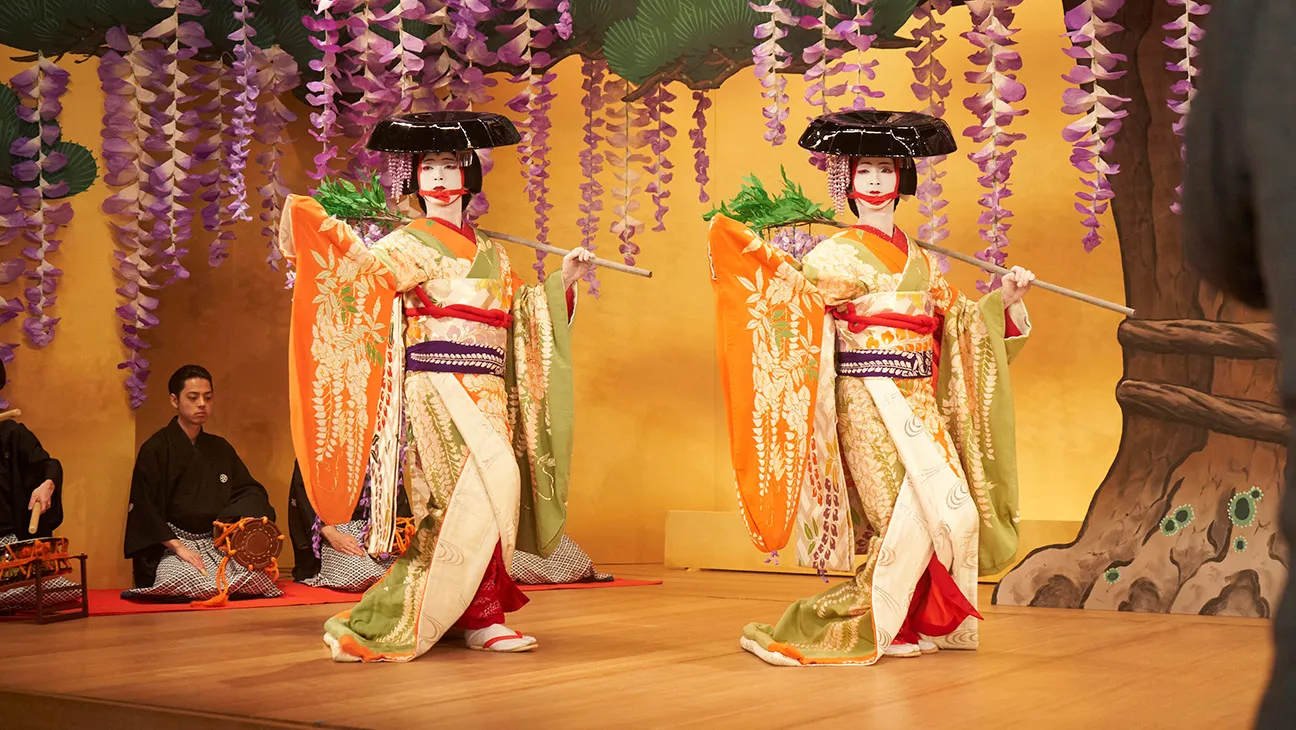
Sadly, this occurs during the day when a rival gang attacks and kills Kikuo’s father in cold blood. He first gains the upper hand and wants to show strength to his son, but is instead gunned down in front of him. The experience profoundly changes Kikuo, who is taken under the wing of Hanjiro, in an attempt to have his own son, Shunsuke (played by Keitatsu Koshiyama and Ryusei Yokohama), take the craft of Kabuki seriously. Shunsuke is set to become Hanai’s heir when he eventually passes away, but his head isn’t so much in the art as is Kikuo, who thinks that, despite his Yakuza tattoos, he has a future in this artform, The first hour or so of Sang-il’s film is genuinely impressive, shot with a deft eye that makes each Kabuki performance feel as textured as it would be in a cinema, with subtitles highlighting the significance of each drama and ensuring each audience member understands what the performers are doing on stage.
In lesser hands, this would feel like handholding, but Sang-il and writer Satoko Okudera give enough context for audiences to latch onto the characters and the importance of their gestures. Each look, or stomping of the foot, means something in the broader context of the play, which cinematographer Sofian El Fani highlights with a show-stopping use of shadows and striking, eye-popping colors. Even during more subdued sections, El Fani’s use of contrasting colors imbues each image with more meaning than you’d expect. Sang-il and Okudera adapt the book of the same name by Shuichi Yoshida and visualize each element of Kikuo’s journey, who is eventually renamed Toichiro when adopted by Hanjiro, with enough intimacy to make us feel close to the character at all times.
Close-ups are Sang-il’s preferred shot composition, especially when homing in on the subtle face shifts Kikuo/Toichiro performs, making us aware of what he’s conveying to the audience watching him on stage and to us, viewing the film. We quickly understand why his performance works, while Shunsuke’s acting lacks conviction, and this is where a rivalry begins to brew. It’s also where the movie starts to lose steam and barely recovers by the time it trudges to a slow and painstakingly obvious denouement, tracking the lives of both performers from the cradle to the grave, instead of choosing which elements are the most meaningful and will have enough dramatic potency to make a lasting impact in the eyes of the viewer.
In some cases, this could be the preferred aesthetic approach for a decade-spanning drama, but Kokuho’s pacing is extremely slow, perhaps too slow to justify such a hefty, 174-minute-long runtime, especially when its latter half is nowhere near as interesting as its amazing first hour, where Yoshizawa acts in ways he was never able to within Japan before joining the project. Of course, we all know how great an actor Ken Watanabe is. That said, for many westerners, seeing fresh faces like Yoshizawa and Ryusei Yokohama express a litany of complex emotions the way they do will quickly sideline the veteran Japanese actor’s talents in favor of a younger generation finally making themselves known not only to a specific public, but to the world.
It’s a shame, then, that Kokuho gets painfully conventional and pedestrian during a jarring shift in atmosphere that makes the film feel much longer than it actually is, and refuses to explore the interiority of the protagonists in the same fashion Sang-il did in the movie’s first half. It also sidelines most of the themes developed in that introductory section for a more traditional approach that continuously keeps us at a distance from the movie’s main characters, even though this is where the tension begins to heat between them, and their kinship becomes forever fractured…until it isn’t…until it is, and then it isn’t anymore.
Motivations become unclear, the characters aren’t as intriguingly fleshed out as they were, and the most interesting aspects of Kokuho begin to fall by the wayside. There’s still much to like and parse in Japan’s official entry for the 98th Academy Awards, but it genuinely feels like one of the rare cases of a film being unable to justify its lengthy runtime, which is made clear by the time the movie reaches its hour mark, or when Watanabe’s Hanjiro becomes less critical to the picture. Watching Kokuho, I was reminded of Chen Kaige’s Farewell My Concubine, which Western critics may find similarities between, especially in how it explores most of the characters’ rawest emotions on the stage (it’s also just as long as Sang-il’s film), but the reason why that film was quickly hailed as a masterpiece was simple: it knew what to focus on and never stopped caring about anyone on screen.
When Kokuho begins to lose sight of what it wants to talk about, the movie also begins to suffer. Sometimes, there’s a better – leaner – movie to make of this story, which likely would’ve provided a more considerable dramatic impact when it reaches its admittedly sobering conclusion, earning our tears naturally instead of pushing the old “now, cry” buttons. Sang-il’s ambition should still be admired, but the end result is far wobblier than I would’ve hoped.