



Director: Jan Komasa
Writers: Bartek Bartosik, Naqqash Khalid
Stars: Stephen Graham, Andrea Riseborough, Anson Boon
Synopsis: A 19-year-old criminal, Tommy, is kidnapped and forced into a rehabilitation process by a dysfunctional couple, Chris and Kathryn, who try to make him a “good boy.” Tommy must find a way to escape.
Jan Komasa has always been at the forefront of drawing cogent portraits of specific, complex individuals, whether in the religious-driven Corpus Christi or the cautionary tale of Anniversary, but he seems to have genuinely stumbled with his newest venture, Heel. Initially titled Good Boy, yet renamed to avoid confusion with the dog horror movie of the same title, Komasa, and screenwriters Bartek Bartosik and Naqqash Khalid don’t really know what they want to treat when focusing on their central character, who seems to be stuck in a fairly complicated predicament.
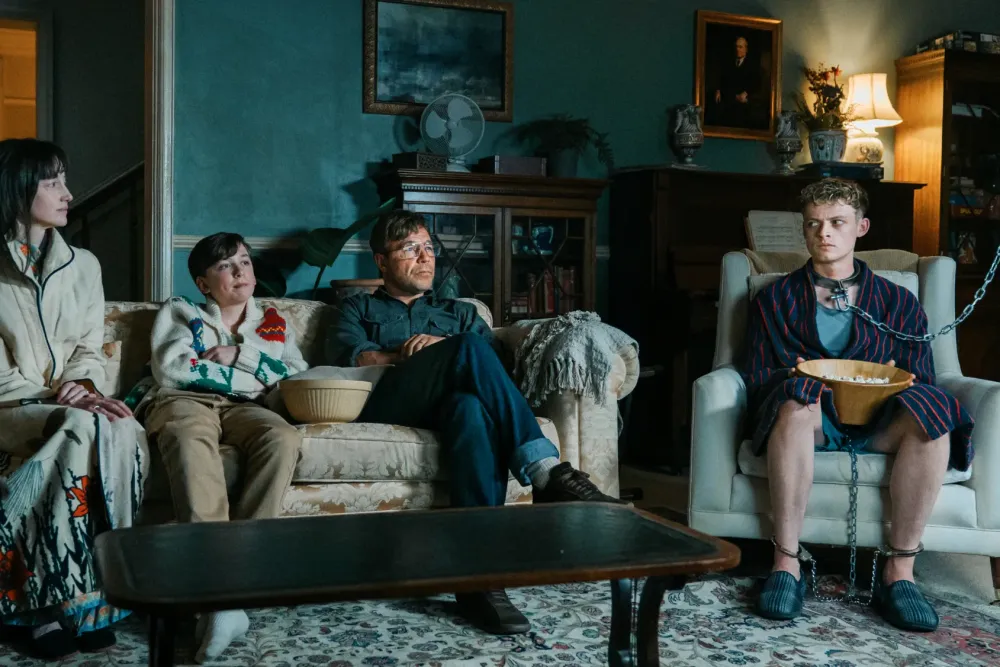
The film opens in media res by introducing audiences to the delinquency of Tommy (Anson Boon, who was excellent in Guy Ritchie’s MobLand last year), who excessively consumes drugs and alcohol and purposefully gets into physical altercations with as many people as he can…until he’s suddenly abducted. We don’t know what happened to him for some time, as Komasa switches to the perspective of housekeeper Rina (Monika Frajczyk), who is being interviewed for potential employment by Chris (Stephen Graham). She eventually gets the gig and travels to Chris’ house, where she meets his reclusive wife, Kathryn (Andrea Riseborough), their son, Jonathan (Kit Rakusen), and Tommy, who is being chained like a dog in their basement.
Who is he? And what is he doing here? These questions will eventually be answered, but in a fairly nonchalant way, or at least treated as if none of this truly matters. Unlike Anniversary, which felt urgent, especially as a potent reflection of the politically unstable times America lives in, Heel possesses no sense of urgency or willingness to engage with the ideas haphazardly presented on screen. Komasa can still craft effective images and control his aesthetic extremely well in the edit, but they don’t have as much of a grip on us as they did in Corpus Christi, The Hater, and Anniversary.
To be clear, pairing with cinematographer Michał Dymek – whose work in Jerzy Skolimowski’s EO and Magnus von Horn’s The Girl with the Needle is some of the decade’s very best photography – is a stroke of genius. However, his talents feel limited when the language isn’t as well-defined as Komasa’s previous works. There are still the odd image or two with lasting power, but they’re sparse compared to the Polish filmmaker’s previous works, which feature many frames that create a tangible impact. These occur near the end of the picture, where the story’s meaning is fully revealed. Despite an assured sense of style, many of these “reveals” fall pitifully flat, including its ridiculous ending, which renders most of the character development moot if Tommy regresses as a result of his time spent within a household he was forced to be in.
It is difficult to discuss a movie whose plot shouldn’t be revealed in any form of critical writing, because most of the narrative developments occur near its conclusion, but please believe me when I say that Heel’s benevolent intentions no longer exist during the film’s baffling climax. You’d be forgiven for thinking Komasa was asleep at the wheel compared to the previous masterworks he’s helmed, because the film lacks the character-driven (and aesthetic) pulse he’s mostly known for, but it’s not entirely his fault.
The screenplay has little to no interest in drawing compelling characters. Chris and Kathryn live in (very) morally grey areas and still seem to be riddled by the passing of one of their children, which might explain the reasoning behind Tommy’s kidnapping. However, none of these people are explored to their fullest extent, even during scenes of child abuse towards their remaining son. It should theoretically give a clue about how they’re controlling their house – and probably how their other son died – but it barely scratches the surface on who they are as trauma-ridden human beings.
The same thing can be said for Tommy. Komasa will scratch an itch on the rise of “dare” (and, by extension, influencer) culture that has created more and more terrible people for their antics to be posted all over the internet, but there’s barely anything to hold onto in the character’s evolution. Even when he manages to break free from the shackles of his dog collar, the resulting catharsis is limited. It has a grab-bag of interesting – and thematically resonant – ideas, but Komasa refuses to go beyond the confines of the screenplay he’s been given. It’s frustrating, because we know of his talent as someone who has always put character first and wasn’t afraid to defy our preconceptions of what we believe a protagonist should accomplish in a film.
He attempts to do it here with Heel, but none of his characters are remotely interesting enough for us to latch onto them, despite solid work from Graham, Riseborough, and Boon. The latter, in particular, gives the movie’s best performance, because he has the most varied register to play in, whilst Graham and Riseborough are stuck in their one-note archetypes from beginning to end. I did enjoy Kathryn’s voice evolving from the first time we met her, closing in on herself, to the last scene, where she has found a new purpose to live again, but it’s about the only thing we can peer into regarding the character. She is, unfortunately, as empty as everyone else.
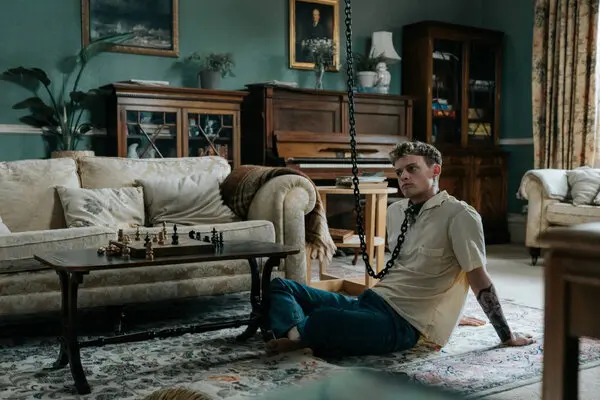
The good news is that Heel isn’t a downright terrible movie, just a particularly unmemorable one. Komasa’s formal impulses are still intact, but they’re in service of a screenplay that has no idea what it wants to say about anything it lays in front of the audience. Unlike Anniversary, which had so much to say about the current rise in fascism that America is undertaking, Heel stops whenever it presents an idea and takes the easy way out of “leaving it open to interpretation.” The thing is, you can’t leave it open to interpretation if you don’t give the audience something to interpret with. There is nothing – and I genuinely mean nothing – to interpret this movie from. It’s complete vacuity from beginning to end. It’s also Jan Komasa’s first (and hopefully last) miss. It had to happen eventually, but I didn’t expect it to be this unremarkable…