



Director: Laurynas Bareiša
Writer: Laurynas Bareiša
Stars: Paulius Markevicius, Karolis Kasperavicius, Greta Grineviciute
Synopsis: To celebrate Lukas’ victory at the martial arts tournament and Tomas’ birthday party, their wives Juste and Ernesta organize a weekend at the summer house with a families. It was suppose to be a quiet weekend at countryside.
It should come as no surprise that Laurynas Bareiša’s Drowning Dry manages to be darkly funny while tackling an almost unbearably bleak subject. This balance is made possible by the fact that, for a long time, the film gives off the impression of not being about a horrifying family tragedy. It begins as a razor-sharp examination of the faltering bond between two Lithuanian sisters, Ernesta and Justé, who appear to have drifted apart. They travel, along with their respective families, to a lakeside cabin for what is intended to serve as a relaxing holiday. Before long, Ernesta’s husband Lukas is engaged in a low intensity conflict with Justé’s husband Tomas. The divide between the sisters only deepens and they find themselves increasingly growing apart as the weekend drags on. When an unexpected catastrophe upends the lives of both families, they each find themselves reflecting on their past experiences through markedly different lenses. These unexpected divergences become the centerpiece of a film that slowly becomes more of a conceptual art piece than a traditional narrative feature film.
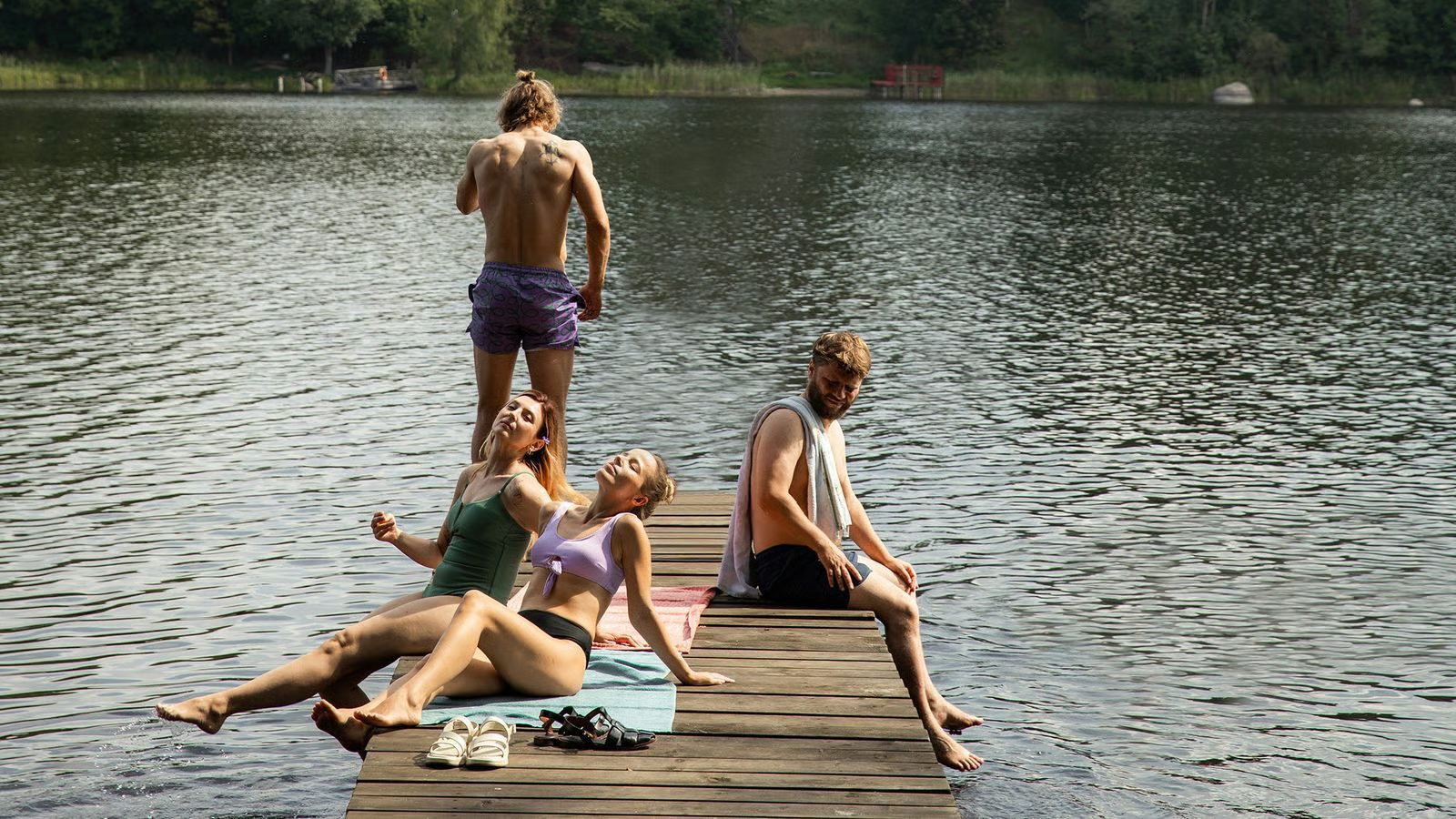
The film is distinguished by its ability to capture the fragility of familial bonds established between members of an extended family unit. The in-fighting and backstabbing that is already commonplace within the immediate family becomes infinitely more complicated when slightly more distant relatives get involved. We watch as in-groups and out-groups quickly form, with a kind of tribalistic outlook being taken on by the sisters at the center of the narrative. The cracks in the foundation of their relationship, which are too close for comfort in some regards, are further exposed when they introduce their children into the mix. Resentments over economic inequality and social status that appear to have driven a wedge between the two women have the effect of chilling relations between members of their respective families. Bareiša is extraordinarily perceptive in his understanding of how delicate arrangements, such as this one, can rapidly spiral out of control when put under pressure. Every character in the film is seen to retreat back into a shell of sorts, or even form somewhat calculated alliances with others, in order to survive this upheaval. Being a slow-moving Lithuanian drama, the film remains light on heavy theatrics or operatic showdowns. However, it does depict familial relations as a form of emotional warfare.
There is also something to be said for the fact that the class dynamics on display here are legitimately knotty and complex. The basic scenario would appear to set Tomas, who is comfortably middle class and capable of buying a home, off against Lukas, who pursues a highly competitive and unstable career that prevents him from making large investments. One can easily imagine a telling of this story in which the perceived ‘tackiness’ of the MMA milieu that Lukas inhabits is played up more. While his physical strength is clearly a source of envy for the comparatively buttoned up Tomas, he is never outwardly portrayed as an unsophisticated or boorish individual. This makes the divide between himself and his brother-in-law less glaring than it could have been. There is ultimately a thin line that appears to separate the two men and Tomas, who faces financial concerns of his own, is eager not to fall behind his rival. As the film goes on, it becomes clearer and clearer that he derives at least some of his sense of self-worth from the fact that he can orient himself as the more stable, reasonable counterpart to a brother-in-law whom he perceives as childish and irresponsible. Part of what we respond to is the fears and anxieties that the two men project on to one another. Their very real antagonism has its basis in a set of unfounded misapprehensions but it also fills a need for the two of them.

The teasing out of the underlying tensions at the heart of their bond occurs in tandem with an exploration of the unreliable nature of memory. In Rashomon fashion, we bear witness to multiple different interpretations of the same events, with slight variations cluing us into the very specific insecurities that each sister suffers from. While this has become a well-worn trope in cinema, it never feels like a gimmick here. The differences in perspective are subtle enough to leave the audience guessing and the message being conveyed is not merely that the human perception of reality is inherently subjective. The brief flashbacks in this film play out as troubled attempts to reconcile half-remembered events from the past with the horrors of the present. There is a heavy sense of foreboding that hangs over these scenes and an eerie feeling of not being rooted in a specific point in time. Bareiša’s utilization of this popular storytelling technique is effective because it disorients the audience instead of seeking to turn the film’s narrative into a puzzle box of sorts. There are no grand revelations that uncover the fact that one seemingly upstanding character was, in fact, lying while another, apparently untrustworthy, figure was telling the truth. All that the viewer is left with is a few fragments of the superficially mundane events that led up to an unspeakable tragedy. Much like Ernesta and Justé, we can only engage with these discrete moments in time from a distance; all the while failing to grasp their full weight and significance.