



Director: Embeth Davidtz
Writer: Embeth Davidtz
Stars: Lexi Venter, Embeth Davidtz, Zikhona Bali
Synopsis: Depicts 8-year-old Bobo’s life on her family’s Rhodesian farm during the Bush War’s final stages. It explores the family’s bond with Africa’s land and the war’s impact on the region and individuals through Bobo’s perspective.
My expectations for Embeth Davidtz’s feature directorial debut, Don’t Let’s Go to the Dogs Tonight, were relatively nonexistent. Being unfamiliar with the source material and period of history Davidtz adapts the story from, the movie felt like a significant ask, especially as a transition from acting to directing. Yet, there was something utterly transfixing about how Davidtz showcased this period in history and the dark coming-of-age tale that acts as the basis of Alexandra Fuller’s memoir that I began to become completely hypnotized by it, even during some of its most difficult scenes.
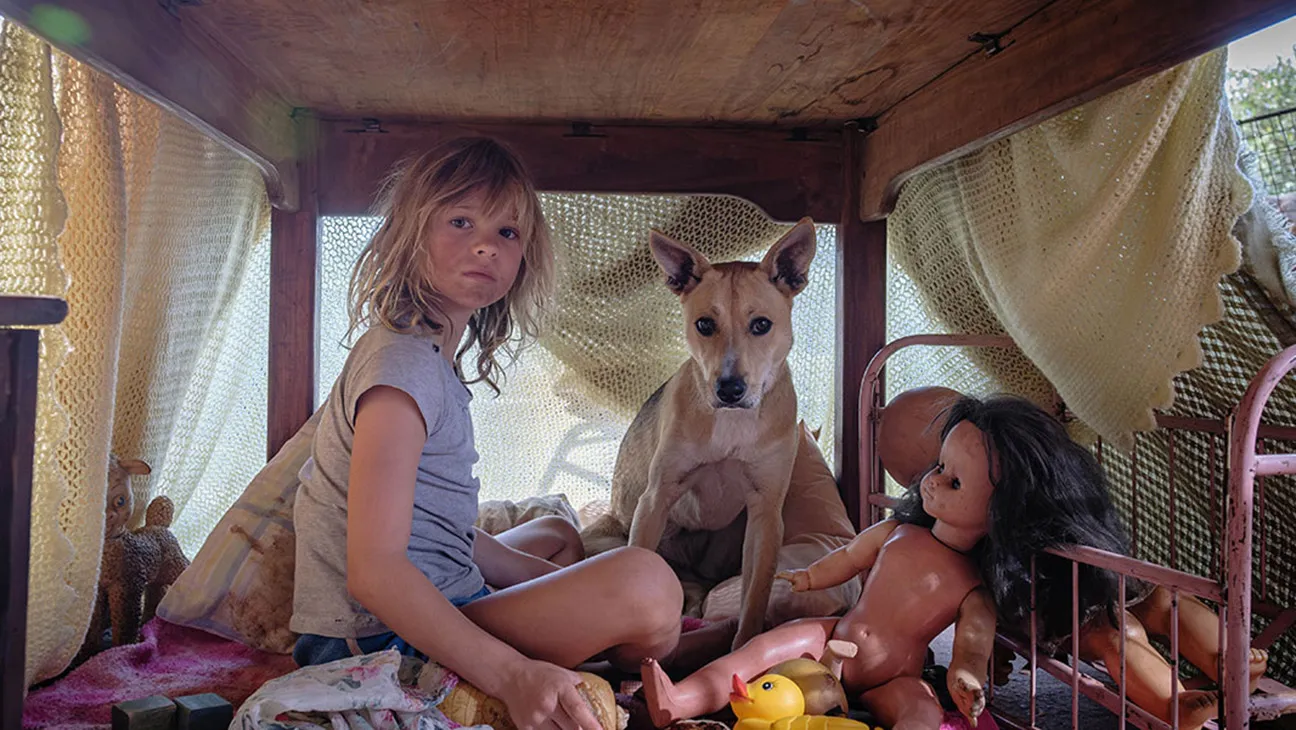
What impressed me the most about Davidtz’s approach to filmmaking, right from the top, is how strong of a formalist she is. With cinematographer Willie Nel, she creates images of real, tangible poetry, whose impact marks an indelible imprint in her memory. For starters, shooting the story through the eyes of its titular character, Alexandra “Bobo” Fuller (Lexi Vinter), gives it a much more intimate feel. We’re forced to observe a child born in the throes of an ongoing war, who has known nothing but conflict and division and whose perception of the world is warped by her parents’ beliefs, attempting to make sense out of a situation that complexifies itself further as the movie progresses.
Davidtz plays Nicola, one of the parents, and her vision of the world is imparted within Bobo’s behavior, and how she (curiously) observes people, either under a table or by directly doing things she shouldn’t, such as smoking, and knowing how to cock a gun. It’s in those moments where the audience understands the weight of what the filmmaker wants to tell, without an ounce of handholding in its 100-minute runtime. In some cases, we perfectly understand what’s going on. Fragmented archival footage of news reports, or radio announcements, gives the audience context in different ways than we’re usually accustomed to in historical dramas. We’re forced to listen and pay attention to what the characters are watching, or listening to, for us to get a sense of what’s happening.
At some point, though, the narrative becomes increasingly muddled, and it’s a bit hard to follow what’s most important. Yet, Davidtz’s image-making is so strong that we’re often encouraged to extract meaning from how she frames Bobo’s story. The fact that the camera is constantly on her level, and lets us see her point-of-view, either through direct shot-reverse-shot exchanges between the characters or images that literally show what Bobo is seeing. One of the most striking recurring ones occurs at the beginning of the movie, where she half-closes her eyes, and we see the sunlight reflect on her eyelashes, saying internally to the person she’s looking at, “If you love me, you have to turn around.”
This is repeated at the end of the movie, and what emerges overwhelms the senses. It’s pure cinema, distilled at its most potent essence. Again, I didn’t know what to expect from Davidtz, and was shocked at how jaw-dropping each frame of her movie was. It envelops us and encourages the audience to come up with their own conclusion as the story gets darker, bleaker, and far more confrontational in its exploration of protagonists we shouldn’t relate to, or feel an ounce of sympathy for, with the exception of Bobo, whose innocence has been stripped out by endless trauma, either direct or indirect.
As Bobo, Venter’s performance is revelatory. We feel for her plight at every turn, and express great compassion when we see what she sees – because a child’s eyes aren’t meant to observe what she looks at on a daily basis. It makes some of the film’s more difficult scenes even tougher to swallow, especially its gut-wrenching conclusion, which is of immense emotional power. Davidtz is equally as good in a supporting performance, but I’m more than hoping she will continue to carve a path as a singular artist within the world of filmmaking rather than acting.

If anything, Don’t Let’s Go to the Dogs Tonight proves to me that Davidtz has what it takes to be one of the best filmmakers working today if she continues in that direction. We already knew how good of an actor she is, whether in her heartwarming portrayal of Mrs. Honey in Danny DeVito’s Matilda or in her sorrowful turn as Helen Hirsch in Steven Spielberg’s Schindler’s List. And as she’s about to blow sixty candles next month, Davidtz has found something that has likely been boiling inside her that she desperately wanted to make, on her own terms, as a director we should all watch out for as she will (hopefully) create another film much sooner than later…