



Director: Adam Hoelzel
Writer: Adam Hoelzel
Stars: Jess Weixler, Jesse Garcia, David Koechner
Synopsis: A broke couple finds a treasure trove hidden in their home. Tempted by riches, they plot to secretly sell the gold, but their illegal scheme jeopardizes their relationship and lives.
Being compared to an accomplished filmmaker is often an honor. If you’re able to capture the essence of a well known filmmaker, but also make your own statement and establish your own style, then it can be a boost to your film. It means most reviews and fans will describe your film as “[famous filmmaker]-esque.” It’s a mixed bag in that way. Some of us think that J.J. Abrams’ original feature Super 8, often described as Spielberg-esque, is a terrific film, but others feel like it’s a poor facsimile of another’s style. The same goes for most of us who balk at an obvious Tarantino-esque film because no one can really achieve the same alchemy that Quentin Tarantino is known for. It’s not to say Tarantino’s brilliant, but that his brain is so full of forgotten fluff and homage to niche culture that his style is impenetrable and thus inimitable because of it. You could rightly call writer and director Adam Hoelzel’s Tender Coen-esque, recalling Joel and Ethan Coen’s stellar filmography of unique crime capers, but in this case Tender‘s comparison will be unfavorable.
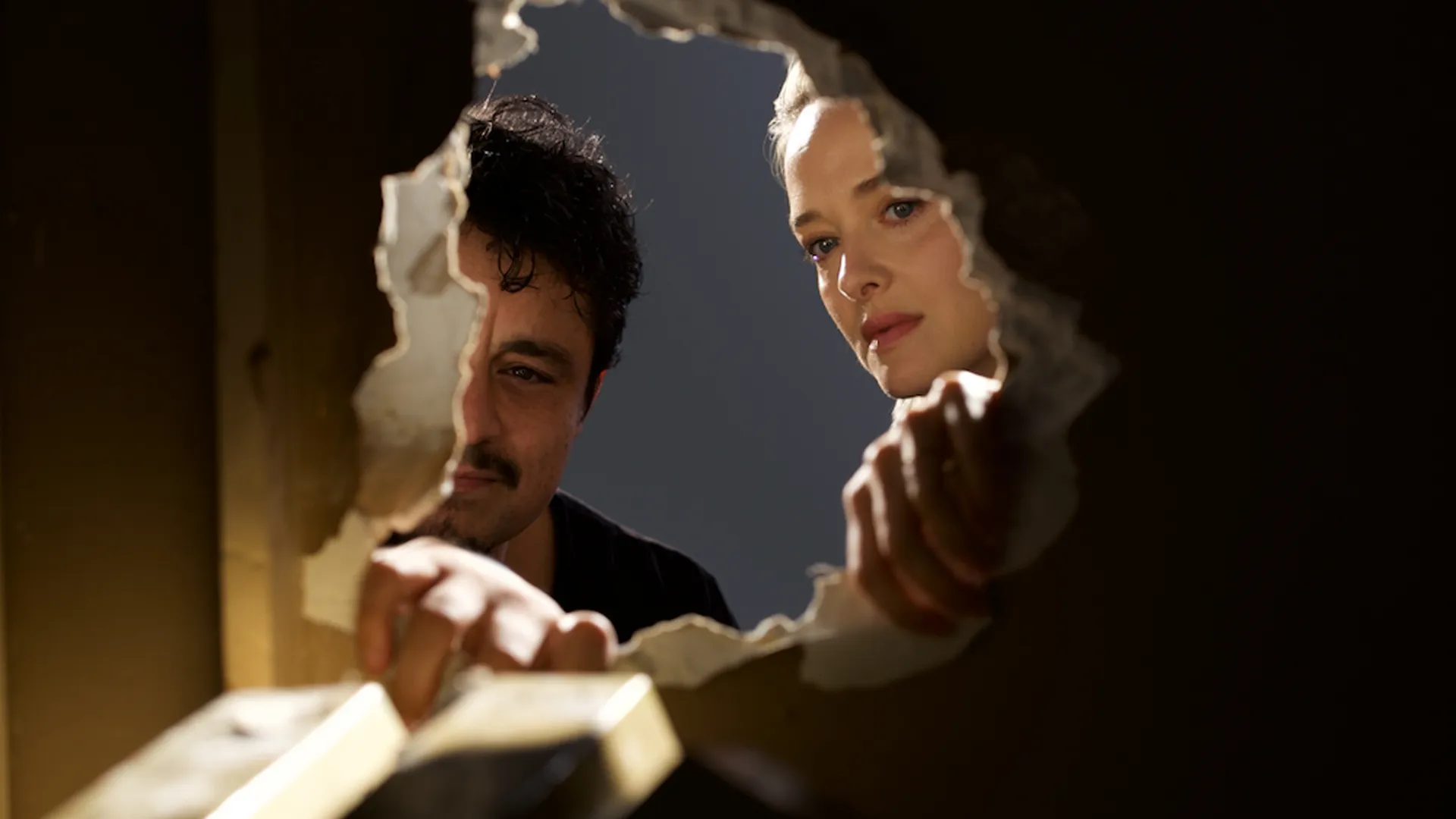
Tender is a film that wants to be much loftier than it is. Yet, its filmmakers are unable to execute its lofty ideas in a compelling way. The problem Tender encounters is a lack of risk. As a director, Adam Hoelzel is not taking the chances that are warranted by the film that Hoelzel the writer put to paper. This is a bland interpretation of a good idea. Hoelzel and cinematographer Antonio Cisneros never attempt a unique visual perspective or a unique visual interpretation. This feels like they spent the budget on things other than cameras or lighting apparati that could evoke the dark mood they wanted. This affects the production design, which looks so sparse and like a theater set rather than a lived-in film location.
There’s a perfect example of this in a scene after Ellison Nash (David Koechner), the big heavy of the film, makes his move on his former partner, Mayor Jerry Kristiansen (Robert Peters), putting Jerry in the hospital. The next day there is a man taking pictures in the office. He’s just a man in a shirt and tie. Another man in a suit walks by, then a couple of our characters bumble into the office. It takes the one character who we’ve seen in a police uniform, Griff (Mark St. Cyr), to show up to make us realize that this is an active crime scene. Then suddenly the daughter of the mayor, Taryn (Shakira Barrera), who also runs his re-election campaign, shows up and everyone understands she’s in charge.
None of the design, costuming, or energy of the scene has any rhythm of a crime scene or the gravity of an elected official being attacked in his office. It feels so odd and jarring. No less jarring than the action that follows, though. Suspension of belief is one thing, but most small American towns have a succession plan for their mayor, who is mostly a figurehead, and it rarely shifts power to the mayor’s heir. It’s also laughable that Taryn, having no power as far as the story tells us, is able to remove police officers from an active crime scene and then sit at a blood stained desk to hold a meeting.
It feels like when Hoelzel came up with the idea for the film he decided not to do any research into real life procedures of police, medical, or political offices. A lot of these interactions and nitty gritty details are half thought through. These easy, unrealistic behaviors do service the plot, though. It’s clear Hoelzel gave a lot of thought into how Billie (Jess Weixler) and Mick (Jesse Garcia) could launder the money they will make from the gold they found. It’s clear he thought about almost every loose end that could ruin their plans to get away with it. It’s clear that the ideas were there, but the execution is just so bland as to supersede any cleverness that may be hidden in there.
If there is any redeeming quality to Tender is that many of the main actors’ performances are compelling enough to make you want to keep watching. Jess Weixler is doing some good work with the material she’s given. Her performance, if not the least bit risky, makes you wish the film didn’t diverge from her perspective. You can see the attempt she’s making at creating a character who’s worth following and that makes her worth watching.
Filmmaking is inherently risky. There’s no guarantee that what is on the page will be interpreted by the actors, the production crew, or the post production crew as clearly as it was felt when the writer put fingers to keyboard. Yet, if a filmmaker is unwilling, or unable, to push beyond the page or challenge themselves in taking a stab at something new and announces their vision to the world, what is left is just uninteresting. Tender had the potential, but its filmmakers didn’t have the gumption. They put out something that is derivative and fails to evoke anything other than a bored sigh after it’s over.