



Director: Bertrand Mandico
Writer: Bertrand Mandico
Stars: Marion Cotillard, Noémie Merlant , Martina Scrinzi
Synopsis: In 1982, an actress on the verge of collapse goes to Rome to shoot what may be her last film.
Upon playing one of his films, you already notice Bertrand Mandico’s unique sense of style and storytelling–his kitsch and provocative vision filled with glamour and gore. The look of his films can’t be imitated. Only Mandico can conjure these off-the-wall concoctions and make them into something strangely beautiful. Excess and artifice merge into a dreamlike experience. Mandico has crafted ballets based on Stravinsky’s Petrouchka, with a hellhound guiding you; a short film about the beauty of our bodies through the lens of a world in complete decay; and a sci-fi western psychedelia with sensual assassins and Dune-inspired nomadic landscapes. All of these sound like projects that shouldn’t and couldn’t work due to their clashing styles and genres. But in Mandico’s hands, they somehow do and fascinatingly so.
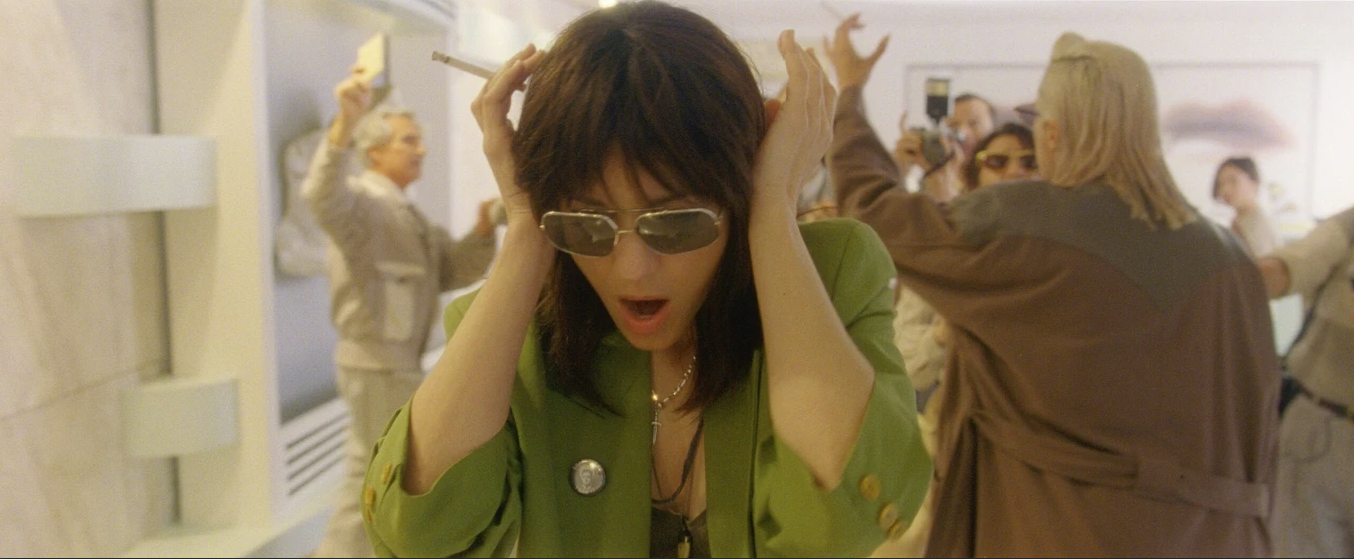
While not for everybody because of his tendency to be explicit and bloody, Mandico’s cinema expresses a boundless fascination with transformation. Beneath the layers of camp, eroticism, and surrealism lies an artist who is consistently searching for new ways to reimagine the medium through his vision. Whether audiences embrace that is another matter entirely. But nobody can deny the singularity of a Bertrand Mandico picture. He has also done his own versions of stories told countless times, like his gender-flipped “adaptations” of “Lord of the Flies” and “Conan the Barbarian.” For his next challenge, he tackles the self-reflection of an artist on the verge of dying, both literally and metaphorically, utilizing Federico Fellini’s grand works 8½ and Roma as the guide for a hallucinatory meditation on creativity, legacy, and the anxieties that accompany an artistic life.
Roma Elastica (screening out of competition in the Midnight section at the 2026 Cannes Film Festival) has the usual provocative flair and glittering flash of Mandico’s filmmaking, but with Fellini’s personal and contemplative touch to create a madcap yet enthralling portrait of an actress and the power cinema has over her. Marion Cotillard plays an aging, slowly dying actress, Eddie Mars (Mandico always gives his characters slick names, like Kate Bush and Apocalypse), whose golden years have passed, yet her dedication to the craft remains at an all-time high. It is probably because Mars knows her time is running out; she has been diagnosed with a brain tumor that is striking hard and fast–Mars is harboring the last strength she has for her last projects.
These aren’t the projects she envisioned to be her last, B-grade horror sci-fi flicks with tons of sex and violence, but Mars will treat them like films made by the most acclaimed director. All she wants at this point is peace and screen immortality, and she will get it no matter what. She hops from the U.S. to Rome, with her assistant, bodyguard, and only friend Valentina (Noémie Merlant), where her last set awaits. But what occurs upon setting just a mere step in the immortal city will leave her mentally unstable, with reality and fiction blurring continually without her even knowing what is actually going on, if it’s inside her head or happening in the film. Mandico paints Mars, during her midlife crisis and forthcoming death, as an artist struggling to embrace the chaos of life and cinema.
Mars understands that the idealized vision for her artistic and personal life didn’t turn out as she had envisioned. The peace and balance Mars seeks will arrive upon embracing the imperfections that arise on set or at home. As such, Mandico utilizes Fellini’s 8½, with each filmmaker having their central characters pick up the fragmented pieces of their psyches and lives. But rather than using personal anecdotes and memories as the passageway for their configurations, as Fellini did, Mandico uses filmic references to do so, creating a tribute and exploration to the directors and artists that influenced him, from the Italian master Michelangelo Antonioni to the B-movie craftsman and horror masterminds Lucio Fulci and Mario Bava. These aren’t just enjoyable references for cinephiles and horror connoisseurs, but essential pieces of the film’s emotional and artistic framework. Through them, Mandico maps out Mars’ inner world, revealing how artists often process their fears and desires through the works that shaped them.
Roma Elastica may be a tad grotesque and explicit for some viewers, as is the entire Mandico catalog, which will distance many–not to mention the multitude of people who walked out of this film during its Cannes premiere. However, that is his way of expressing love and admiration for the masters who helped shape his sense of style, in all its unique and bloody beauty. Mandico also references another Fellini joint, Roma, one of his most underrated pictures. It is also a blend of the personal with the surreal, but with conversations about the ravages of time, religious pageantry, and the clash between traditions and new cultural traits. The French provocateur uses such an exploration of the past and present to talk about cinema today and the one he grew up with.
As Fellini contrasted Rome’s legacy with its current societal changes, Mandico does the same with the art form we all love and adore, and should protect. Nostalgia is tested amongst the unknowable future of cinema, Mandico finding himself caught between reverence for the artists who inspired him and curiosity about where the medium might go next. In contrast to his previous work, Roma Elastica feels more like an array of well-dressed, stylized set pieces than a contribution to a complete narrative. Each segment is too loose to actually cohere into a satisfying dramatic whole–an excuse for Mandico to indulge in visual and cinephile digressions. However, the vision behind each creation, whether costume and makeup work or practical effects and set, is so innovative that you can’t help but be entranced.