



In the wake of Nolan’s latest incoming box office freight train, The Odyssey, many folks are quick to forget about what he was up to prior to his recent string of heartful, experimental blockbusters teeming with cultural relevance and cinematic prowess. Projects like Memento, The Prestige, and even Dunkirk have, to a relative (and arguable) point, fallen out of the mainstream limelight of filmic discussion. Yet somehow, now 15 years old, Inception still remains. Why is that?
Among many masteries, and a few mysteries, the film then favored what Nolan would eventually become known for now; namely, that aforementioned penchant for emotionally open, psychic, and personal adventures. Inception is exceptionally honest with both itself and the audience. Despite the twisted, often confusing nature of the narrative, the thread of familial betrayal and lost love that runs through the film is what successfully defines it in retrospect. For a director as accomplished as Nolan, Inception still, to this day, being one of his finest works is no small feat.
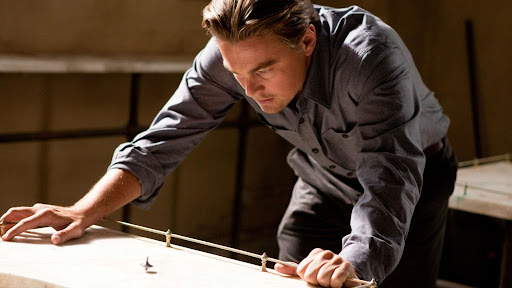
It’s a hard movie to even synopsize; better experienced than explained. Leonard DiCaprio, in the lead role, showed incoming signs of his eventual Academy Award – while he’d win it for The Revenant five years later, he may have deserved it more at the turn of the last decade. His turn as Dom Cobb (perhaps Nolan’s worst name) is the heart of a movie that lives and dies by his impact. Alongside more respectable efforts all around, with a special shout to Cillian Murphy, as usual, the film puts together an ensemble cast that work together to manage the mental load required to understand this story.
What begins as an apparently simplistic “dream invasion” type movie ends up examining the obsessions of a man whose thoughts have overflowed into his subconscious as a result of his inability to handle them while awake. This is a movie that, despite its age, I’d really hate to spoil now. Cobb’s journey and conflict regarding his family is one of the best, most potent character arcs Nolan has ever constructed, second only to his work in Interstellar. And in some places, it may be even more effective.

There’s something to be said about how Nolan is able to work his themes into his visuals here, too. The more Cobb unravels, the looser his grip gets on reality, the more kinetic things feel. The camera starts to speed up; rooms lose their shape, the sky its color, and people their words. There’s a refined visual chaos that pervades the whole thing, which is made even better by the extreme practical sets used as well. Everyone has seen the rotating hallway set – which is a marvel in its own right – but Nolan’s diehard dedication to “old school” filmmaking, if you will, gives Inception ground to stand on as time goes on.
It’s a film that wonderfully allows its audience to think for themselves, too. There are oodles of interpretations, theories, and essays surrounding this film written by audiences of all ages, all equally enthralled by the non-linear narrative and open-ended questions. The best part? They’re all right, or perhaps wrong; Nolan turned his movie into one of life’s timeless questions. Much like life’s objective purpose or the existence of tangible love, nobody knows exactly what this movie means, or how it ends… and that’s a beautiful thing.

Up to this point, Inception has held up incredibly well, and I can’t imagine that’ll change anytime soon. Everything comes down to that little spinning top: the passage of time, as inevitable as it may be, can’t stop the momentum. Inception lives by that momentum to this day and, as a natural result, will continue to spin in the hearts and minds of movie lovers and cinephiles everywhere. It’s about as close to a modern, instant classic as you can get. 15 years down and, for all we know, an infinite number remaining.